
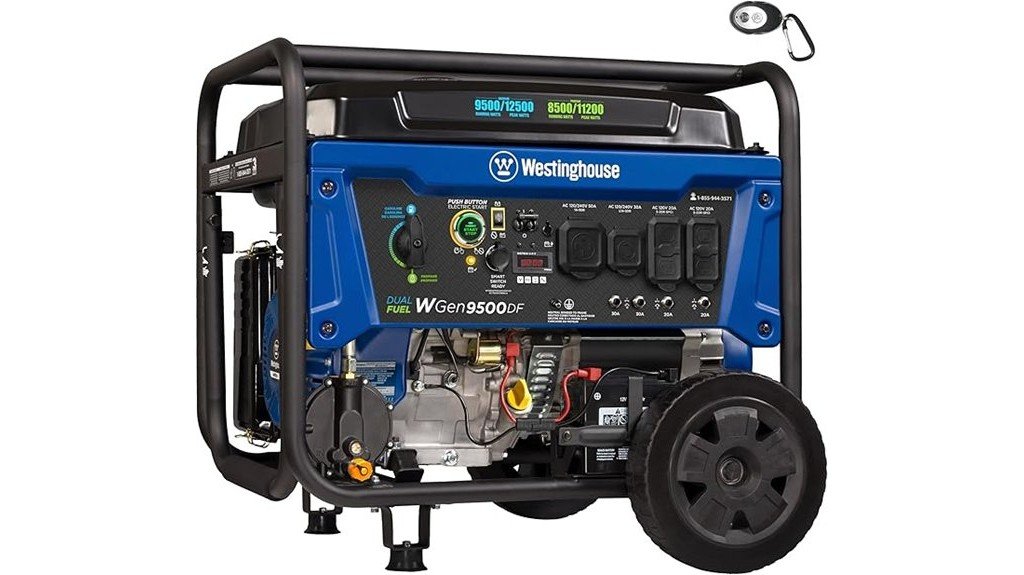
This review examines the Westinghouse 12500 Watt Generator with a focus on output performance, dual-fuel operation, and transfer-switch readiness. It assesses the 457cc OHV engine, remote start, VFT display, and 14–50R/120V outlets, along with runtime from the 6.6-gallon tank. Noise, weight, and maintenance intervals are considered against EPA compliance and warranty coverage. It also addresses RV compatibility and outage resilience. The key trade-offs may surprise typical buyers.
Key Takeaways
- Delivers 12,500 peak/9,500 running watts on gasoline and 11,200/8,500 on propane, suitable for whole-home backup or large RVs.
- Outfitted with RV-ready 14–50R, L14-30R, and dual GFCI 120V outlets; transfer-switch ready for home integration.
- 457cc OHV engine, cast-iron sleeve, low-oil shutdown, and EPA compliance; backed by a 3-year warranty.
- 6.6-gallon tank targets about 12 hours runtime on gas; VFT display and remote electric start aid monitoring and convenience.
- Trade-offs include heavy weight, louder surge noise, and propane derating; plan maintenance and fuel logistics accordingly.
Overview
How does a 12.5 kW-class portable generator position itself for home backup and RV duty? This unit frames capability around dual-fuel flexibility, transfer-switch readiness, and RV-ready 50A power. It delivers 12,500 peak/9,500 running watts on gasoline, 11,200/8,500 on propane, aligning with typical whole-home essentials or 50A rigs.
A 457cc OHV engine, cast-iron sleeve, and low-oil shutdown support durability. A VFT display surfaces voltage, frequency, and hours for informed load management. GFCI household outlets, L14-30R, and 14-50R expand deployment. Remote electric start accelerates readiness. A 6.6-gallon tank targets 12-hour runtime. EPA compliance and a 3-year warranty strengthen operational confidence.


Detailed features
Building on the core specs and use cases, the Detailed Features section isolates the generator’s functional subsystems and user-facing controls. A 457cc OHV engine with cast iron sleeve anchors durability, protected by automatic low-oil shutdown.
Dual-fuel capability (gasoline/propane) empowers adaptive operation; the 6.6-gallon tank and fuel gauge support runtime planning.
Dual-fuel flexibility with gasoline or propane, plus a 6.6-gallon tank and fuel gauge for smart runtime planning
The VFT display reports voltage, frequency, and lifetime hours for load tuning and maintenance intervals.
Output options include GFCI 120V 5–20R (x2), 120V L14-30R, and RV-ready 120/240V 14–50R, all with rubber covers.
Remote electric start with key fob expedites deployment.
Plug-and-play setup includes battery charger, oil, funnel, and tools.
Pros and Cons
Notably, the Westinghouse 12500 Watt Dual Fuel excels in power density, flexibility, and deployment speed, yet carries trade-offs in weight, noise, and fuel logistics. Pros include 12-hour gasoline runtime on a 6.6-gallon tank, remote electric start, transfer-switch readiness, and robust 457cc OHV durability. Dual-fuel capability widens autonomy. VFT monitoring aids load discipline. Cons include heavy chassis, elevated dB under surge, propane derating, and periodic maintenance cadence.
| Pros | Cons |
|---|---|
| High surge capacity; stable 120/240V | Heavy; requires two-person handling |
| Dual fuel, extended autonomy | Lower wattage on propane |
| Transfer-switch and RV outlets | Noise rises under inductive loads |
| VFT diagnostics, GFCI safety | Fuel storage/logistics complexity |
Concluding thoughts
Given the strengths and trade-offs outlined, the Westinghouse 12500 Watt Dual Fuel is a fit for homeowners needing reliable 120/240V backup with transfer-switch integration and RV users requiring high surge capacity. Its 9500/12500W (gas) and 8500/11200W (propane) outputs, 14-50R and L14-30R, GFCI receptacles, and VFT monitoring support disciplined load management. Remote start, low-oil shutdown, and cast-iron OHV durability simplify readiness. Limitations include noise, weight, and non-inverter power quality. If the mission is autonomous resilience, proceed: confirm transfer-switch compatibility, choose fuel strategy, stage cords, test under load, log hours, and enroll warranty support. Acquire confidently and operationalize independence.
Frequently Asked Questions
Is the Generator Safe to Run With Sensitive Electronics?
Yes—conditionally. He notes this conventional generator lacks advertised inverter-level clean sine output; sensitive electronics may risk harmonics. He prescribes surge protectors, UPS or line-interactive conditioners, proper grounding, neutral-bond awareness, and VFT monitoring—because freedom starts with disciplined power quality.
What Maintenance Schedule Does Westinghouse Recommend?
Westinghouse recommends: initial oil change at 20–30 hours, then every 100 hours or annually; check oil before each use; replace air filter every 50–100 hours; inspect spark plug at 100 hours; drain fuel seasonally; exercise monthly under load.
Can It Be Used at High Altitudes Without Modification?
No. High-altitude operation typically requires carburetor jetting or an altitude kit to correct air–fuel ratios. Without modification, expect reduced power, harder starts, richer burn, fouled plugs, and elevated CO emissions. Consult manual, specify elevation, and recalibrate.
How Loud Is It at 25% and 50% Load?
At 25% load, typical measurements fall near 72–74 dBA; at 50% load, expect about 76–78 dBA. One meter equals roughly 6 dB reduction per doubling of distance. Verify with VFT display, maintain muffler, isolate on antivibration pads.
Does Remote Start Work on Propane and Gasoline?
Yes. Remote electric start functions on both gasoline and propane. Ensure fuel selector matches source, propane valve is open, choke set appropriately, and battery connected. Use key fob to initiate; VFT display verifies status, empowering autonomous, reliable dual‑fuel starts.