
Have we ever wished we could bring reliable, quiet power with us anywhere—without lugging around a massive gas generator?

What Is the EnginStar 300W Solar Generator?
When we first look at the EnginStar Solar Generator, 300W Portable Power Station, we are essentially seeing a compact 296Wh lithium battery power bank designed to run and charge our everyday devices. It is marketed as a portable power station for camping, road trips, RV life, and home emergency backup during a blackout.
What stands out immediately is how the unit combines a reasonably high capacity with a small footprint. At about 9 x 5.5 x 7.5 inches, it gives us 300W of output power and roughly 296Wh (about 80,000mAh at a lower voltage) of stored energy in a package that we can easily carry with one hand.
Design, Size, and Portability
The overall portability of this power station is one of the key reasons we would consider it for outdoor trips or as a backup in a small apartment. The compact form factor makes it easy to tuck into a car trunk, RV cabinet, or camping gear.
The body is designed to be handled frequently, moved around, and taken on the road without feeling like a burden. We can set it next to our tent, under a desk at home, or in the backseat during a road trip without taking up much space or causing clutter.
Dimensions, Weight, and Build Quality
Understanding the physical characteristics helps us picture how it fits into our everyday situations. The EnginStar 300W’s dimensions are around 9 x 5.5 x 7.5 inches, making it more comparable to a small shoebox than a traditional generator.
The housing is typically a hard plastic shell, which keeps the weight down. While not indestructible, it is sturdy enough for normal outdoor use if we handle it with basic care. We would not want to toss it around, but we can confidently move it in and out of vehicles, tents, and rooms.
Carrying It on the Go
For camping or road trips, we usually want something we can move quickly from the car to the campsite or picnic table. This unit checks that box. We can carry it with one hand and still have the other hand free to manage other gear.
Portability also matters for emergency use. In a blackout, we might want to shift it from the living room (running lights and charging phones) to a bedroom (powering a fan or CPAP) without struggling. The EnginStar’s size and weight make this kind of mobility very manageable.

Power Capacity: 296Wh and 300W Output
The heart of any power station is the combination of its storage capacity (how much energy it holds) and its output rating (how much power it can deliver at once). The EnginStar’s 296Wh capacity and 300W output place it squarely in the compact, light-duty category.
We should think of it as a versatile backup power hub for small electronics, not as a replacement for large gas generators that power entire homes or heavy-duty appliances.
What 296Wh Actually Means in Real Use
The 296Wh rating can be a bit abstract, so it helps to translate it into realistic scenarios. Wh (watt-hours) is a measure of how much energy is available. To estimate run time, we roughly divide 296Wh by the wattage of our device (and then account for some efficiency loss).
For example:
- A 10W LED light might run for roughly 20–24 hours.
- A 60W laptop could run for 4–5 hours.
- A 5W smartphone charge might be possible dozens of times.
Actual runtimes vary depending on conversion losses and how many devices we run at once, but this gives us a practical sense of what the battery can handle in real-world use.
300W Output Limit: What We Can and Cannot Power
The “300W” in the product name refers to its maximum continuous AC output power. This is a crucial limit we need to keep in mind. Any device or combination of devices drawing more than about 300W from AC will be too much for this unit.
It is ideal for:
- Phones, tablets, laptops
- Cameras and drones
- LED lights and camping lanterns
- Small fans
- Low-wattage mini projectors
- Small routers or modems
- Some CPAP machines (depending on wattage)
It is not suitable for:
- Microwaves
- Electric grills and hot plates
- Coffee makers (most are 700–1500W)
- Large refrigerators or freezers
- Space heaters and hair dryers
If we limit ourselves to devices under that 300W threshold, we will find this power station very practical and reliable within its category.
Output Ports and Connectivity
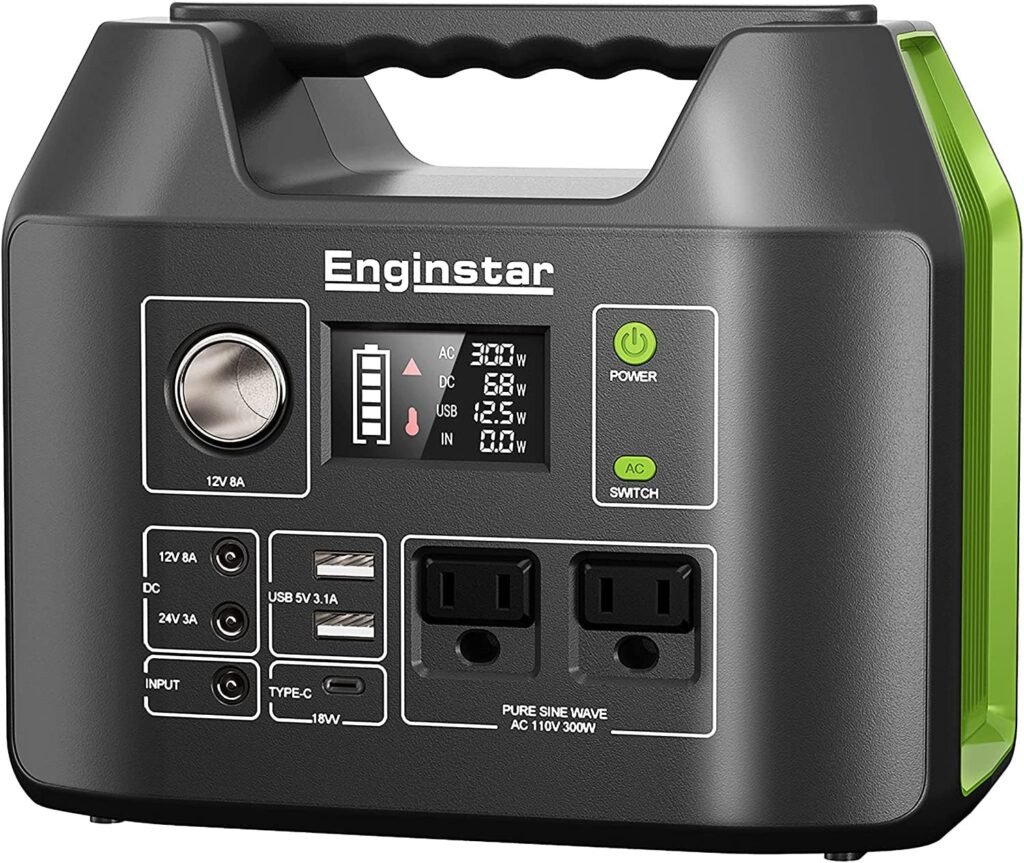
One of the strengths of the EnginStar 300W Portable Power Station is its variety of output options. Having multiple ports means we can connect several devices at once, mixing AC and DC loads without constantly swapping cables.
This is a big plus when camping with friends or family or when we want to keep multiple gadgets running during a blackout.
AC Outlets: Two 110V Pure Sine Wave Ports
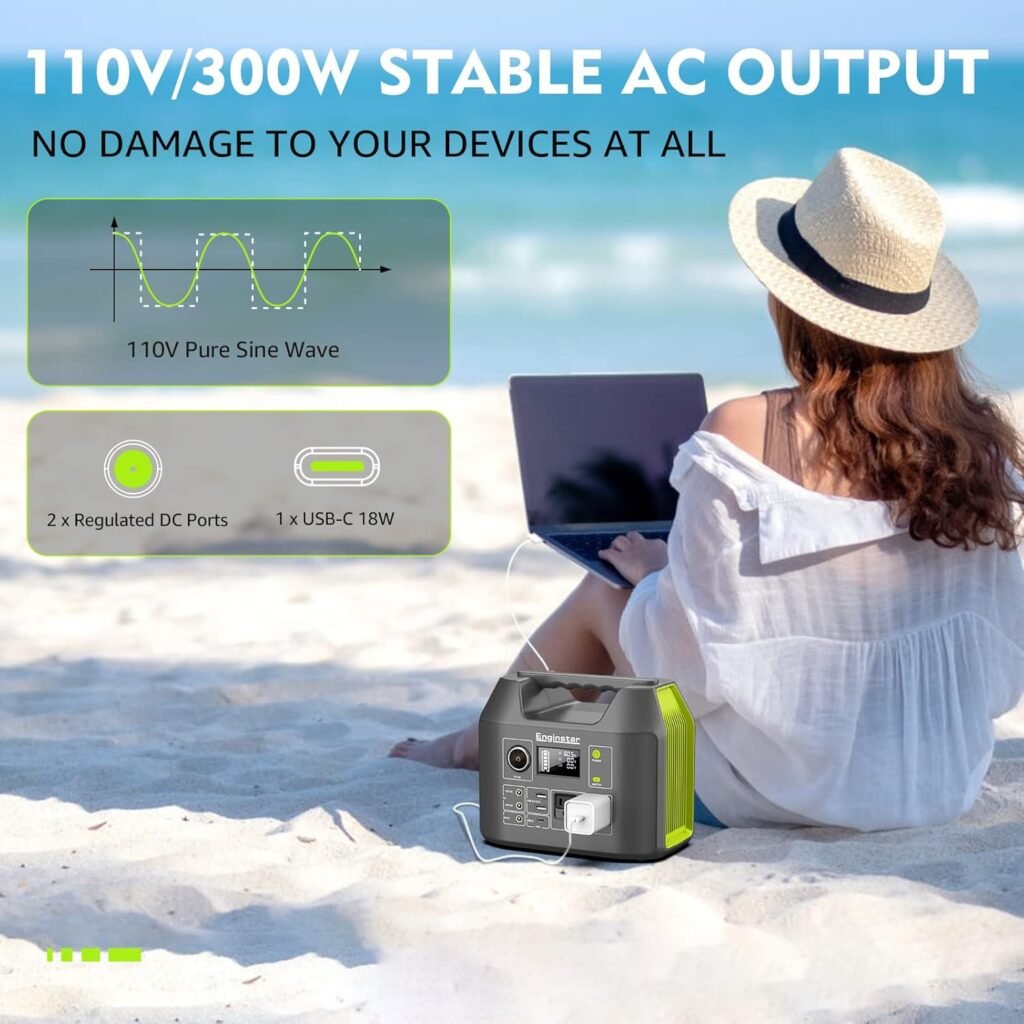
The unit provides two 110V AC outlets with pure sine wave output. This detail matters more than we might think. Pure sine wave output is cleaner and safer for sensitive electronics like laptops, medical devices, and certain chargers.
Many cheaper inverters use modified sine wave, which can cause extra heat, noise, or long-term stress on electronics. With pure sine wave, we can feel more confident plugging in valuable equipment.
The two AC ports allow us to power two low-to-medium-wattage devices at the same time—as long as their combined draw stays under 300W. For example, we could run a laptop and a small fan, or a projector and a portable speaker.
USB and USB-C Ports for Everyday Devices
The EnginStar power station includes three USB outputs, one of which is a USB-C 18W port. This selection is ideal for our everyday portable devices:
- Smartphones
- Tablets
- Bluetooth headphones and speakers
- Action cameras and drones
- E-readers
The dedicated USB-C 18W port supports faster charging for compatible phones and small tablets compared to standard USB-A ports. This is convenient when we want to top off a device quickly without using an AC adapter.
DC and Car Ports for Extra Flexibility
Beyond AC and USB, we also get:
- 1 x 12V car port
- 1 x 12V DC port
- 1 x 24V DC 5.5×2.1mm barrel port
These DC outputs are helpful for:
- Car-powered coolers or mini-fridges (within power limits)
- 12V air pumps
- Some camping gear that uses barrel connectors
- Amateur radio equipment, in some cases
The mix of ports makes the EnginStar more versatile than a basic power bank. We can treat it as a centralized hub for nearly all our small and midsize electronics, whether they draw from AC, USB, or DC.
Power Flow at a Glance: Key Specs Table
To make things easier to compare and understand, we can summarize the core specifications in a simple table:
| Feature | Specification / Details |
|---|---|
| Battery Capacity | 296Wh (approximately 80,000mAh equivalent) |
| AC Output Power | Up to 300W continuous (pure sine wave), 110V AC |
| AC Outlets | 2 x 110V AC ports |
| USB Ports | 3 total (including 1 x USB-C 18W fast charge port) |
| DC Outputs | 1 x 12V car port, 1 x 12V DC port, 1 x 24V DC 5.5×2.1mm barrel port |
| Charging Options | AC wall adapter, 12–25V solar panel, car charger |
| Approximate Full Charge Time | ~7 hours via AC wall adapter (may vary by conditions) |
| Battery Type | Lithium battery with built-in Battery Management System (BMS) |
| Protection Features | Overload, over-discharge, overcharge, overheating, short-circuit protection |
| Recommended Load Limit | Devices under 300W total; not suitable for large appliances (microwaves, heaters, etc.) |
| Cycle Life | Up to around 1000 recharge cycles (under proper use and care) |
| Dimensions (approx.) | 9 x 5.5 x 7.5 inches (compact and portable) |
| Warranty / Service | 12 months limited service from date of purchase |
We can use this table as a quick reference when deciding if this power station aligns with our specific needs.
Recharging Options: AC, Solar, and Car
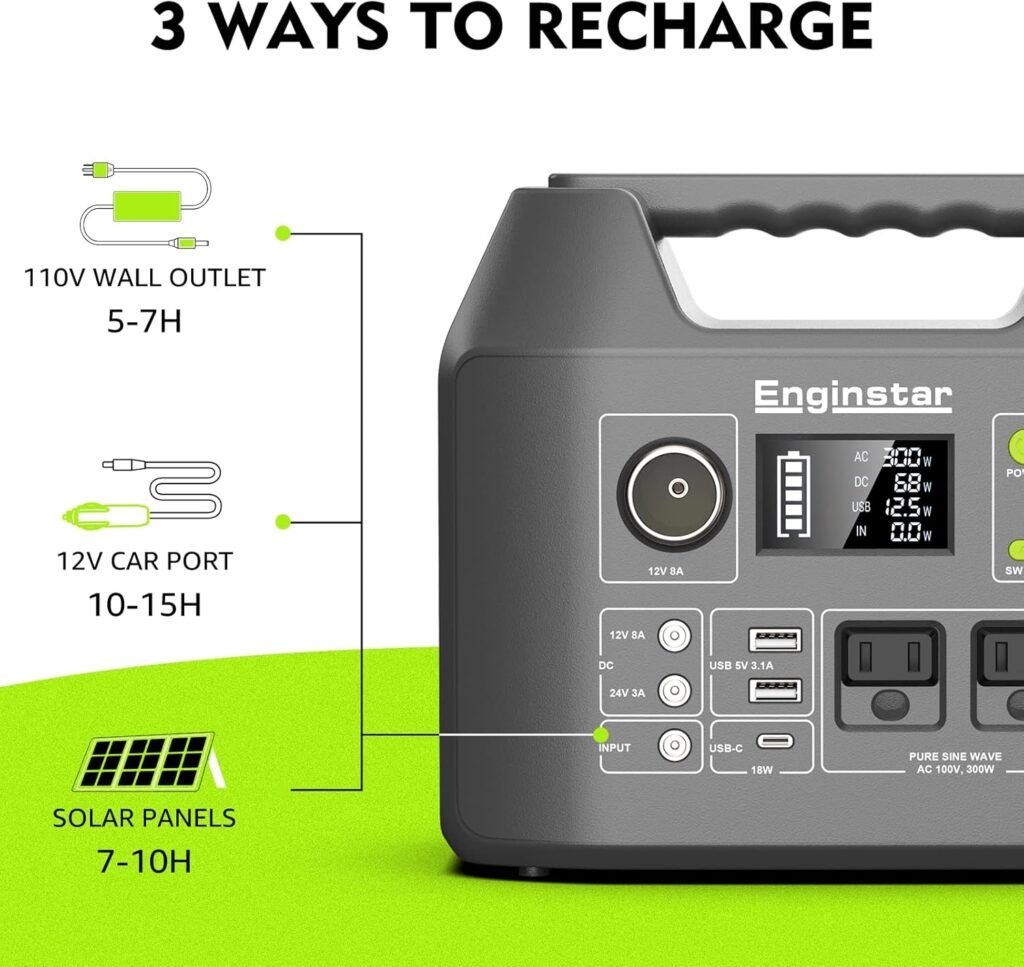
The EnginStar Solar Generator 300W offers three main ways to recharge, providing flexibility whether we are at home, on the road, or in an off-grid campsite. Having multiple recharge paths is critical if we want to rely on it for extended trips or unpredictable blackouts.
Recharging with the AC Wall Adapter
The simplest and often fastest method is using the included AC wall charger. Plugging the station into a standard wall outlet at home or in an RV will usually refill the battery in about 7 hours, depending on the remaining charge level.
This method is ideal for:
- Pre-charging before a trip
- Topping off between uses
- Keeping the unit ready as a home backup in case of a blackout
We can think of it like charging a large laptop battery overnight so it is ready to go the next day.
Recharging with a Solar Panel (12–25V)
Solar charging is where the “solar generator” label comes into play. We need to purchase a compatible 12–25V solar panel separately (EnginStar sells their own panels), then connect it to the power station to charge from the sun.
This approach is especially useful if we camp for more than one night or stay in one place for several days. Under good sunlight, we can harvest enough energy during the day to recharge a substantial portion of the battery, extending our off-grid autonomy.
We need to keep in mind that solar charging speed depends heavily on:
- Panel wattage
- Sunlight intensity
- Panel angle and orientation
- Weather conditions
Solar charging tends to be slower and more variable than AC charging, but it gives us a form of sustainable, renewable energy on the go.
Recharging Through a Car Charger
On long road trips, the car’s 12V outlet becomes another handy charging option. Using the included car charger cable, we can plug the EnginStar into the vehicle while driving and gradually top it up.
This method works well when:
- We are moving from campsite to campsite
- We have extended driving time
- We want to maintain charge between stops
We just need to be careful not to leave it drawing power from the car battery while the engine is off, unless we know the impact on the vehicle’s battery.
Battery Management and Safety Features
Lithium batteries require thoughtful design and protection to stay safe and reliable. The EnginStar 300W Solar Generator includes an internal smart Battery Management System (BMS) to monitor and regulate battery performance.
This system manages charging, discharging, and safety thresholds to help protect both the battery cells and our connected devices.
Built-In Protections
The power station includes multiple layers of safety protection:
- Overloading protection
- Over-discharging protection
- Overcharging protection
- Overheating protection
- Short-circuit protection
These protections are not just marketing terms; they help safeguard against common mistakes like plugging in too many devices, running the battery too flat, or operating the unit in hot environments.
Knowing these protections exist lets us use the power station more confidently, especially when charging valuable electronics or running equipment while we sleep.
Certified and Tested Battery Standards
The product description mentions that the unit is extensively tested and certified according to battery standards set by UL. This type of certification is a positive sign that the manufacturer has put the battery system through recognized safety and performance tests.
Combined with the BMS and protective circuits, this helps give us a reasonable level of trust when we are using the unit indoors, near family members, or around sensitive electronics.
Realistic Use Cases: Where This Power Station Shines
To decide if this power station is a good fit for us, it helps to picture specific situations. The EnginStar 300W Portable Power Station is optimized for light-to-moderate duty use across several scenarios.
Camping and Outdoor Adventures
For camping, this unit acts like a silent, fume-free generator. Instead of running a noisy gas generator, we can:
- Charge phones and cameras overnight
- Run small LED lights around the campsite
- Power a low-wattage fan for comfort in warm weather
- Charge a drone between flights
- Keep a Bluetooth speaker going for music at the campsite
The absence of fumes and noise makes it much friendlier in shared campgrounds or quiet natural settings. It also avoids conflicts with campground rules that restrict gas generators.
Road Trips and Van Life
On road trips, having our own portable power source means we do not have to depend entirely on the car’s outlets. We can:
- Keep laptops charged for working on the go
- Run a mini projector for a movie night in the back of a van
- Power a small 12V cooler (within wattage limits)
- Charge multiple devices for every passenger
Because the unit can recharge from the car while driving, we can create a self-sustaining loop: charge while on the road, use the power station during stops and at night.
RV and Small Cabin Use
In an RV or small off-grid cabin, this power station can act as a supplemental or backup power source. While it will not run high-wattage appliances, it is useful for:
- Keeping communication devices powered
- Running small 12V lights and fans
- Charging batteries for flashlights and tools
- Acting as a quiet nighttime power supply when we do not want to run a larger generator
Its compact size means we can store it easily in a small space, pulling it out only when needed.
Home Emergency Backup During Blackouts
One of the most important roles for a device like this is as an emergency backup during power outages. While it cannot replace full-house backup systems, it can make a blackout much more manageable:
- Charging phones to stay connected
- Powering a router/modem if our internet stays available
- Running a few essential LED bulbs to light key areas
- Powering a laptop or tablet for work or entertainment
- Potentially supporting a low-wattage CPAP machine (verify wattage and run time needs)
In many cases, having even a handful of powered devices can greatly reduce the stress and inconvenience of a blackout.
What the EnginStar 300W Cannot Do
To avoid disappointment, we should be honest with ourselves about what this unit is not designed for. Understanding its limitations helps us use it wisely and appreciate its strengths.
Not for High-Power Appliances
The most important limitation is the 300W continuous output limit. Nearly every major household appliance uses far more:
- Microwaves can draw 700–1200W or more
- Standard coffee makers frequently use 800–1500W
- Space heaters often use 1000–1500W
- Hair dryers can exceed 1500W
- Full-size refrigerators usually need more starting power than this unit can provide
If we attempt to run these loads, the safety systems should protect the unit, but it will not power them successfully. This station is meant for small electronics and low-power devices, not large resistive or motor-driven loads.
Limited Capacity for Long-Term Whole-Home Backup
At 296Wh, even though the capacity is good for a compact power station, it is not enough to power an entire home, even for a short period. It is best used as:
- A targeted backup for key devices
- A complement to other backup solutions
- Emergency power for short to moderate outages
If we need to run larger systems or a whole house, we would need a much bigger and more expensive setup, likely involving multiple large batteries or a hybrid solar-and-generator system.
Battery Care and Maintenance Tips
Lithium batteries can last many years if we treat them properly. EnginStar provides clear guidelines to help us keep the 300W power station working well over time. Following these recommendations improves both performance and safety.
Charging Habits for Longevity
EnginStar suggests:
- Fully charging the power station before first use.
- Recharging the battery before it is completely exhausted.
Running lithium batteries to zero on a regular basis can shorten their lifespan. It is better to top up when the battery runs low rather than intentionally draining it to empty.
They also recommend fully charging the unit every 2–3 months if we store it unused. This helps maintain battery health and ensures the unit is ready when we suddenly need it.
Storage Conditions and State of Charge
For longer-term storage, EnginStar advises:
- Recharging every 3–6 months
- Keeping the charge between about 40% and 70%
- Storing in a dry environment between 40°F and 100°F (4°C to 35°C)
- Keeping it away from heat sources and direct sunlight
This kind of care minimizes internal chemical stress on the battery cells. In simple terms, the battery likes moderate temperatures and does not like being stored totally full or totally empty for long periods.
Following these guidelines can help us reach or even exceed the stated 1000 recharge cycles and keep capacity loss gradual over the unit’s lifespan.
Day-to-Day Usability and Interface
A power station may have great specs, but if it is confusing or frustrating to use, we will not enjoy owning it. The EnginStar 300W is designed for straightforward operation, even for people who are not technically inclined.
Power Buttons and Indicators
EnginStar includes dedicated controls for different types of outputs. Typically, we:
- Turn on the main power
- Enable AC output with a specific button
- Enable or disable DC/USB outputs as needed
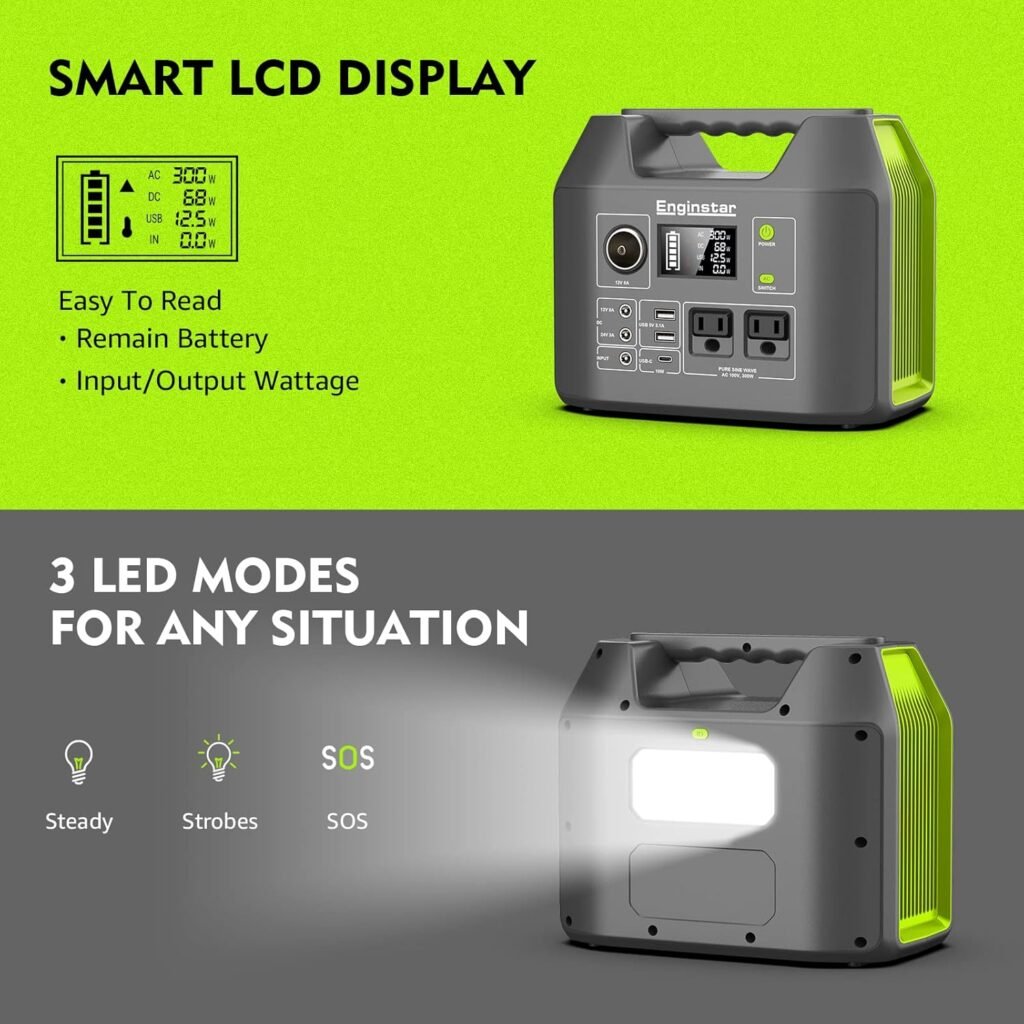
The note in the product description mentions that when we turn on the AC output button, a red triangle indicator may appear for a few seconds while the system checks the AC output. This is normal and disappears in 3–5 seconds. Knowing this in advance can prevent us from thinking something is wrong.
Clear indicators usually show the remaining battery level and which groups of ports are active. This feedback helps us manage power use more carefully, especially when the battery gets low.
Noise Level and Indoor Friendliness
Unlike gas generators, this unit operates silently except for any small internal fans it may use under heavy load or during charging. That means we can comfortably use it:
- In a bedroom
- In a home office
- Inside a tent
- In an RV
The absence of fuel fumes and loud engine noise makes it suitable for indoor operation, provided we follow basic electrical safety practices.
Who Is the EnginStar 300W Solar Generator For?
Not every power solution fits every user. Understanding who benefits most from this product helps clarify its purpose and value.
Ideal Users and Scenarios
This 300W portable power station is especially suited for:
- Casual campers who want to keep devices charged
- Digital nomads who work from the road and need laptop and router power
- Road trippers who want extra convenience for charging multiple devices
- RV owners who want a small, portable backup source aloof from the main system
- Homeowners and renters looking for a compact emergency backup solution
- Students or apartment dwellers with limited space for larger backup systems
If our power needs revolve around personal electronics, small fans, lights, and modest DC loads, this unit is a solid fit.
Users Who Might Need a Larger System
We might want to consider a bigger power station or a different solution if we:
- Frequently need to run high-wattage devices like microwaves or coffee makers
- Want to run a full-size refrigerator for many hours
- Want to power multiple heavy loads at once
- Need long-duration backup for medical equipment with higher wattage requirements
In those cases, stepping up to a higher-capacity unit with more output power would make more sense than pushing this 300W unit beyond its design.
Pros and Cons Overview
Summarizing the strengths and weaknesses can help us make a balanced decision about whether the EnginStar 300W suits our needs.
Advantages We Get
- Compact and portable: Easy to carry and store, ideal for camping and small spaces.
- Decent capacity for small devices: 296Wh is ample for phones, laptops, lights, and similar devices.
- Pure sine wave AC output: Safer and more compatible with sensitive electronics.
- Multiple charging options: AC wall, solar (12–25V), and car charging support flexible use.
- Variety of ports: Two AC outlets, three USB ports (including USB-C 18W), and DC outputs.
- Built-in safety features: Protection against overload, overcharge, over-discharge, overheating, and short circuits.
- Reasonable cycle life: Around 1000 recharge cycles when cared for properly.
- Quiet and fume-free: Much more pleasant to use than traditional gas generators.
Limitations to Keep in Mind
- 300W output cap: Cannot power high-wattage household appliances like microwaves or heaters.
- Modest total capacity: Suitable for small devices over hours or a day, but not for long-term heavy use.
- Solar panel not included: We need to purchase compatible panels separately for off-grid solar charging.
- Not weatherproof: Like most power stations, it needs to be kept away from rain and extreme heat.
If our expectations match what this unit is built to provide, these limitations are reasonable. The key is to use it within its intended range.
Tips for Getting the Most Out of the EnginStar 300W
Once we decide to use a power station like this, a few practical strategies help us stretch its capacity and extend its value.
Prioritizing Essential Devices
During a blackout or long trip, we may be tempted to plug in everything. To maximize run time, we should focus on:
- Low-wattage devices first (phones, LED lights, routers, small fans)
- Avoiding devices with heating elements whenever possible
- Turning off or disconnecting when not in active use
Even small choices—like using a 5W LED lamp instead of a 60W incandescent—can multiply our available run time.
Combining Charging Methods
If we have both a solar panel and the option to charge from our car, we can alternate or combine methods to keep the station topped up whenever possible. For example:
- Charge from solar during the day at the campsite
- Charge from the car while driving between locations
By treating the unit as part of a flexible power ecosystem, we can often avoid running it completely empty, which is also better for battery health.
Regular Health Checks and Maintenance
We should periodically:
- Check that all ports are functioning correctly
- Inspect the cables for wear
- Confirm that the battery indicator behaves as expected
- Test run a few critical devices to ensure compatibility and runtimes
Doing this before a big trip or before storm season helps us avoid surprises when we really need backup power.
Final Thoughts: Is the EnginStar 300W Portable Power Station Worth It?
When we look at the EnginStar Solar Generator, 300W Portable Power Station, 296Wh Lithium Battery Backup, we see a compact, user-friendly, and versatile power solution aimed squarely at light-duty and emergency use.
It excels at:
- Providing reliable backup power to small electronics
- Supporting camping, road trips, and RV outings
- Acting as a quiet, clean, and portable alternative to bulky generators for modest loads
Its pure sine wave AC output, multiple output ports, and flexible recharging options (AC, solar, car) make it more than just a big power bank. It functions as a small, portable energy hub that can keep our essential devices running in many everyday and emergency scenarios.
At the same time, it is vital that we respect its 300W limit and modest 296Wh capacity. It is not a solution for running high-wattage appliances or providing whole-home backup for long periods. Instead, it fills a very practical role in the middle ground between a simple USB power bank and a full-scale whole-house power system.
If our needs match this middle ground—charging phones, powering laptops, running a fan or a light, keeping communication devices alive during a blackout, and supporting short off-grid adventures—then this EnginStar 300W portable power station offers a balanced mix of features, portability, and reliability that can fit nicely into our everyday preparedness and travel gear.
Disclosure: As an Amazon Associate, I earn from qualifying purchases.