
Looking for a Reliable Power Station That Actually Feels Future-Proof?
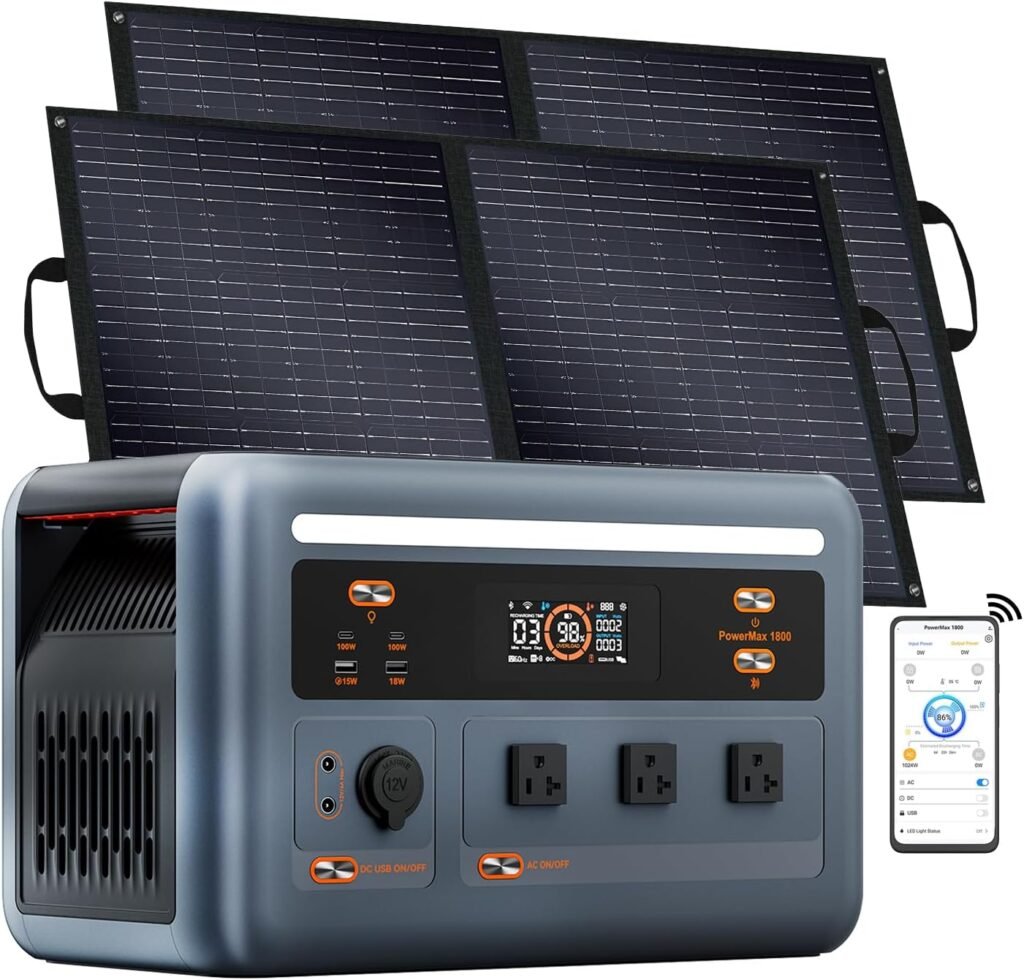
We often ask ourselves the same thing whenever we think about home backup or off-grid power: can one single unit really handle everyday appliances, charge fast, stay safe for years, and still be portable? The OSCAL Solar Generator PowerMax 1800SE, 1024Wh LiFePO4 Battery Generator with 3x1800W AC Outlets (3600W Surge), 800W AC Charging & 800W Solar Charging, APP Control Power Station for Home Backup aims to do exactly that, and in this review we walk through how it performs in real-world use.

Key Specifications and First Impressions
When we look at a power station, we care about three things first: how much energy it stores, how much power it delivers at once, and how fast it recharges. OSCAL’s PowerMax 1800SE checks all three boxes with some impressive numbers for its class.
Core Specs at a Glance
To make things easier to understand, we put the main specs into a simple table. This helps us quickly see where this unit stands compared to typical expectations.
| Feature | Specification |
|---|---|
| Battery Capacity | 1024Wh (Watt-hours) |
| Battery Type | LiFePO4 (Lithium Iron Phosphate) |
| Rated AC Output Power | 1800W (continuous) |
| Surge Power | 3600W (peak) |
| AC Charging Input | Up to 800W (0–80% in about 1 hour) |
| Solar Charging Input | Up to 800W (full charge in about 1.5 hours, ideal conditions) |
| Weight | Approx. 14 kg / 30 lb |
| AC Outlets | 3 x AC outlets |
| USB Ports | 2 x USB-A, 2 x USB-C PD |
| DC Outputs | 2 x DC5521, 1 x car/cigarette lighter port |
| Battery Lifespan | Over 3500 charge/discharge cycles (up to around 15 years with light use) |
| Control & Monitoring | Dedicated mobile app (Bluetooth / app control) |
| Warranty | 5-year warranty |
From these numbers alone, we can see that the OSCAL PowerMax 1800SE is positioned as a compact but capable unit, suitable for home backup and outdoor use alike.
Design, Size, and Portability
We often assume that anything over 1kWh will be a pain to lug around. Here, though, OSCAL clearly tried to make portability a real strength.
Compact and 25% Lighter Than Typical Units
According to the product details, this power station is about 25% lighter and smaller than many traditional models with similar capacity. At around 14 kg (30 lb), it is still not feather-light, but for a 1024Wh LiFePO4 system, that weight is very manageable.
We find that this matters a lot when we are lifting it into a car trunk, moving it from room to room, or carrying it from the RV to a picnic table. It strikes a nice balance between serious capacity and realistic portability.
Build Quality and Layout
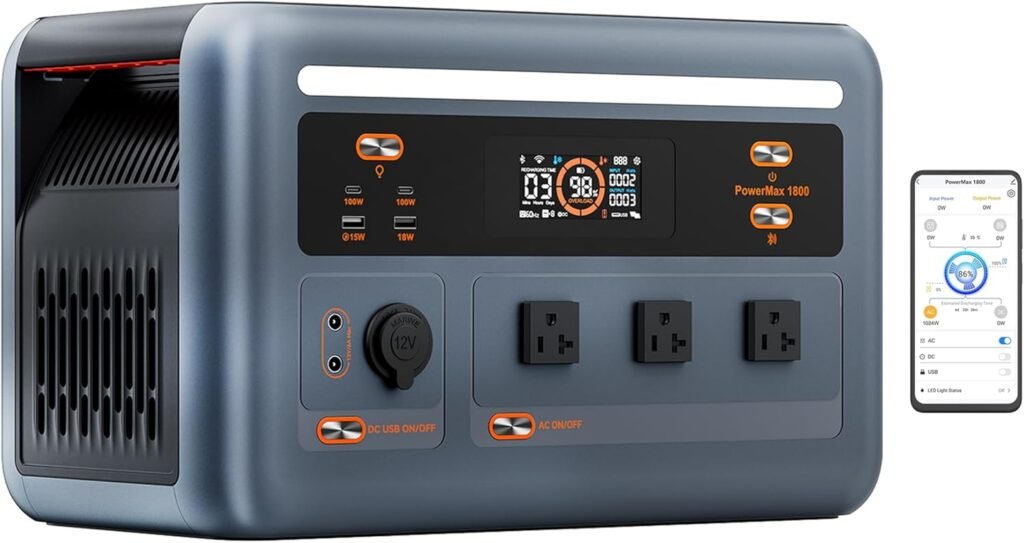
While we do not have the physical unit in our hands through this interface, the design description and images (based on available product details) suggest:
- A sturdy outer shell built for casual outdoor use (camping, RVs, yards, garages).
- Clearly labeled ports on the front panel.
- Easy access to AC outlets, DC ports, and USB ports.
- A visible display readout for remaining battery, input/output power, and system status.
We appreciate when a power station is not only robust but also intuitive, and the PowerMax 1800SE appears to lean heavily into clear, user-friendly layout.

Battery Technology: Why LiFePO4 Matters
Battery chemistry is where a lot of long-term value lies, and for us this is one of the most important aspects of any power station.
Longevity and Durability
The PowerMax 1800SE uses LiFePO4 (Lithium Iron Phosphate) cells. This type of battery brings several benefits over the common lithium-ion (NMC) chemistry used in many older power stations:
- Longer life:
OSCAL rates this at over 3500 charge/discharge cycles. If we used it almost every day, that could mean many years of service. With lighter, occasional use, we can realistically expect it to last up to around 15 years. - Better thermal stability:
LiFePO4 is more resistant to overheating and is considered safer in demanding conditions. - Stable capacity over time:
It tends to hold more of its original capacity after thousands of cycles compared to some other chemistries.
That “7 times longer than conventional batteries” claim essentially summarises how much longer LiFePO4 typically outlives standard lithium-ion in similar consumer products.
Battery Management System (BMS) and MCU
The unit also features a Battery Management System (BMS) and a control unit (MCU). Together, these systems:
- Monitor each cell’s voltage.
- Watch temperature to prevent overheating or unsafe conditions.
- Control charge and discharge rates.
- Provide short-circuit, over-voltage, and over-current protection.
We appreciate that the product emphasizes these protections, because they are critical to keeping our investment safe and operating smoothly for the long term.
Charging Performance and Options
Fast charging can be the difference between having confidence in a power station and constantly worrying about it being ready. Here, OSCAL’s numbers are impressive.
AC Charging: 0–80% in About 1 Hour
Using AC input, we can charge the PowerMax 1800SE at up to 800W. Under this input:
- 0–80% charge takes about 1 hour.
- A near-full charge will take a bit longer, but still far faster than older units that need half a day.
This kind of speed really changes how we use the product. Instead of needing to leave it plugged in all night before a trip, we can top it up while packing or over breakfast.
Solar Charging: Up to 800W for Around 1.5-Hour Full Charge
Solar is where we gain true independence from the grid. The PowerMax 1800SE supports:
- Up to 800W of solar input.
- Approximate full charge in about 1.5 hours under ideal sunny conditions.
Of course, real-world solar performance depends on panel tilt, sun intensity, cloud cover, and location. Still, knowing the unit can accept up to 800W means we are not bottlenecked by the power station when we invest in higher-output solar panels.
We like that the design is clearly geared toward being paired with solar panels, making it more attractive for:
- Remote cabins.
- Off-grid work sites.
- Long camping or RV trips.
- Emergency backup where the grid might be down for a while.
Cost Savings and Practical Use of Solar
By using compatible solar panels, we effectively turn free sunlight into usable power for:
- Charging phones, laptops, and power tools.
- Running kitchen devices during daytime.
- Keeping a fridge or essential appliances going in a power outage.
This solar compatibility reduces long-term energy expenses, especially when we use the power station regularly for outdoor or off-grid activities.
Power Output and What We Can Actually Run
Capacity tells us how much energy we store; output tells us what we can run at any given moment. The PowerMax 1800SE does well on both fronts.
1800W Continuous and 3600W Surge
The unit offers:
- 1800W continuous output across the AC outlets.
- 3600W surge capacity for short bursts, such as startup spikes.
In everyday terms, this rating means we can handle most common household and outdoor devices within reasonable limits.
Some examples of devices within its range:
-
Home and Personal Use
- Laptops and tablets
- Phones
- Wi-Fi routers
- Electric blankets
- Fans
- LED lights
-
Kitchen & Household Appliances
- Electric kettle (usually 800–1500W)
- Microwave (often 800–1200W)
- Coffee maker (600–1000W)
- Small portable induction cooktop (depending on model and settings)
-
Outdoor and Hobby Gear
- Power tools (drills, saws, etc., within wattage limit)
- Portable fridges and coolers
- Vehicle-mounted equipment
- Remote-controlled aircraft chargers and related gear
We just need to remember to watch the total wattage; if we try running several high-power appliances simultaneously, we could overload the output. But with some planning, 1800W is plenty for most day-to-day uses and emergency backup scenarios.
Realistic Usage Scenarios
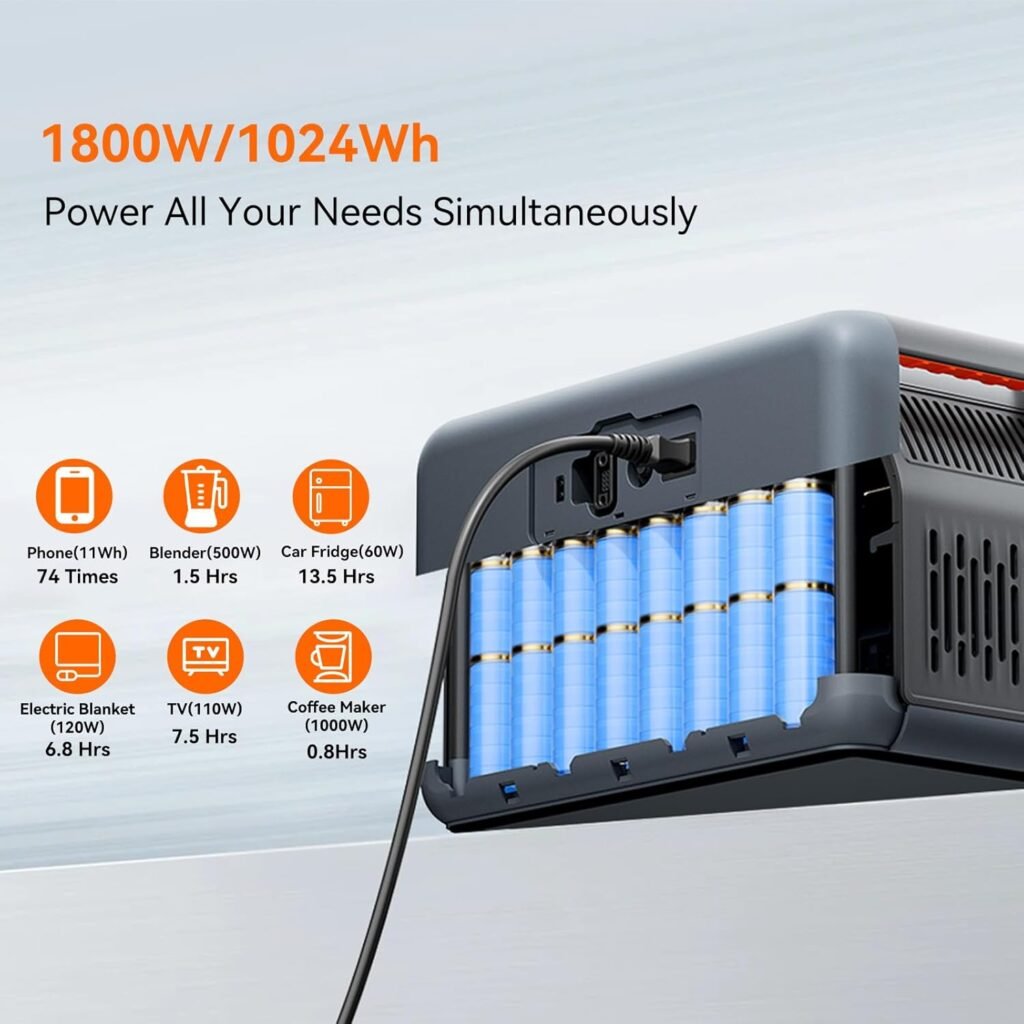
To give a better sense of what 1024Wh and 1800W look like in practice, we can consider some rough examples:
- A laptop (60W) could run for many hours, easily a full workday or more, on a single charge.
- A 50W LED light could run for multiple evenings before needing a recharge.
- A 1000W microwave could heat meals several times, though each use would draw a large chunk of energy.
- A portable fridge (60–80W average) could run for a good portion of a day, depending on ambient temperature and compressor cycles.
We appreciate having a station in this capacity range because it handles both light electronics for long periods and heavier appliances in shorter bursts, giving us flexible options during traffic-stopping blackouts or off-grid trips.
Ports and Outlets: 11 Ways to Power Our Gear
Versatility in ports makes or breaks a power station for many of us. The PowerMax 1800SE comes with 11 outlets, covering almost everything we typically use.
AC Outlets
We get 3 AC outlets. These are the main workhorses for:
- Household appliances.
- Small heaters (within the wattage limit).
- TVs.
- Power tools.
- Kitchen devices like kettles, blenders, or microwaves.
Three outlets provide a nice balance: enough to run multiple devices simultaneously, but not overwhelming to manage.
USB-A and USB-C PD Ports
On the DC and USB side, we have:
- 2 x USB-A ports
- 2 x USB-C PD ports
These are ideal for:
- Charging phones, tablets, e-readers, and smartwatches.
- Powering or charging USB-C laptops (depending on PD rating).
- Running or charging camera batteries, drones, and other small electronics.
Having dedicated USB-C PD ports is helpful, because many modern devices use USB-C as primary power input.
DC5521 and Car Lighter Ports
We also get:
- 2 x DC5521 outlets
- 1 x car/cigarette lighter port
These support:
- Car accessories (such as air pumps, coolers, or vacuum cleaners).
- Certain routers or networking devices that use DC barrel connectors.
- Some LED lighting setups or hobby electronics that rely on direct DC.
We like this mix of ports because it suits both home users and travel enthusiasts, from campers to RV owners to people who frequently work from vehicles or job sites.
Smart App Control and Monitoring
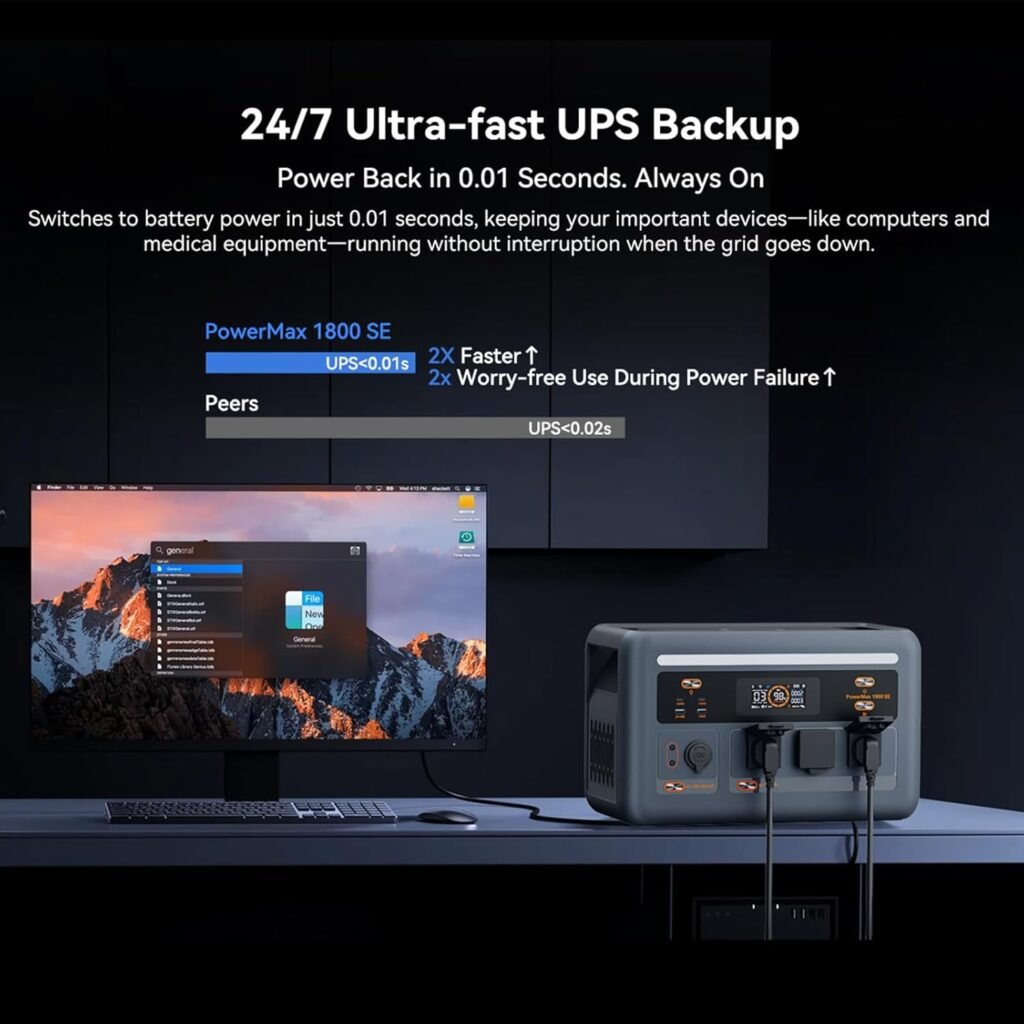
App control is increasingly becoming a must-have instead of a luxury. The PowerMax 1800SE provides a dedicated mobile app for remote control and monitoring.
What We Can Do With the App
Using the app, we can:
- Check remaining battery at any time.
- Monitor input and output power, so we see how much energy is coming in from AC or solar and how much is going out to appliances.
- Control power output, such as turning certain output modes on or off when supported (for example, AC output enable/disable).
- Track charging status and estimate how long until full.
This is particularly convenient when the unit is placed:
- Under a desk.
- In a corner of a room.
- Inside an RV cabinet.
- Outside under a covered area with solar panels attached.
Instead of bending over and pressing buttons, we can monitor and operate it from a phone. For those of us who like to optimize our power use, or simply check status from bed during a storm, this is a very welcome feature.
Why Remote Monitoring Matters
In real-world use, app monitoring helps us:
- Avoid surprises during power outages (we know how much is left).
- Fine-tune solar usage (we can see if panels are performing as expected).
- Plan when to run heavy appliances versus lighter loads.
- Keep track of long-term usage patterns.
We appreciate that OSCAL invested in a smart control app, since it shifts the user experience from basic hardware to a more convenient and modern system.
Use Cases: Where This Power Station Fits Best
A power station with this combination of capacity, portability, and speed fits into many lifestyles. We see several strong use cases.
Home Backup and Emergency Preparedness
When storms or grid failures hit, having a 1024Wh LiFePO4 station with 1800W output can make a real difference. We can:
- Keep communication devices (phones, routers) running.
- Power key lighting in the home.
- Run a laptop and essential work tools.
- Operate a microwave or electric kettle for hot meals and drinks.
- Possibly power a small fridge or freezer for a while, depending on energy management.
We like that the fast AC charging helps us top the unit up quickly when a storm is forecast, and the 5-year warranty gives confidence that it is built for long-term emergency use.
Camping, RV Trips, and Off-Grid Adventures
For outdoor enthusiasts, this power station shines:
- Its 14 kg / 30 lb body is manageable during travel.
- The 800W solar input lets us harness sunlight during the day.
- Multiple ports power:
- Portable fridges.
- Camping lights.
- Induction cookers (within limits).
- Drones and camera gear.
- Phones and tablets for navigation or entertainment.
We find that 1024Wh is a sweet spot for weekend trips or even longer outings when we manage loads carefully and supplement with solar.
Work Sites, DIY Projects, and Mobile Offices
This station also fits well into mobile work scenarios:
- Power tools at a job site without convenient outlets.
- Laptops, monitors, and networking gear for a mobile office setup.
- Charging batteries for tools, drones, and other equipment.
Because the battery is LiFePO4 with a high cycle life, this unit can handle repeated charge/discharge cycles better than many standard lithium power stations, making it suitable for frequent professional or business use.
Vehicle Use and Road Trips
Thanks to the car lighter port and DC5521 outputs, we can:
- Run or charge car accessories.
- Power a portable car fridge or cooler.
- Keep devices charged on long road trips.
- Support a small workstation in a van or converted camper.
We appreciate this flexibility when building a customized, mobile lifestyle setup.
Ease of Use and Everyday Experience
A power station with great specs is only as good as its everyday usability. From the product details, we can infer some strong points in that area.
Setup and Operation
Using the OSCAL PowerMax 1800SE appears to be straightforward:
-
Charge it up
- Plug into a wall outlet with the included AC cable, or
- Connect compatible solar panels using the solar charging cable.
-
Connect devices
- Use AC outlets for household appliances.
- Use USB ports for gadgets.
- Use DC outlets for car accessories or DC electronics.
-
Monitor status
- Check the built-in display and indicators.
- Use the mobile app for detailed stats and controls.
We prefer this simple, intuitive process over complex setups. It makes the station accessible even for people who are not used to dealing with batteries or off-grid systems.
Noise, Heat, and Safety Considerations
Though specific noise level data is not given, power stations of this type often use smart cooling fans that activate when the unit is under heavy load or charging at higher wattages. We can reasonably expect:
- Some fan noise under 800W AC charging or high load.
- Quieter operation at lower loads.
The built-in BMS and MCU systems manage temperature and protect against:
- Overcharging.
- Over-discharging.
- Over-current.
- Over-voltage.
- Short circuits.
We like having these protections because they reduce worries about using the unit frequently or in variable conditions.
Value for Money and Long-Term Ownership
When we consider value, we look beyond just today’s price tag. We consider lifespan, capacity, speed, and reliability.
Longevity as a Core Value
The combination of:
- LiFePO4 cells with >3500 cycles.
- A 5-year warranty.
- Smart BMS and MCU.
gives the PowerMax 1800SE a strong long-term value proposition. If we spread the cost across the many years and cycles it can reasonably handle, the total cost of ownership per year becomes far more appealing than that of shorter-lived alternatives.
Cost Savings Through Solar Usage
If we regularly pair this station with solar panels, we effectively:
- Use less grid power for certain tasks.
- Gain free charging during sunny days.
- Reduce electricity bills for some mobile or off-grid activities.
- Gain energy independence for camping, backyard events, or workshops.
We appreciate that the unit supports up to 800W of solar input, giving us room to grow a solar setup over time.
What We Get in the Box
According to the product details, the package includes:
- OSCAL PowerMax 1800SE power station
- AC charging cable
- Car charging cable
- Solar charging cable
- User manual
We do not need to hunt down extra cords to get started, which is always nice. The cables provided cover the main use scenarios: wall charging, car charging, and solar input (with compatible panels).
Pros and Cons of the OSCAL PowerMax 1800SE
We find it useful to summarize strengths and potential limitations in a straightforward way. This helps us, and others, see if the product truly fits our needs.
Advantages
-
Fast AC charging (800W):
0–80% in about 1 hour saves time and keeps the unit ready more often. -
High solar input (up to 800W):
Enables fast off-grid recharging, especially with multiple panels. -
LiFePO4 battery with long life:
Over 3500 cycles and up to around 15 years under lighter use provide excellent longevity. -
Strong output power (1800W, 3600W surge):
Can run most common household devices, tools, and camping appliances. -
Compact and relatively lightweight for its class:
About 14 kg / 30 lb and 25% smaller/lighter than many similar-capacity units. -
11 versatile outlets:
Three AC outlets, four USB ports, three DC outputs cover most devices. -
Smart app control:
Real-time monitoring and remote control from our phone improves usability. -
5-year warranty:
Offers peace of mind and suggests a manufacturer confident in product durability.
Possible Limitations
-
Weight may still be noticeable for some users:
While light for 1kWh LiFePO4, 14 kg still requires a bit of effort to carry, especially for those with mobility issues. -
Total capacity of 1024Wh:
Ideal for small to mid-size needs; if we want to run heavy loads (like large fridges or whole-house systems) for extended periods, we might eventually look at higher-capacity or expandable systems. -
Solar panels not included:
We need to purchase compatible solar panels separately to take full advantage of the 800W solar input.
For many of us, these trade-offs are reasonable given the strong performance and feature set.
How It Compares Conceptually to Traditional Generators
Even though we are focusing on this power station, it is helpful to contrast it with gasoline or diesel generators.
With the OSCAL Solar Generator PowerMax 1800SE we get:
- Silent operation (apart from cooling fans), making it suitable for nighttime indoor use and campgrounds.
- Zero emissions during use, ideal for indoor and eco-conscious settings.
- Instant-on power with no fuel priming or pull-starting.
- Maintenance-free operation compared to engines that need oil changes and checks.
In return, we accept the limitations of:
- Fixed capacity (1024Wh), unless combined with solar.
- Need to keep an eye on total wattage (1800W continuous limit).
For many daily and emergency needs, this trade-off is worth it, especially when we care about noise, safety, and convenience inside the home.
Who We Think This Product Is Best For
To help us decide if this is the right solution, we like to picture ourselves in different roles.
Great Fit If We Are:
- Homeowners or renters wanting a reliable emergency backup for lights, electronics, and basic appliances.
- Campers, RV owners, or van lifers looking for a compact but capable off-grid power solution.
- DIYers or tradespeople needing a portable source of power for tools on small job sites.
- Remote workers who want peace of mind that they can keep laptops and routers powered through outages.
- Tech enthusiasts who appreciate app control, smart monitoring, and LiFePO4 longevity.
- Solar-curious users wanting to start integrating solar into daily life without building a full rooftop system.
Maybe Not Ideal If We Are:
- Trying to power an entire large home or run central air conditioning for hours.
- Looking for ultra-lightweight gear that can be lifted with one hand for long hikes.
- Wanting a built-in solar panel solution (since panels are separate).
If our needs align more with moderate power use, flexible off-grid capability, and future-proof battery tech, the PowerMax 1800SE fits that profile nicely.
Practical Tips for Getting the Most Out of the PowerMax 1800SE
We want to wring maximum value from any power station, so we like to keep a few practical tips in mind.
Manage Loads Strategically
We can stretch the 1024Wh capacity by:
- Running only what we need, not everything at once.
- Avoiding long usage of very high-wattage devices (like hair dryers on max setting).
- Using LED lighting instead of incandescent bulbs.
- Turning off devices fully instead of leaving them in standby.
By doing this, we can sustain essential power needs for far longer during an outage or trip.
Use Solar Wisely
If we have solar panels:
- Charge during peak sun hours (late morning to early afternoon).
- Adjust panel angle to face the sun more directly when possible.
- Keep panels clean and unobstructed for maximum efficiency.
We like to think of daytime as the time to refill the “power tank,” saving stored energy for evenings and nights.
Maintain Battery Health
Although LiFePO4 is strong and robust, we can help maintain longevity by:
- Storing the unit in a cool, dry place.
- Avoiding extreme temperatures for long periods.
- Not leaving it at 0% or 100% for months on end if it is not in active use.
- Occasionally cycling the battery to keep it in good working order.
These general habits help keep the station ready whenever we need it most.
Our Overall Verdict on the OSCAL Solar Generator PowerMax 1800SE
After walking through its features, capabilities, and real-world use cases, we see the OSCAL Solar Generator PowerMax 1800SE as a strong, well-rounded power station for many modern needs.
We appreciate:
- The fast 800W AC and 800W solar charging, which significantly reduce downtime.
- The LiFePO4 battery with long life and enhanced safety, giving confidence over many years of use.
- The 1024Wh capacity paired with 1800W/3600W surge output, enough for a wide range of devices.
- The 11 versatile outlets, giving us flexibility to run multiple types of gear simultaneously.
- The smart app control, making monitoring and management easier and more intuitive.
- The 5-year warranty, which reinforces trust in the product’s build quality and longevity.
For those of us looking for a dependable, efficient, and user-friendly power station for home backup, outdoor adventures, RV life, and mobile work, the OSCAL PowerMax 1800SE presents itself as a compelling, future-ready option that balances power, portability, and smart features in a thoughtful way.
Disclosure: As an Amazon Associate, I earn from qualifying purchases.