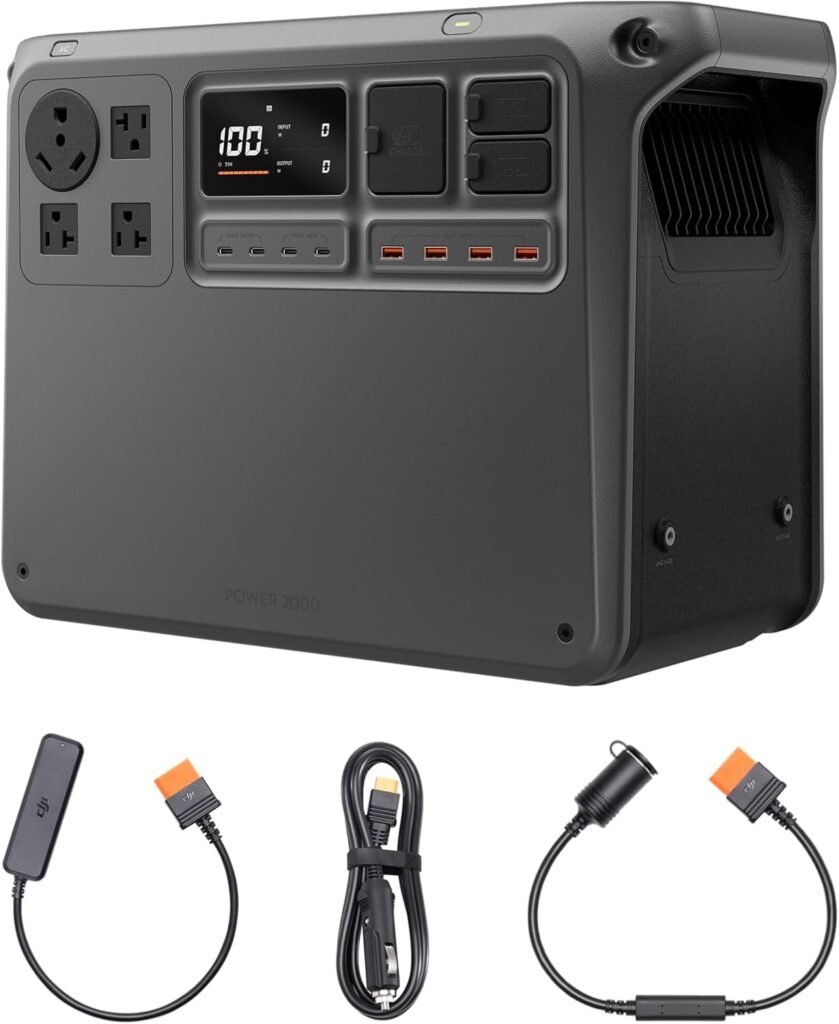
DJI Power overview:
The DJI Power is aimed at shoppers who need more than phone charging, combining a 2048Wh LFP battery with car-charging cables, backup functionality, and enough connections for a group. The package is worth considering for camping, RV travel, DIY work, road trips, emergency backup, and off-grid use, but its value depends on whether we will regularly use that capacity.
The DJI Power 2000 is advertised as running 99% of appliances, including kettles, cookers, projectors, electric saws, and impact drills. It provides ports, including dual full SDC ports, and includes both an SDC-to-car-charger plug cable and a car-power-outlet-to-SDC cable. That combination makes it more travel-ready than a station supplied only for indoor charging.
At $1,370, the DJI Power 2000 has several strong arguments: rapid advertised recharging, a ms UPS switch time, low stated noise, and the option to expand the system later. The central question is simpler: do we need this much power? Availability is listed as only units, so we should check the current price and stock status before ordering rather than treating the displayed listing as permanent.
Our early view is balanced. The DJI Power 2000 looks best for demanding trips, several simultaneous users, or backup planning. Buyers who mainly recharge phones and small electronics may get better value from a smaller station.


DJI Power specifications at a glance
The core specifications establish this as a high-capacity station rather than a compact power bank. The table separates stated product specifications from broader marketing claims, which helps us judge what is confirmed and what should be treated as a performance promise.
| Specification | Stated detail |
|---|---|
| Battery | 2048Wh lithium iron phosphate battery |
| Ports | 15 total, including dual full SDC ports |
| Minimum noise | As low as dB |
| UPS switch time | 10 ms |
| Recharge claim | 80% in minutes |
| Expansion | Up to 22.5kWh with separately sold expansion batteries |
The DJI Power 2000 package includes the DJI Power Station, an SDC to Car Charger Plug Power Cable, and a Car Power Outlet to SDC Power Cable. The 22.5kWh figure is not the capacity of the base unit; it describes a larger system that requires additional batteries purchased separately.
The DJI Power 2000 product description also claims that the station can run 99% of appliances. That is a marketing claim rather than a guarantee of identical runtime across every appliance. The supplied information does not provide dimensions, weight, AC output wattage, solar-input specifications, or detailed port types beyond the dual full SDC ports, so we won’t fill those gaps with assumptions.
For a purchase decision, we would record the base capacity, included cables, charging claim, UPS figure, and expansion requirement separately. That prevents the advertised maximum system capacity from being confused with what arrives in the standard package.
DJI Power key features in everyday use
A 2048Wh battery is useful when a trip involves more than occasional phone charging. It gives the DJI Power 2000 a role in longer camping sessions, RV use, outdoor work, DIY tasks, lighting, laptops, fans, and emergency devices. The practical benefit is not simply a large number on the label; it is having more energy available before we need access to a wall outlet or vehicle.
The 15-port design also suits shared use. On a group trip, four or five people may want to charge phones, lights, fans, and laptops at the same time. A larger selection of connections can reduce the need to rotate chargers, although the product data does not identify every port type or state how much power each connection can supply.
The DJI Power 2000 package is especially interesting for road users because it includes two full SDC ports and two vehicle-related cables. Those accessories are the reason this bundle is more relevant to car travel and RV trips than a standard home-oriented power station without the same stated charging equipment.
The listed appliance range includes kettles, cookers, projectors, electric saws, and impact drills. Actual runtime will vary with the appliance’s demand and how long we use it, so the product’s 99% claim should not be read as a promise that every high-draw tool will operate for an extended period.
Before buying the DJI Power 2000, we should write down each intended device, its wattage, and the expected operating time. Add the loads that may run together, then decide whether the base station is sufficient. This simple exercise is more useful than judging suitability from the appliance list alone.
Fast charging, car charging, and backup readiness
The advertised recharge figure is one of the package’s most useful features: the station reaches 80% in minutes. For road trips, outdoor work, and emergency preparation, a shorter turnaround can make it easier to use the station, recharge it, and set off again without a long wait.
The DJI Power 2000 includes an SDC to Car Charger Plug Power Cable and a Car Power Outlet to SDC Power Cable. Their purpose is to connect the station with vehicle-based charging arrangements, which is valuable when a car or RV is the available power source. The supplied information does not state a specific vehicle-charging speed, so we should not assume that both cables provide identical performance.
The station also has a seamless UPS feature with a stated ms switch time. In practical terms, it is intended to keep connected devices running when mains power unexpectedly fails. The product description says this is twice as fast as Power 1000, but that comparison should not be turned into a guarantee that every device will behave identically during a changeover.
To prepare it properly, we would use this sequence:
- Charge the station before the trip or backup period.
- Connect the device that matters most during an outage.
- Test the backup behavior before relying on it.
- Store the required vehicle cables with the station.
The DJI Power 2000 is therefore more than a large battery for occasional use. Its value comes from combining quick stated recharge, vehicle-oriented accessories, and backup switching in one package. We should still test our own equipment rather than waiting for a real outage to discover an incompatibility.
Safety, battery chemistry, and quiet operation
The DJI Power 2000 uses a 2048Wh lithium iron phosphate battery and lists several safety-related design features: a smart battery management system, sub-nano coating, and flame-retardant housing. These features are presented as support for use in wet or rugged outdoor conditions, which matches the intended camping, RV, DIY, and outdoor-work roles.
That wording does not provide a waterproof certification or a specific protection rating. We should therefore treat outdoor suitability as a stated product claim, not as permission to expose the unit to any conditions without checking the manufacturer’s instructions. A sensible setup is a stable, dry, ventilated surface away from avoidable hazards.
Noise is another practical consideration. The station is rated at as low as dB, which may matter when it is used overnight in an RV or enclosed living area. Lower noise can be more comfortable around sleeping spaces than a louder generator, but “as low as” does not mean silent operation in every charging or load condition.
The DJI Power 2000 should be placed securely before we connect equipment. We would also keep the unit dry, allow suitable ventilation, and follow the manufacturer’s instructions for operation, charging, and outdoor use. Those steps are particularly relevant when the station is used near sleeping areas or alongside tools.
The battery chemistry, housing claims, and minimum noise figure make the package more appealing for regular outdoor use. They don’t remove the need for sensible placement, and they don’t tell us how loud the unit will be under every possible load.
DJI Power smart controls and expansion potential
The station can connect wirelessly to the DJI Home app, allowing us to check status and adjust settings remotely. For an RV owner, that may mean monitoring the unit without repeatedly opening a storage area. For home-backup users, it offers a way to check the station from a short distance instead of standing beside it.
The DJI Power 2000 can expand to a stated maximum of 22.5kWh when separately sold expansion batteries are added. The product description says that expanded system can power essential home devices for four to six days during blackouts, storms, or off-grid living. That is a system-level claim, not what the base station alone provides.
Expansion changes the budget significantly because the $1,370 price covers the listed package, not a complete 22.5kWh installation. We should price the additional batteries before deciding that this is an affordable multi-day backup plan. The advertised duration will also depend on which essential devices we run and how heavily we use them.
A practical planning method is:
- List essential loads such as lighting, communications, refrigeration, or other devices we genuinely need.
- Estimate how long each one must operate.
- Decide whether the base capacity meets that plan.
- Price the expansion batteries only if the base unit falls short.
The DJI Power 2000 is consequently more flexible than a fixed-capacity station, but flexibility has a separate cost. App control and future expansion are useful only if we actually need remote monitoring or longer backup duration.
What customers are saying about the DJI Power 2000
We can’t responsibly present a customer-review consensus here because the supplied product data includes no current star rating, review count, or individual buyer comments. That means we cannot verify whether users consistently achieve the advertised 55-minute recharge, find the dB operation suitable for sleeping areas, or use the SDC ports in particular vehicle setups.
The DJI Power 2000 should therefore be assessed from the stated specifications rather than invented review patterns. There is no supplied evidence confirming or disputing charging speed in practical use, car-charging convenience, capacity, port selection, app reliability, build quality, emergency usefulness, weight, accessory compatibility, runtime, or expansion cost.
When current buyer feedback is available, we would give more weight to repeated comments than to isolated complaints. We would specifically separate reports from camping users, RV owners, DIY users, and home-backup households because each group places different demands on a power station. A short-trip camper may value ports and vehicle charging, while a home-backup buyer may focus on UPS behavior and sustained loads.
For now, shoppers should check the live listing for the current rating and review count before ordering. We would search the reviews for practical details about whether the 80% charging claim matches use, whether noise is acceptable overnight, how the SDC cables are used, and whether the app remains dependable. Without those buyer reports in the supplied evidence, confident claims about customer satisfaction would be misleading.
The DJI Power 2000 has a detailed feature list, but a feature list isn’t a substitute for verified customer experience. This is the section where the current listing deserves a final check immediately before purchase.
Who should buy the DJI Power 2000?
The best match is someone who needs more than a phone charger. The DJI Power 2000 is aimed at RV travelers, campers, outdoor workers, DIY users, households preparing for outages, and groups that may run several devices at once. Its combination of large battery capacity, appliance support, vehicle cables, UPS switching, quiet-operation claim, and app control fits longer trips and planned backup better than casual day use.
It is also a reasonable option for households that may eventually require multi-day backup and are prepared to budget for separately sold expansion batteries. We should not buy it solely because a larger system is possible; the expansion path makes sense only after we have identified the essential loads and calculated the required duration.
The DJI Power 2000 is less compelling for people who only charge small electronics or take occasional short trips. A smaller, less expensive station may meet those needs without asking us to pay for capacity that remains unused. The $1,370 price is easier to justify when the station will regularly support tools, appliances, group charging, vehicle travel, or outage preparation.
Before deciding, we would check:
- Which devices must run and for how long.
- Whether vehicle charging is essential.
- How many people may charge equipment simultaneously.
- Whether low-noise operation matters overnight.
- Whether future expansion is part of the plan.
The DJI Power 2000 suits a specific buyer: someone with substantial, recurring power needs. If our checklist contains mostly small electronics and short sessions, we should compare smaller options instead.
Is the DJI Power good value?
At its current price, the DJI Power 2000 offers a substantial package on paper: a 2048Wh LFP battery, 15-port design, two stated car-charging cables, an advertised 80% recharge in minutes, UPS functionality, low-noise operation, and app control. Those features create a stronger value case for people who will use the station frequently rather than store it for occasional emergencies.
The price is easiest to justify when our plans include vehicle travel, demanding appliances, several simultaneous users, outdoor tools, or outage backup. The package’s car-oriented accessories may also reduce the need to source compatible cables separately, although we should confirm that the included connections suit our vehicle and intended setup.
The DJI Power 2000 becomes a different financial proposition if we want the advertised 22.5kWh system or four-to-six-day backup claim. Expansion batteries are sold separately, so the $1,370 base price is not the final cost of that larger arrangement. We should add those batteries to the budget before comparing it with competing systems.
We cannot make a reliable current-price comparison with the EcoFlow DELTA Max or Jackery Explorer Plus because their listing prices and specifications were not included. Check each live listing separately, distinguishing base-unit prices from bundled accessories and expansion costs.
Our conclusion is straightforward: consider the DJI Power 2000 if we need substantial portable power, vehicle charging, group use, or backup capability. Look at a smaller station if our needs stop at phones and short trips. Before ordering, verify current price, stock, rating, review count, included cables, expansion pricing, and suitability for the devices we intend to run.
Pros and Cons
Pros
- High stated 2048Wh LFP battery capacity
- Includes SDC-to-car charging cables for vehicle-focused use
- 15-port design with dual full SDC ports
- Advertised 80% recharge in minutes
- 10 ms UPS switch-time claim
- App control and expansion potential
- Stated minimum noise level of dB
Cons
- $1,370 is a substantial upfront price for buyers with modest power needs
- Expansion batteries are required to reach the advertised 22.5kWh system capacity
- The supplied information does not state the full recharge time
- No current customer rating or review count was provided for verification
- Detailed port types, output wattage, dimensions, and weight are not supplied
- The 99% appliance claim does not establish runtime for every high-draw device
Final Verdict
Key Takeaways
- The $1,370 package combines a 2048Wh LFP battery, ports, UPS functionality, app control, and vehicle-charging cables.
- The stated 22.5kWh capacity requires separately sold expansion batteries and is not the base unit’s capacity.
- Its strongest fit is camping, RV travel, outdoor work, group charging, and household backup rather than occasional phone charging.
- The supplied data does not include a current customer rating, review count, or verified competitor specifications, so those details should be checked before ordering.
- Confirm intended device loads, current stock, included accessories, and the full expansion cost before committing.
Frequently Asked Questions
Can DJI Power be used as an UPS?
Yes. The product description states that it has a seamless UPS function with a ms switch time. We should test the connected device before relying on it during an outage.
How long does it take to fully charge a DJI Power 2000?
The supplied information states that it reaches 80% charge in minutes. It does not provide a full 0%-to-100% charging time, so we cannot state the complete charging duration.
Can I charge my DJI drone without the charger?
The supplied product information does not confirm drone-charging compatibility or explain whether a drone can be charged without its charger. Check the drone’s charging requirements and the station’s confirmed output connections before relying on it.
Disclosure: As an Amazon Associate, I earn from qualifying purchases.