

Like a lighthouse in a storm, the right 10,000-watt generator guides us through outages without drama. In 2025, we weigh dual- and tri-fuel flexibility, true inverter cleanliness, CO safety, and transfer-ready outlets that actually fit our homes. We also consider runtime, mobility, and support that won’t disappear after the sale. Together, we’ll cut through spec-sheet noise and highlight models that earn their keep—so you can decide which one deserves a spot by your panel.
WEN 11,000-Watt Dual Fuel Portable Generator (DF1100T)
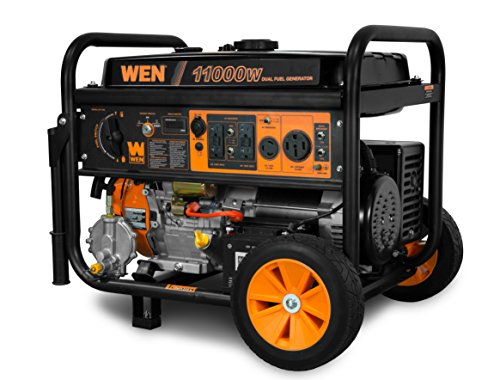

If you want big-league backup without a whole-home install, WEN’s DF1100T stands out for its dual-fuel flexibility and true 120/240V output. You’ll get 11,000 surge and 8,300 running watts on gasoline, or 9,500/7,500 on propane, letting you prioritize cost, runtime, or storage. Hit the electric start to fire up the 457cc OHV engine, then rely on the 6.6-gallon tank for up to 8.5 hours at half load.
You’re covered on outlets: four 120V GFCIs, an L5-30R, a 50A NEMA 14-50R, and a 12V plug. A wheel kit, oil, 47-inch LPG hose, and a two-year warranty round it out.
Best For: Homeowners or RV users needing flexible, high-output emergency or job-site power with true 120/240V capability and the option to run on gasoline or propane.
Pros:
- Dual-fuel operation with strong output: 11,000/8,300W (gas) or 9,500/7,500W (propane)
- True 120/240V output with robust outlet selection including 50A NEMA 14-50R and L5-30R
- Electric start and up to 8.5 hours runtime at half load on a 6.6-gallon tank
Cons:
- Heavy/large footprint despite wheel kit; not ideal for frequent manual transport
- Noise and fuel consumption typical of high-wattage open-frame generators
- Requires proper transfer switch and setup for safe home backup integration
Champion 12,500-Watt Tri Fuel Portable Generator with CO Shield

Champion’s 12,500-Watt Tri Fuel with CO Shield is for homeowners who want true flexibility without compromising output. You can run it on natural gas, propane, or gasoline, and it ships with the hoses you need, plus engine oil and a battery for the electric start. On gasoline, you’ll get 12,500 starting watts and 10,000 running watts; propane delivers 11,250/9,000; natural gas provides 10,000/8,000.
You’ll appreciate Intelligauge for tracking voltage, frequency, session and total run time, and maintenance intervals. CO Shield adds automatic carbon monoxide shutdown. Backed by a 3-year limited warranty and free lifetime tech support, it’s a confident home-backup pick.
Best For: Homeowners wanting a flexible, high-output backup generator that can seamlessly switch between natural gas, propane, and gasoline with easy electric start and built-in safety/monitoring.
Pros:
- Tri-fuel versatility (natural gas, propane, gasoline) with hoses included; ready to run out of the box
- Strong power output across fuels, maxing at 12,500 starting/10,000 running watts on gasoline
- Electric start, Intelligauge monitoring, and CO Shield safety; backed by 3-year warranty and lifetime tech support
Cons:
- Lower running wattage on propane and natural gas versus gasoline may limit heavy concurrent loads
- Portable unit of this size can be heavy/bulky to move and store
- Requires periodic maintenance and fuel management to ensure reliable emergency readiness
Westinghouse 10000 Peak Watt Portable Inverter Generator with Remote Start

Need whole-house-ready power without hiring an electrician right away? Westinghouse’s 10,000 Peak Watt Portable Inverter Generator gives you clean, quiet muscle with less than 3% THD—safe for sensitive electronics. You’ll get 7,600 running watts, a durable 420cc OHV engine with a cast iron sleeve, automatic low-oil shutdown, and up to 12 hours on a 5.28-gallon tank. Start it your way: remote key fob, push button, or recoil.
Power up easily with four GFCI 120V outlets, a transfer-switch-ready L14-30R, and a 120/240V 14-50R—each with rubber covers. The VFT display and digital hour meter simplify monitoring. It arrives plug-and-play and includes a 3-year limited warranty.
Best For: Homeowners and RV users who need quiet, clean whole-house-capable backup power with easy remote start and transfer-switch-ready connections.
Pros:
- 7,600 running watts (10,000 peak) with <3% THD for safe use with sensitive electronics
- Multiple start options (remote key fob, push-button, recoil) and long 12-hour runtime on a 5.28-gallon tank
- Transfer-switch-ready L14-30R and 120/240V 14-50R plus four GFCI 120V outlets with protective covers
Cons:
- Heavier and bulkier than smaller generators, reducing portability
- Runs on gasoline only; no dual-fuel flexibility
- “Whole-house” capability may still require an electrician-installed transfer switch for full-home integration
Westinghouse 13500W Tri-Fuel Portable Generator

Serious home backup and RV users will appreciate the Westinghouse 13500W Tri-Fuel’s versatility: it delivers up to 13,500 peak watts on gasoline and lets you switch to propane or natural gas without sacrificing reliable power. You’ll get 10,500 running watts on gas, 9,500 on propane, and 8,500 on natural gas—plus up to 19 hours from the 9.5-gallon tank. Start it your way: remote key fob, electric, or recoil. Plug in confidently with GFCI 20A outlets, a transfer-switch-ready L14-30R, and an RV-ready 14–50R. The 500cc OHV engine adds CO and low-oil shutdowns, digital hour meter, and a 3-year warranty. Plug-and-play kit included.
Best For: Homeowners and RV users who need a high-capacity, tri-fuel portable generator with long runtime, easy starting options, and transfer/RV-ready outlets for reliable whole-home or travel power.
Pros:
- Tri-fuel flexibility (gasoline, propane, natural gas) with strong running watts across all fuels
- Long runtime up to 19 hours on a 9.5-gallon tank and multiple start methods including remote key fob
- Transfer-switch-ready L14-30R and RV-ready 14–50R plus GFCI household outlets and safety shutoffs (CO, low oil)
Cons:
- Heavy-duty 500cc unit is large and heavy, making frequent transport or small-space storage challenging
- Higher fuel consumption at full load compared to smaller generators
- Natural gas output is lower than gasoline/propane, which may limit peak-demand appliances on NG
Westinghouse 12500W Dual Fuel Portable Generator

Looking for a dual-fuel workhorse with true home-backup readiness? You’ll appreciate the Westinghouse 12500W Dual Fuel Home Backup Portable Generator. On gasoline, it delivers 9500 running watts and 12500 peak; on propane, 8500 running and 11200 peak. Start it your way: remote key fob, electric, or recoil. The 6.6-gallon tank with gauge supports up to 12 hours of runtime.
You get transfer-switch-ready 120V L14-30R (30A), RV-ready 120/240V 14–50R (50A), plus two GFCI 120V 5–20R outlets—each with rubber covers. The 457cc OHV engine features a cast iron sleeve, low-oil shutdown, and a digital hour meter. Plug-and-play accessories and a 3-year warranty seal it.
Best For: Homeowners and RV users needing a powerful, dual-fuel portable generator that’s transfer-switch ready for whole-home backup and long runtimes.
Pros:
- Dual fuel flexibility with strong output: 9500/12500W on gasoline and 8500/11200W on propane
- Home-backup friendly with transfer-switch-ready 120V L14-30R and RV-ready 120/240V 14–50R outlets
- Convenient starts (remote key fob, electric, recoil) and up to 12-hour runtime from a 6.6-gallon tank
Cons:
- Heavy-duty unit can be bulky and heavy to move compared to smaller generators
- Noise level not specified; likely louder than inverter generators
- Requires proper fuel storage and maintenance; EPA compliant but not specified as CARB compliant
DuroStar DS13000MX Dual Fuel Portable Generator (13,000-Watt)

Balancing whole-home muscle with fuel flexibility, the DuroStar DS13000MX stands out if you want transfer‑switch‑ready power without guesswork. You get 13,000 watts for reliable backup, plus dual‑fuel freedom: run gasoline for maximum output or propane for longer, cleaner runtime. A fuel selector lets you switch quickly as availability changes.
You’ll appreciate push‑button electric start and optional remote start for easy, staged restoration. The 50‑amp outlet connects directly to a transfer switch, making whole‑home, RV, or job‑site deployment simple. CO Alert shuts the unit down at dangerous levels, protecting your family. Rugged all‑metal construction and a reinforced power panel handle harsh use.
Best For: Homeowners or RV users who want a rugged, transfer-switch-ready 13,000‑W generator with dual-fuel flexibility, remote start convenience, and CO safety for reliable backup during outages.
Pros:
- 13,000 watts with 50-amp outlet for direct transfer switch hookup and whole-home capability
- Dual Fuel Technology allows gasoline for max power or propane for longer, cleaner run times with quick fuel switching
- Push-button electric and optional remote start for easy, staged power restoration; CO Alert adds safety
Cons:
- Large, heavy unit may be cumbersome to move and store compared to smaller generators
- Propane typically delivers slightly lower peak wattage than gasoline
- Requires proper transfer switch installation and safe ventilation practices to operate correctly
WEN 8000-Watt Dual Fuel Portable Generator (DF8000X)

Need dual fuel flexibility without jumping to a full 10kW class? The WEN DF8000X gives you serious backup with gasoline or propane. Its 340cc engine delivers 8000 surge/6500 running watts on gas, or 7200/5850 on propane. You’ll get 120/240V versatility through a 30-amp L14-30R for transfer switches, plus an RV-ready 120V 30-amp TT-30R.
Start it with a switch, roll it on the included wheel kit, and monitor safely with the WEN Watchdog CO Shutdown Sensor. A 6.7-gallon tank provides up to 10.5 hours at half-load. Outlets include four 120V 5-20R and a 12V DC port. Backed by a three-year warranty.
Best For: Homeowners and RV users who want a mid-size, dual-fuel generator with 120/240V capability for transfer switches and an RV-ready outlet without moving up to a 10kW unit.
Pros:
- Dual fuel flexibility with strong output: 8000/6500W (gas) and 7200/5850W (propane)
- Transfer-switch-ready 120/240V L14-30R plus RV-ready 120V 30A TT-30R
- Electric start, wheel kit, CO shutdown sensor, and up to 10.5-hour runtime at half-load
Cons:
- 30A output limits whole-home coverage compared to 50A/10kW-class units
- Heavier portable form factor may be cumbersome despite wheels
- Propane wattage is lower than gasoline, reducing peak capacity on LP
Jackery Explorer 1000 v2 Portable Power Station (1070Wh, LiFePO4)

Prefer silent, grab-and-go backup over gas noise and fumes? You’ll like the Jackery Explorer 1000 v2. It packs a 1,070Wh LiFePO4 battery, 1,500W AC output (3,000W surge), and just 23.8 lbs with a foldable handle. Power fridges, small ACs, and cookers via three pure sine AC ports, plus two USB-C (up to 100W), one USB-A, and a 12V car port.
Charge fast: 0–100% in one hour via the app’s emergency mode (default 1.7 hours for longevity) using ChargeShield 2.0. The app offers quiet 30 dB overnight charging and efficiency modes. It’s solar-ready (Jackery panels only, not included). Durable LFP chemistry lasts 10+ years (70% after 4,000 cycles).
Best For: Campers, RVers, and homeowners who want a quiet, portable, fast‑charging LiFePO4 power station to run essentials like fridges, small ACs, and cooking gear without gas noise or fumes.
Pros:
- 1,500W AC output (3,000W surge) with three pure sine wave outlets plus dual 100W USB‑C, USB‑A, and 12V car port
- Fast charging: 0–100% in 1 hour via app emergency mode (default 1.7 hours to protect battery) with ChargeShield 2.0
- Long‑life LFP battery: 4,000 cycles to 70% (~10+ years), portable 23.8 lbs with foldable handle and smart app controls (quiet/efficiency modes)
Cons:
- Solar panels not included and solar charging is compatible only with Jackery panels
- App requires account management and adds complexity for some users
- Display size and premium price may not suit all buyers
Portable Power Station 600W 293Wh with 120V AC and 100W PD

Looking for grab-and-go power more than whole-home output? This 600W/293Wh portable power station delivers pure sine wave AC with 1200W surge, weighing just 7.7 lbs. You get seven outputs: one 120V/600W AC outlet, a 100W USB-C PD, a 24W USB-C, two QC 3.0 USB-A ports, a car port, and a DC port—perfect for laptops, drones, cameras, and daily devices under 600W.
A premium BMS monitors voltage, current, and temperature, supports 1500+ cycles, and a clear LCD shows status. You’ll receive the station, AC adapter, and manual; car charger cable isn’t included. Recharge every 1–2 months. Hold the AC button three seconds to toggle. 24/7 support.
Best For: Campers, travelers, and emergency-prep users who need lightweight, grab-and-go power for laptops and small devices under 600W with fast USB-C PD.
Pros:
- 600W pure sine wave AC (1200W surge) with 7 versatile ports, including 100W USB-C PD for rapid laptop charging
- Lightweight 7.7 lbs design with clear LCD and premium BMS for safety and 1500+ charge cycles
- Quiet, portable backup suitable for camping, outages, and on-the-go work
Cons:
- Single AC outlet limits simultaneous AC device use
- 293Wh capacity isn’t ideal for high-draw appliances or long-duration power needs
- Car charger cable not included; must be purchased separately
DuroMax XP13000EH Dual Fuel Portable Generator

For whole‑home backup that doesn’t tie you to a single fuel, DuroMax’s XP13000EH delivers 13,000 watts of peak power and true dual‑fuel flexibility (gas or propane). You get a portable, EH‑series workhorse built for outages, RVs, and jobsites.
Fire it up with push‑button start, flip fuels in seconds from a front‑facing interface, and plug into a transfer‑switch‑ready 50A outlet plus a full outlet spread. The all‑metal frame, steel power panel, and no‑flat tires handle rough weather and terrain. Inside, 100% copper windings and a long‑life core engine set it apart from aluminum‑wound rivals. If you want versatile, durable power, this one’s ready.
Best For: Homeowners, RVers, and jobsite crews who want whole‑home‑capable backup power with the flexibility to run on gasoline or propane in a rugged, portable package.
Pros:
- Dual Fuel versatility (gas or propane) with quick, front-facing fuel switching and push-button start
- 13,000W peak output with a transfer switch–ready 50A outlet and a broad outlet selection
- Durable, all‑metal build with 100% copper windings, steel power panel, and no‑flat tires
Cons:
- Heavy unit; portability requires wheels and may be cumbersome for one person
- Louder than smaller inverter generators; not ideal for ultra-quiet environments
- Requires regular maintenance and safe fuel storage/handling for both gas and propane
Factors to Consider When Choosing 10000W Portable Generators
As we compare 10,000-watt portables, we should look at power output by fuel and understand the gap between starting and running watts. We’ll also check THD and inverter quality for sensitive electronics, plus the outlet mix and whether the unit is transfer-switch ready. Finally, we’ll note runtime and fuel tank size to gauge real-world endurance.
Power Output by Fuel
Which fuel you choose directly changes how much usable power a 10,000-watt portable generator delivers. On gasoline, most models hit their highest outputs—typically around 10,000W running with peaks near 12,500W or more. If we want maximum capacity for heavy loads, gasoline usually wins.
Propane trades a bit of output for cleaner storage and longer shelf life. We commonly see 8,000–9,000W running and roughly 9,000–11,000W peak on propane. Natural gas trends similar or slightly stronger than propane for peak but still below gasoline—about 8,000–10,000W running and 10,000–12,000W peak.
Tri-fuel and dual-fuel units add flexibility. We can switch fuels to stay powered during shortages, though output changes with each fuel. Expect gasoline to deliver the highest running watts on multi-fuel models.
Starting Vs Running Watts
Why does a 10,000-watt generator sometimes trip even when our total load seems under the limit? Because starting watts and running watts aren’t the same. Starting (surge) watts are the brief peak a generator can deliver to overcome inrush current when motors or compressors kick on. Running watts are the continuous power it can sustain after startup.
We should total the surge requirements of devices that may start at the same time—HVAC, well pumps, fridges, power tools—and compare that number to the generator’s starting-watts rating. If the combined surges exceed that rating, we’ll see nuisance trips even if the running load looks fine.
Plan startup sequences or use delay relays so large loads don’t surge together. Verify both ratings; don’t size by running watts alone.
THD and Inverter Quality
How clean is the power we’re actually getting from a 10,000-watt portable generator? THD—Total Harmonic Distortion—tells us. Lower is better. We aim for under 3% THD because it delivers a stable sine wave that protects sensitive electronics and reduces overheating in motors and magnetized components. That’s why true inverter models stand out; they regulate voltage and frequency precisely and keep distortion low under changing loads.
We also check inverter quality signals: a digital VFT or similar display that shows real-time voltage and frequency, plus automatic regulation to hold set points. If a unit’s spec sheet states “<3% THD,” that’s a strong indicator of clean output. Conventional non‑inverter generators often run higher THD, so we scrutinize their regulation claims carefully before trusting them with delicate gear.
Outlets and Transfer Ready
Clean power only matters if we can deliver it where it’s needed, so we look hard at outlet sets and transfer-ready capability. For home backup, an L14-30R or similar transfer switch-ready outlet is essential. It lets us tie into a manual transfer switch for safe, seamless utility-to-generator switching. We also prefer panels with four 120V GFCI outlets for flexible, protected household circuits and tools.
Compatibility matters for heavy loads. A 14-50R (50A) outlet supports RVs and large appliances, while L5-30R or L14-30R twist-locks give secure connections and match common site standards. We also check that dual-fuel or tri-fuel models keep their transfer-ready ports active regardless of fuel, so wiring plans don’t change. The right outlet mix prevents improvisation under pressure.
Runtime and Fuel Tank
When we’re sizing up a 10,000-watt portable, runtime and tank capacity make or break real-world usability. Bigger fuel tanks typically deliver longer operation, but actual hours hinge on load. At half load, many 9–11kW gasoline models run about 8–12 hours, with engine efficiency nudging results up or down. We’ll also weigh dual-fuel flexibility: propane or natural gas can stretch runtime versus gasoline, but consumption rates differ, so published hours are fuel-specific.
For planning, we always check the manufacturer’s rated runtime at a stated load (often 50%) alongside tank size. Then we match that to our expected load profile to estimate refueling intervals. If we’ll run lighter loads overnight, we can extend hours; heavier daytime draws shorten them accordingly.
CO Safety Features
Why does a 10,000-watt portable absolutely need CO protection? Because these engines produce significant exhaust, and carbon monoxide can become deadly before we notice symptoms. We should prioritize models with a dedicated CO safety shutdown or alert system that cuts the engine automatically when dangerous levels are detected.
Look for branded systems like CO Shield or clearly labeled CO detection with automatic shutdown. These mechanisms operate independently from low-oil or fuel-related shutdowns, so they’ll trigger even when the engine appears healthy—critical for garages, workshops, basements, or limited-ventilation setups like cabins or treehouse-style builds.
As we compare options, verify certification. We want explicit auto-shutdown thresholds, sensor placement details, and published testing procedures. Clear documentation signals a reliable, validated implementation—not just marketing. This feature isn’t optional; it’s life safety.
Portability and Start Methods
How easily can we move and start a 10,000-watt portable? We should look at wheels, handles, and start controls first. Most units include wheel kits, integrated handles, and compact frames, so we can roll them across gravel or grass and pivot them into tight spaces. Weight still matters—bigger alternators add pounds—so balanced frames and lift points make a difference.
Start methods shape daily convenience. Electric start via key or push button saves time, while remote options—fob or app—let us fire up the generator from a safe distance, handy when it’s staged away from the work area. Finally, outputs and readiness affect “power portability.” Transfer-switch-ready panels and RV/TT-30R or 14-50R outlets let us route power cleanly without ad‑hoc rewiring.
Frequently Asked Questions
Are These Generators Compliant With Local Noise Ordinances and Campground Rules?
Yes, but compliance varies by model and location. We’ll check each unit’s decibel rating, local ordinances, and campground quiet hours. We’ll recommend mufflers, placement, and inverter modes, and suggest alternatives when noise limits are stricter than specifications.
What Permits or Inspections Are Required for Home Transfer Switch Installation?
Yes—most towns require an electrical permit and inspection by the authority having jurisdiction; some utilities need approval too. We pull permits, use a licensed electrician, follow NEC/UL/utility specs, and schedule the final inspection. Let’s get ducks in a row.
How Do I Safely Store Gasoline and Propane for Long-Term Emergencies?
We store gasoline in approved metal cans with stabilizer, dated, rotated every 6–12 months, kept cool, ventilated, and away from flames. We keep propane cylinders upright outdoors, shaded, inspected for rust, leak-checked, and never indoors or enclosed spaces.
Can These Units Run Sensitive Electronics Without Additional Surge Protection?
Yes—if they feature true inverter output or <5% THD regulation. Worried about your laptop’s safety? We recommend using built-in AVR, eco mode, quality surge protectors, and line-interactive UPS units for extra buffering during startups and load swings.
What Insurance Implications Exist When Backfeeding or Using Interlock Kits?
Insurance often denies claims if we backfeed illegally. We should use permitted interlock kits or transfer switches installed by licensed electricians, notify our insurer, document inspections, and follow code. Otherwise, liability, fire, and injury claims can be excluded.
Conclusion
We’ve covered the best 10,000-watt portable generators for 2025, from dual- and tri-fuel workhorses to clean, quiet inverter options. They’re transfer-ready, CO-safe, and built for long runtimes and sensitive electronics. Here’s a stat that stands out: a modern 10,000W inverter can cut total harmonic distortion to under 3%, protecting laptops and medical devices while starting HVACs. Let’s match your power needs, fuel flexibility, and budget—so when the lights go out, we keep everything running.