
Like a quiet hum behind a campfire, dependable power should be felt, not heard. In 2025, we’ve narrowed down five 2000-watt portable generators that balance low noise, clean output, and real-world portability. We focus on runtime, weight, outlet options, and safety features like CO protection and inverter quality. Whether you’re camping, tailgating, or prepping for outages, these picks aim to make power simple. And one option isn’t even gas-powered—curious which one earns a spot?
2450-Watt Portable Inverter Generator (EPA Compliant)


If you want a quiet, travel-ready inverter that runs long on a small tank, this EPA-compliant 2450-watt unit stands out. You get 2450 watts of starting power at 120V from a gasoline inverter that weighs just 43 pounds, so you can carry it for camping or emergency backup without hassle.
It sips fuel from a 6L (about 1.6-gallon) tank and runs up to 14 hours at 25% load. Noise stays low at 59 dB thanks to advanced sound reduction, so you won’t disturb the campsite. Gasoline keeps refueling simple and affordable. Use it for outdoor work, home backup, or light commercial needs.
Best For: Campers, homeowners, and light commercial users who need a quiet, portable, gasoline inverter generator with long runtime for reliable 120V backup power.
Pros:
- Quiet operation at 59 dB with advanced sound reduction
- Long runtime up to 14 hours at 25% load from a 6L (≈1.6-gallon) tank
- Lightweight 43 lb design for easy transport and setup
Cons:
- 2450-watt starting power limits use with high-demand appliances
- Gasoline engine requires regular maintenance and fuel storage considerations
- Single-voltage (120V) output may not suit all applications
GENMAX Ultra Lightweight Generator for Home Backup and Camping
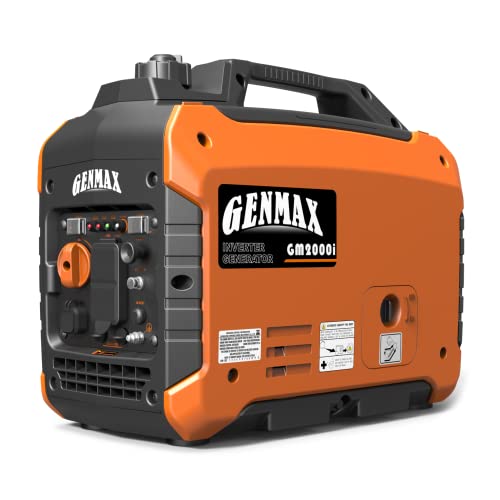
Craving true grab-and-go power for campsites or quick home backups? The GENMAX Ultra Lightweight Generator delivers with 2000 starting watts and 1600 running watts from a 79.7cc 4-stroke OHV engine. You’ll get clean power under 3% THD for phones, laptops, and sensitive gear.
At just 34 pounds with a sturdy handle, it’s among the lightest 2000W units you can carry. It runs as low as 60 dBA and up to 8 hours at 50% load on a 1-gallon tank. Switch on Economy Mode to stretch fuel.
The panel is practical: 120V/20A, 5V/1A, 5V/2.1A, output indicator, overload and low-oil alarms, CO warning, and CO Detect shutdown. Parallel-ready, too.
Best For: Campers, RVers, and homeowners who need ultra-portable, quiet, clean power for small appliances and electronics, with occasional parallel-ready backup capability.
Pros:
- Ultra lightweight 34 lb design with sturdy handle for easy carry
- Clean inverter power (<3% THD) safe for phones, laptops, and sensitive electronics
- Quiet operation (~60 dBA) with Economy Mode delivering up to 8 hours at 50% load on 1-gallon tank
Cons:
- 1600 running watts may be insufficient for larger appliances or whole-home backup
- Small fuel tank limits runtime at higher loads
- Lacks 30A RV outlet without using adapters or a parallel kit
WEN 2350-Watt Portable Inverter Generator (Model 56235i)
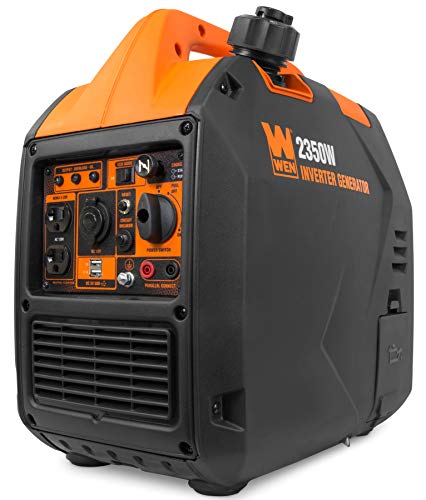
Need ultra-quiet power you can carry with one hand? WEN’s 56235i delivers 2350 surge watts and 1900 running watts in a 39-pound inverter you’ll actually bring along. Its 79cc 4-stroke OHV engine hums at just 51 dB at quarter load, sips a 1-gallon tank, and runs over 5.7 hours at half load with Eco-Mode. You get clean, pure sine power (THD <0.3% no load, <1.2% full) for phones, laptops, and TVs.
Plug in with two 120V NEMA 5-20R, one 12V DC, and two USB ports. Safety includes low-oil/fuel shutdown and overload protection. Parallel-ready, CARB compliant, and backed by a two-year warranty.
Best For: Campers, tailgaters, and homeowners who need ultra-quiet, lightweight, clean power for sensitive electronics and occasional backup.
Pros:
- Ultra-quiet operation (51 dB at quarter load) and only 39 lbs for easy portability
- Clean pure sine wave power (THD <0.3% no load, <1.2% full) safe for phones, laptops, and TVs
- Eco-mode, fuel shutoff, and 5.7+ hours at half load for efficient, low-maintenance use
Cons:
- 1900 running watts may be insufficient for high-demand appliances (e.g., large AC units)
- 1-gallon fuel tank limits runtime for extended outages without refueling
- Parallel kit required (sold separately) to expand capacity beyond single-unit output
Champion 2500-Watt Ultralight Portable Inverter Generator with Quiet Technology and CO Shield

Looking for an ultralight, quiet inverter you can lift with one hand? Champion’s 2500-Watt Ultralight (model 201317) weighs 39.7 pounds yet delivers 2500 starting watts and 1850 running watts of clean power (<3% THD) for sensitive electronics. Its 80cc engine, 1.1-gallon tank, and efficiency stretch run time up to 11.5 hours at 25% load. You’ll appreciate the 53 dBA noise level, 120V 5-20R duplex, 12V outlet, and parallel-ready ports.
CO Shield adds automatic carbon monoxide shutoff. Cold Start Technology helps in winter. It’s ideal for camping, tailgating, RV basics, and small home essentials—not whole-home emergencies. Backed by a 3-year warranty and lifetime tech support.
Best For: Campers, tailgaters, and RV owners who need an ultralight, quiet, clean-power inverter for small essentials and sensitive electronics.
Pros:
- Ultralight 39.7 lb design with 53 dBA operation for easy carry and quiet campsites
- Clean power (<3% THD) with 120V 5-20R duplex and 12V outlet; parallel-ready for more capacity
- Long run time up to 11.5 hours at 25% load; CO Shield safety and Cold Start Technology
Cons:
- 1850 running watts limits use to smaller appliances and essentials
- Parallel kit for higher output is sold separately
- Not suited for whole-home emergency backup or high-demand tools/appliances
Anker SOLIX C1000 Gen 2 Portable Power Station

If you want wall-to-full in under an hour without the roar of a gas engine, Anker’s SOLIX C1000 Gen 2 stands out. You get 2,000W continuous (3,000W peak) from a 1,024Wh LiFePO4 pack that holds 80% after 4,000 cycles. HyperFlash AC recharges at 1,600W in 49 minutes; solar hits full in about 1.8 hours with 600W.
You’ll power up to 10 devices via AC, USB-C/A, and a car socket. The app’s TOU mode helps dodge peak rates. It’s 14% smaller, 11% lighter, has a 10 ms UPS, clear display, and a 5-year warranty. Note solar cable needs and some app history limitations.
Best For: Homeowners and campers who want fast, quiet, fuel-free backup power with true UPS support and rapid AC/solar recharging for multiple devices.
Pros:
- 1,600W HyperFlash AC recharging to full in 49 minutes; 600W solar input refills in ~1.8 hours
- 2,000W continuous (3,000W peak) output with 10 ports, 10 ms UPS, and TOU mode via app
- Durable 1,024Wh LiFePO4 battery rated 4,000 cycles to 80% capacity; compact, lighter design with 5-year warranty
Cons:
- Solar cables/connectors may not be included; some compatibility nuances with DC inputs
- App has limited historical power consumption data and controls
- 1,024Wh capacity may be insufficient for high-draw appliances over long outages without expansion/extra panels
Factors to Consider When Choosing 2000 Watt Portable Generators
As we compare 2000-watt generators, we’ll start with the essentials: power output ratings that match your appliances and tools. We’ll weigh fuel type options, noise level range, and the balance between runtime and tank size for real-world use. Finally, we’ll look at weight and portability so we can carry it easily without sacrificing performance.
Power Output Ratings
Why do power numbers on a “2000-watt” generator feel confusing at first glance? Because that headline figure often reflects surge output, not what we can sustain. Start-up (surge) watts cover motor inrush—think fridge or compressor kicks. Running watts are the continuous rating we should plan around. In this class, many inverters deliver roughly 1600–1850 running watts and about 2000 starting watts, which determines what we can start simultaneously.
We also watch power quality. Clean power with under 3% THD keeps laptops, cameras, and medical devices safe. If we need more headroom, parallel capability lets us link two units for a larger combined output without upsizing a single generator. Finally, consider real-world loads versus runtime; most models run 8–11+ hours at 25–50% load on a tank.
Fuel Type Options
So what should we burn to keep a 2000-watt inverter humming? For most of us, gasoline is the practical choice. It’s widely available, works in every season, and on these small inverters typically delivers about 6–8+ hours per tank at moderate load. Tank size matters: expect roughly 1.0–1.6 gallons on many 2000W models, with runtime stretching when we stay near 25%–50% load.
We should also look for eco or economy modes. They automatically lower engine speed when demand drops, sipping fuel and extending runtime without sacrificing stable 120V output. Because these are inverters, we’re getting clean power—often under 3% THD—for laptops and sensitive gear. If we need more capacity later, parallel-capable models let us link two units and keep using the same fuel.
Noise Level Range
How quiet can a 2000-watt inverter really be? We should expect most units to land between about 51 and 60 dBA at quarter to half load. Ultra-quiet models reach roughly 51 dBA at quarter load, while others hover around 59–60 dBA under similar conditions. That 5–10 dBA spread matters—we’ll hear a clear difference at campsites or in small yards.
Let’s read the fine print. Manufacturers typically measure noise at a set distance—often around 23 feet—and at a specific load, like quarter or half. If we stand closer or push higher loads, noise rises. Eco or idle modes help by throttling the engine during light demand to stay quieter. When comparing specs, we’ll match distance and load, then prioritize the lowest verified dBA.
Runtime and Tank
Runtime and tank size go hand in hand, and we should weigh both against how we’ll actually use a 2000-watt inverter. Most 2000–2500-watt inverters carry 1.0–1.1 gallon tanks (about 3.8–4.2 liters), which set the ceiling for how long they run. Load matters more: at 25% load, some 2450-watt units stretch a 6‑liter tank to roughly 14 hours.
We should match capacity to our duty cycle. If we’re powering a fridge, lights, and charging gear at partial load, eco mode can extend runtime beyond the nominal spec. If we need overnight power, a larger tank (around 6 liters) increases endurance without refueling. Parallel capability won’t lengthen per-unit runtime, but it can let us share loads across two units, keeping each at efficient partial load for longer sessions.
Weight and Portability
Weight drives real-world portability. When we’re hauling a generator from garage to campsite, every pound matters. Ultra-light models in the 34–39 pound range feel genuinely grab-and-go, while units nearing 43 pounds or more may require two-handed carries or short breaks. A well-placed, sturdy handle and compact dimensions reduce awkward lifts and make trunk packing easier.
We should also weigh fuel capacity against carry comfort. Smaller tanks—around 1.1 gallons—keep weight down for frequent moves, while larger tanks up to 6 gallons add heft but reduce refueling stops. For bigger loads, parallel capability offers a portability win: we can pair two light inverter generators instead of stepping up to a bulky, higher-wattage machine. For camping and emergencies, smaller, lighter footprints typically deliver the most transport-friendly experience.
Outlet and Ports
Curiously, the right outlet mix can make a 2000-watt generator feel twice as useful. We should inventory our plugs before buying: a 120V 5-20R duplex covers most tools and appliances, while onboard USB-A and USB-C ports charge phones, headlamps, and GPS without extra bricks. A 12V DC socket helps with inflators or battery maintenance on the road.
If we camp or tailgate, a dedicated 30A/RV-ready outlet or an adapter-friendly layout saves hassle. Let’s also check the panel’s layout—clear labeling and spacing prevent cable crowding.
Parallel capability matters when we might outgrow 2,000 watts; a compatible parallel kit lets two units combine output. Finally, we like panels that include CO shutdown status and low-oil indicators for safer, uninterrupted operation.
THD and Electronics
How clean is the power we’re plugging our electronics into? THD—Total Harmonic Distortion—tells us. Lower THD means fewer voltage ripples and safer operation for sensitive gear. Modern 2000-watt inverter generators shine here: many list THD under 3% at light loads and even below 1.2% at full load, which keeps laptops, cameras, and medical equipment running cool and stable.
We look for models advertising pure sine wave output with low THD across their operating range. That’s crucial for devices with switching power supplies, which are picky about waveform quality. Also note that THD changes with load. Some units actually deliver their lowest THD at half or full load thanks to refined inverters and regulators. Our rule: prioritize verified THD specs and real-world load performance when we’re powering sensitive electronics.
Safety and Sensors
Clean power is only part of the story; we also need generators that watch out for us. In 2025, safety-savvy 2000-watt inverters make protection proactive. We look for models with low-oil alerts that automatically shut down the engine before damage occurs. That saves repairs and keeps uptime predictable.
CO protection is nonnegotiable. Generators with CO detection shutoff—or branded systems like CO Shield—monitor ambient air and kill the engine if carbon monoxide reaches dangerous levels. It’s a crucial safeguard when camping, tailgating, or working near structures.
Fuel management matters, too. Auto shutoff for low fuel prevents lean running, stalls, and surprise voltage dips. Finally, clear panel indicators—overload alarms, output lights, and status icons—let us confirm load, watch for faults, and respond immediately without guesswork.
Frequently Asked Questions
Can 2000-Watt Generators Run Sensitive Medical Devices Safely and Continuously?
Yes, but only if it’s an inverter model with clean sine wave output and adequate surge capacity. We’d confirm wattage, use medical-grade UPS backup, test continuity, and follow manufacturer guidelines to ensure safe, uninterrupted operation.
How Do Noise Levels Change Under Eco-Mode Versus Full Load?
Eco-mode lowers noise dramatically; we often hear drops of 5–10 dB. That’s roughly half as loud to our ears. Under full load, RPMs rise, exhaust and fan noise spike, and tonal harshness becomes more noticeable.
What Maintenance Intervals Apply for Ethanol-Blended Gasoline Use?
We recommend shorter intervals: inspect fuel weekly, run monthly, change oil every 25 hours, replace spark plug and air filter every 100 hours, and drain carburetor after each season. Use stabilizer, avoid E15/E85, and store fuel under three months.
Are Parallel Kits Cross-Compatible Between Different Generator Brands?
No—most parallel kits aren’t cross-compatible. Picture mismatched plugs like puzzle pieces that won’t lock. We should follow each brand’s approved kit list, match connector types and inverter specs, or use third-party kits explicitly certified for both models.
How Do These Generators Perform at High Altitudes Without Jet Kit Modifications?
They lose power above 3,000–4,000 feet, often 10–20% by 6,000–8,000 feet, and may run rich. We’d lighten loads, monitor spark plug fouling, and prioritize maintenance; without jet kits, expect harder starts, surging, and reduced fuel efficiency.
Conclusion
In the end, we’ve seen that these 2000-watt champs punch above their weight—quiet, efficient, and ready to roll. Whether we’re camping off-grid, prepping for outages, or powering projects, each model offers a smart mix of clean power, portability, and safety. Pick the one that fits your runtime, noise, and outlet needs, and you’re golden. Because when the lights go out or the road calls, it’s better to have power in your pocket than promises in the wind.