

Can a 5,000-watt class generator truly balance power, portability, and reliability without compromise? We think it can, but only if we focus on real-world performance, not just specs. We’ll compare dual-fuel flexibility, inverter quietness, surge handling, and RV-ready outputs, then weigh runtime, CO safety, and warranties. Along the way, we’ll flag trade-offs—weight, noise, and cost—that matter when the lights go out or the job can’t wait. Let’s test the claims.
A-iPower 5000-Watt Portable Dual-Fuel Generator (GXS5000D)


Need a 5,000-watt workhorse that runs on either gas or propane? You’ll like the A‑iPower GXS5000D. Its 223cc OHV engine with a cast‑iron sleeve delivers 5,000 starting/4,000 running watts on gas and 4,500/3,600 on LPG. Expect up to 20 hours at 25% load on the 6.3‑gallon tank, or 18.5 hours on a 20‑lb propane cylinder. You get 120V outlets (two 5‑20R duplex), an L5‑30R 30A, plus an L14‑30R 120/240V 30A. Noise clocks in at 68 dB. It weighs 125.7 lb, includes automatic idle, a data display, and a CO sensor light. Backed by a 3‑year limited warranty.
Best For: Homeowners, RVers, and jobsite crews who want a durable 5,000-watt dual-fuel generator with long runtimes, multiple 120/240V outlets, and a 3-year warranty.
Pros:
- Dual-fuel flexibility (gas or propane) with long runtimes: up to 20 hrs at 25% load on gas, 18.5 hrs on a 20 lb LPG tank
- Versatile outlets: 2x 5-20R duplex (120V), L5-30R (30A), and L14-30R (120/240V 30A) for home backup or RV/jobsite use
- Useful features for safety and efficiency: CO sensor indicator, automatic idle, data center display; heavy-duty 223cc OHV engine
Cons:
- Heavier unit at 125.7 lb may be cumbersome to move without assistance or a wheel kit
- Noise level of 68 dB is louder than inverter-style generators
- Recoil start only; no electric start mentioned
WEN Dual Fuel Portable Generator (DF475T)

Looking for transfer-switch-ready backup power without giving up portability? WEN’s DF475T delivers dual-fuel flexibility and straightforward operation. Run 4750/3800 watts on gasoline or 4350/3500 on propane, then flip the voltage selector for 120V or 240V output to feed your transfer switch via the L14-30R. You get two 120V GFCI outlets and a 12V DC plug for essentials and tools.
The 224cc OHV engine and electric start keep outages simple. Expect up to 11 hours at half load from the 4-gallon tank; a 47-inch LPG hose is included. At 105.8 pounds, the wheel/handle kit helps. It’s CARB compliant, rugged, and backed by WEN’s 2-year warranty.
Best For: Homeowners or contractors who need a portable, transfer-switch-ready generator with dual-fuel flexibility and enough power for essential backup loads.
Pros:
- Dual fuel operation (gasoline or propane) with electric start for convenient, flexible use
- 120V/240V selector and L14-30R outlet make it transfer-switch ready for home backup
- Long runtime up to 11 hours at half load with a 4-gallon tank; wheel/handle kit aids portability
Cons:
- 105.8 lbs can be heavy to maneuver without the wheel kit or on uneven terrain
- 3800 running watts (gas) may be insufficient for larger whole-home loads
- Limited outlet variety (two 120V GFCI, one L14-30R, one 12V DC) compared to bigger models
PowerSmart 5000W Portable Inverter Generator with Electric Start and CO Protect
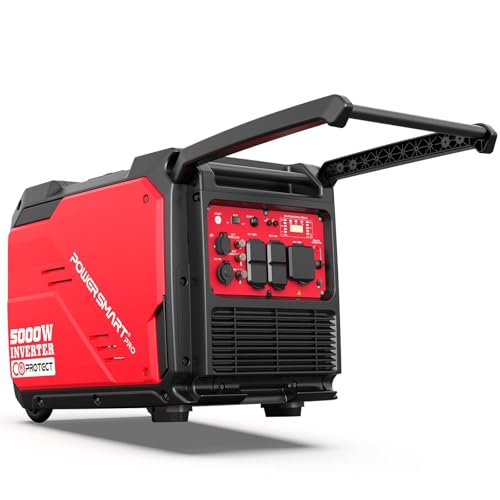
Prefer a super-quiet inverter with electric start for home backup and tailgates? You’ll like the PowerSmart 5000W Portable Inverter Generator. It delivers 5000 starting watts and 4000 running watts of clean power (<3% THD) at 120V, with a 30A receptacle, four 20A outlets, 12V DC, and two USB ports. At 59 dBA (25% load), it’s neighborhood-friendly. Run up to 10 hours at 50% load from a 1.9-gallon tank, aided by Eco Mode.
At 89 lb, the wheel/handle kit helps you move it. Safety’s strong: CO Protect, carbon monoxide auto shutdown, low-oil shutdown, and overload reset. Parallel-ready, 224cc engine, 2-year warranty.
Best For: Homeowners and tailgaters who want a super-quiet, clean-power 120V inverter with electric start and enough capacity to run essentials via a 30A outlet.
Pros:
- Super quiet for its class: 59 dBA at 25% load; clean power (<3% THD) safe for electronics
- Versatile outputs: 30A 120V receptacle, four 20A outlets, 12V DC, and dual USB; parallel-ready
- Strong safety/features: CO Protect auto shutdown, low-oil shutdown, overload reset, electric start, Eco Mode
Cons:
- 120V-only output limits use with 240V appliances or well pumps
- Small 1.9-gallon tank; ~10 hours at 50% load may require refueling on long outages
- Hefty at 89 lb; wheel/handle help, but still bulky for frequent lifting
PowerSmart 4800W Gas-Powered Portable Inverter Generator with CO Sensor

If you want an RV-ready inverter that’s super quiet yet capable, PowerSmart’s 4800W Gas-Powered Portable Generator with CO Sensor hits a sweet spot for home backup, camping, and light jobsite use. You get 5000 starting watts, 4000 running watts (rated 3600W), and clean power under 3% THD from a 223cc OHV engine. It weighs 85 pounds and includes a wheel-and-handle kit for easy moves.
Plug into seven outlets: four household AC, a 30A RV outlet, a 12V DC port, and two USB-A. Safety features include CO protection and low-oil shutdown. It’s parallel-ready to reach up to 10,000W. EPA compliant. Two-year warranty.
Best For: RV owners, homeowners, and campers who need a super-quiet, clean-power inverter generator with RV-ready 30A output and easy portability for backup and light jobsite use.
Pros:
- Clean power (<3% THD) with 5000 starting watts and up to 4000 running watts; RV-ready 30A outlet plus 7 total outputs
- CO protection and low-oil auto shut-off; EPA compliant; parallel-capable to reach up to 10,000W
- Portable 85-lb design with wheel-and-handle kit; includes 12V DC and dual USB-A ports
Cons:
- Recoil start only (no electric start)
- Parallel kit sold separately for higher wattage needs
- Rated running wattage listed as 3600W despite 4000W running claim, which may cause spec confusion
Westinghouse Dual Fuel Portable Inverter Generator (5000 Peak Watts)

Crave RV-ready convenience without sacrificing quiet, clean power? Westinghouse’s iGen5000DF delivers 5000 peak and 3900 running watts with under 3% THD, safe for laptops and TVs. Run it on gas or propane, switch with ease, and enjoy as low as 52 dBA. You get an RV-ready TT-30R, two 20A outlets, USB ports, and parallel capability.
Fire up via electric start, key fob, or recoil. A 3.4-gallon tank lasts up to 18 hours with economy mode and variable speed. At 122.7 pounds, the telescoping handle and wheels help you roll it to camp, trailer, or home backup. Backed by a 3-year warranty and lifetime tech support.
Best For: RV owners, campers, and homeowners who want quiet, clean, RV-ready power with dual fuel flexibility and easy electric/remote start.
Pros:
- Dual fuel (gas/propane) with easy switching; up to 18 hours on a 3.4-gallon tank in economy mode
- Clean inverter output (<3% THD) with quiet operation (as low as 52 dBA), safe for sensitive electronics
- RV-ready TT-30R plus two 20A outlets and USB; electric start with key fob; portable with wheels and telescoping handle
Cons:
- Heavy at 122.7 lbs; still requires some effort to move despite wheels/handle
- 3900 running watts may be limiting for whole-home backup or larger RV loads without load management
- Occasional user reports of accessory omissions or minor design quirks (e.g., gas cap, warranty/maintenance experiences)
Factors to Consider When Choosing 5000 Watt Portable Generators
Before we pick a 5000-watt portable generator, we should match power output to our essential loads and choose a fuel type that fits how we plan to use it. Let’s compare runtime and efficiency for long outages, and pay attention to noise level ratings if we’ll run it near living spaces or campsites. We’ll also check outlet compatibility—120/240V, TT-30, and covered GFCI—to ensure it powers our gear safely.
Power Output Needs
How much power do we really need from a 5000-watt portable generator? Let’s match output to our loads. Most 5000-watt units deliver about 5000 starting watts and 4000 running watts on gasoline, with some dropping to roughly 3600 running watts on LPG. For essential home backup—fridge, lights, modem—we should target a continuous capacity near 3000–4000W to avoid brownouts when compressors cycle.
For jobsites, we need surge capability close to 5000W to absorb tool startup spikes without tripping. In RV or camping setups, we should look for 30A or 50A 240V outlets if we’ll power multiple circuits at once. Runtimes matter too: many gas models run about 18–20 hours at 25% load per tank, while propane typically delivers shorter runtimes.
Fuel Type Options
When we pick a 5000-watt portable generator, fuel choice shapes performance, runtime, and maintenance. Many models are dual-fuel, letting us switch between gasoline and propane based on what’s available. Gasoline usually delivers higher starting and running watts—often near 5,000 starting and 4,000 running—so it’s our pick when we need maximum surge. Propane trades a bit of power for convenience: it stores longer without spoiling and avoids fuel-stabilizer routines.
Tank options matter. A full gasoline tank holds several gallons, while LPG cylinders vary—commonly 20 lb or larger—so runtime depends on what we connect. Features can influence fuel decisions, too. Automatic idle control trims consumption at light loads, CO sensors add safety, and parallel-ready designs let us expand capacity regardless of fuel.
Runtime and Efficiency
Curious why some 5000-watt generators run all night while others don’t? Runtime hinges on load, tank size, engine efficiency, and fuel. In this class, 223–224cc engines are common, and their tuning heavily influences how long we can run between refuels. On gasoline, we typically see about 11–20 hours at 25% load, while certain dual-fuel models stretch to roughly 18.5 hours on LPG—though propane usually yields shorter runtimes than gas for the same tank due to lower energy density.
We should also weigh efficiency features. Eco/CO Protect modes and smart throttle management reduce RPM during light loads, cutting fuel burn and extending runtime. If we need longer coverage, parallel-capable units let us split the demand between two generators, improving efficiency under variable loads.
Noise Level Rating
Something as simple as noise can make or break a 5000-watt generator choice, so we should look closely at its dB rating and how it’s measured. Manufacturers typically cite decibels at 23 feet, and the spread is wide: quiet inverter models can post 52–59 dBA at half load, while open-frame units often land around 68–70 dBA at similar load. At full load, many conventional designs climb to about 67 dBA or more.
If we want quieter operation for neighborhoods or campsites, we should favor inverter generators, especially those with CO protection and Eco/Smart modes or automatic idle control. These features lower RPM at lighter loads, cutting noise. Dual-fuel units can stay tame on gasoline, but expect higher dB at max output or with accessories attached.
Outlet Compatibility
How do we make sure a 5000-watt generator actually fits our plugs and power needs? We start by matching outlets to what we’ll run. Most models include multiple 120V 5-20R duplex outlets for household cords and a 30-amp option—typically an L14-30R twist-lock for 120/240V or a TT-30R for RVs. If we plan to connect a transfer switch or power 240V tools, we’ll want 240V capability and a clear 120/240V selector switch.
We also check convenience ports. USB and a 12V DC outlet help with phones, routers, and battery charging. If we anticipate bigger loads later, parallel-ready units let us combine two generators with a kit. For dual-fuel models, we confirm LPG hose/regulator compatibility so fuel choice doesn’t limit usable outlets.
Portability and Weight
Where will we actually move and store the generator? Let’s look at size and weight first. Most 5000-watt units run about 85–125 pounds, so lifting solo isn’t realistic for many of us. We should check whether a model includes wheels and a folding handle; those mobility aids make rolling across pavement, gravel, or grass far easier.
Dimensions matter for storage and maneuvering. Typical footprints—about 25–30 inches long, 17–21 inches wide, and 23–24 inches tall—fit tight corners in garages or trailers and slide beside other gear. If we plan frequent transport to job sites or campgrounds, compact frames with wheel kits and solid grab handles save time and strain.
Consider fuel type, too. Dual-fuel models often weigh more due to larger fuel systems, slightly reducing portability versus gasoline-only options.
Safety and Protection
Portability gets us to the site; safety keeps everyone protected once the generator’s running. We prioritize models with built-in CO sensors or CO Protect that shut down automatically if carbon monoxide rises to dangerous levels. We also insist on low-oil shutdown to prevent catastrophic engine damage when lubrication drops.
To curb wear and fuel use, we look for automatic idle control that lowers RPMs when loads dip. Overload protection matters, too; a clear data center or monitor should show real-time wattage, voltage, hours, and alerts so we can react before problems escalate.
Electrical protection is nonnegotiable. Circuit breakers safeguard the generator and connected gear, while GFCI outlets reduce shock risk on jobsites and at home. Together, these features make 5,000-watt units safer and more dependable.
Frequently Asked Questions
How Do Generator Emissions Regulations Vary by State in 2025?
They vary widely: we’ll see federal EPA floors, stricter CARB rules in California and allied states, moderate limits elsewhere, and local noise/operating-hour ordinances. We’ll check labeling, spark arrestors, low-emission certifications, and fuel choices to stay compliant when traveling.
Can I Integrate a 5000W Generator With Home Solar Systems?
Yes—we can, with care. We’ll use a transfer switch or hybrid inverter with generator input, match voltages, manage neutral bonding, and add an autostart module. We’ll verify interlocks, load limits, grounding, and code compliance.
What Cybersecurity Risks Exist With App-Connected Inverter Generators?
They face risks like weak default passwords, outdated firmware, insecure Bluetooth/Wi‑Fi, exposed APIs, and data leakage. We should change credentials, disable remote access when unused, segment networks, enable MFA, apply updates promptly, and monitor logs for anomalies.
How Do Noise Ordinances Impact Campground Generator Usage?
They limit when and how loudly we can run generators. Many campgrounds cap noise at 60–65 dB and restrict hours, enforce quiet times, and require placement rules. We should use eco-mode, baffles, distance, and courteous communication.
Are Extended Warranties Transferable to New Owners?
Yes, many are. Nearly 60% of extended warranties allow transfer, often within 30 days of sale. We recommend checking plan terms, paying any transfer fee, documenting maintenance, and submitting proof of purchase to guarantee the new owner’s coverage.
Conclusion
When the lights go out or the job demands power, we want gear that won’t skip a beat. These 5,000-watt generators hit the sweet spot—portable, reliable, and ready for home backup, RVs, or worksites. With dual-fuel flexibility, quiet inverter options, RV-ready outlets, and CO protection, we’re covered. Factor in runtime, warranty, and 120/240V needs, and we’re off to the races. Pick the model that fits your load and budget, and keep life humming when it matters most.