
Can propane generators really offer reliable, flexible power without the gas-station hassle? We think so, and the latest dual-fuel and inverter models suggest a smart shift for campers, homeowners, and job sites alike. We’ll weigh noise, runtime, portability, and transfer-switch compatibility, and we won’t ignore RV-ready outlets or USB convenience. From ultra-light units to quiet 8,000-watt workhorses, we’ve narrowed the field. One pick, though, surprised us in a way that changes the shortlist.
GENMAX Ultra Lightweight Generator for Home Backup and Camping
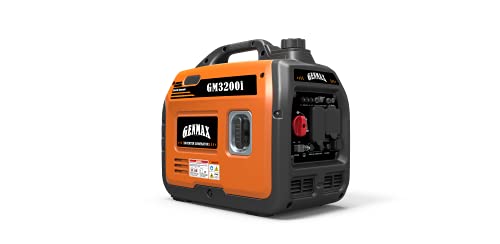

Looking for a quiet, travel‑friendly inverter that still packs real home-backup punch? You’ll like GENMAX’s GM3200i. Its 5.2 HP, 145cc engine delivers 3200 surge watts and 2800 running watts, with inverter tech that protects laptops, routers, fridges, and tools.
You won’t disturb the campsite: the fully enclosed design keeps noise to 57 dBA no‑load, about 62 dBA at 25% load, and 68 dBA at full tilt. Switch on Economy mode to stretch up to 8 hours from just 1 gallon. At 47.3 pounds with a built‑in handle, it’s easy to carry. You get USB, 120V 20A duplex, an environment‑protected 120V 30A, LED alerts, parallel‑ready capability, a 1‑year warranty, and lifetime tech support.
Best For: Campers, RVers, and homeowners who want a quiet, ultra-portable inverter generator that can safely power essential electronics and small appliances with occasional home-backup capability.
Pros:
- Lightweight 47.3 lb design with built-in handle makes transport easy for camping and travel.
- Clean inverter power (3200 surge/2800 running watts) safe for laptops, routers, fridges, and tools.
- Quiet operation (57–68 dBA) with Economy mode delivering up to 8 hours on 1 gallon.
Cons:
- 1-year warranty is shorter than some competitors offering longer coverage.
- 2800 running watts may be insufficient for whole-home or high-demand appliances without load management.
- Parallel kit required (sold separately) to double power, adding extra cost.
WEN Dual Fuel Portable Generator (DF475T)

Need a compact, transfer‑switch–ready backup that won’t lock you into one fuel? Pick the WEN DF475T. Its 224cc OHV engine delivers 4,750 starting/3,800 running watts on gas or 4,350/3,500 on propane. Flip the selector for 120V or 120/240V, then plug into the L14‑30R for your transfer switch. Two 120V GFCI outlets and a 12V DC port cover essentials and tools.
You’ll get up to 11 hours at half load from the 4‑gallon tank, or run propane via the included 47‑inch hose. Electric start, wheel/handle kit, and rugged steel build boost usability. It’s CARB compliant, 105.8 pounds, and backed by a 2‑year warranty.
Best For: Homeowners or small job-site users who need a compact, transfer-switch–ready generator with flexible gasoline/propane fueling and reliable backup power.
Pros:
- Dual-fuel operation with electric start and 120V/240V selector for transfer switch compatibility (L14-30R)
- Up to 11 hours runtime at half load on a 4-gallon tank; propane hose included for quick LPG setup
- Portable wheel/handle kit and rugged steel build; CARB compliant with 2-year warranty
Cons:
- 105.8-pound weight can be cumbersome without assistance despite wheels
- Limited outlet variety (only two 120V GFCI plus one L14-30R and 12V DC)
- Not an inverter generator, so power is louder and not ideal for the most sensitive electronics
Westinghouse Portable Inverter Generator (2550 Peak Watt, Dual Fuel)
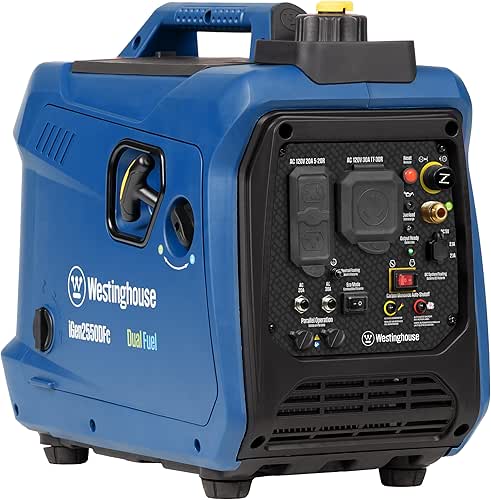
Prefer a compact, RV-ready inverter you can run on propane or gas? Westinghouse’s iGen2550DFc delivers 2550 peak watts and 1900 running watts with clean <3% THD power. At 42–43 lbs with a built-in handle, it’s easy to haul. You get a TT-30R 30A RV outlet, two 120V 20A outlets, and two USB ports.
It purrs as low as 52 dBA and runs up to 12 hours on its 1.11-gallon tank, aided by Economy Mode and automatic idle. Safety features include CO shutdown, low-oil protection, voltage regulation, and overload protection. It’s parallel-ready, includes a propane hose and oil, and carries a 3-year warranty with lifetime tech support.
Best For: RV owners, campers, and emergency backup users who want a lightweight, quiet, dual-fuel inverter with clean power and RV-ready outlets.
Pros:
- Dual fuel (gas/propane) flexibility with RV-ready TT-30R, two 120V outlets, and USB ports
- Quiet operation (as low as 52 dBA) with Economy Mode and automatic idle for up to 12 hours on a 1.11-gallon tank
- Clean <3% THD power safe for electronics; parallel-ready; includes propane hose and 3-year warranty
Cons:
- 1900 running watts may be insufficient for larger home loads or high-surge appliances
- Small fuel tank limits runtime under heavier loads despite efficiency features
- No electric start (manual pull start) and lacks 240V output for well pumps or larger tools
AIVOLT 8000W Dual Fuel Super Quiet Inverter Generator

Crave quiet, dual‑fuel power that runs in harsh weather and sips propane? You’ll like AIVOLT’s 8000W Super Quiet Inverter Generator. Its 322cc OHV engine with 100% copper windings delivers 8,000W surge and 6,100W running, with automatic gas‑to‑propane switching. Expect ≤3% THD pure sine power, 62 dBA at 23 feet, and over 10 hours at 25% load in Eco‑Mode, from -4°F to 140°F.
At 129 lbs, it tows easily via a telescopic handle and 7″ never‑flat wheels. You get CO Alert, overload and low‑fuel shutdown, EPA/CARB compliance, and a 5‑in‑1 LCD. Parallel for 240V, power RVs or homes, and start heavy loads first.
Best For: RV owners, home backup users, and job-site crews who need a quiet, dual-fuel inverter generator with clean power, long runtime, and easy portability across harsh weather.
Pros:
- Dual-fuel with automatic gas-to-propane switching; ≤3% THD pure sine wave for sensitive electronics
- Quiet operation at 62 dBA and over 10 hours runtime at 25% load in Eco-Mode
- Portable design with telescopic handle and 7″ never-flat wheels; parallel-capable for 240V
Cons:
- 129 lbs is heavy to lift without wheels or assistance
- Only four AC outlets may be limiting for larger setups without a power strip
- Parallel kit required for 240V output, adding extra cost
Westinghouse Dual Fuel Portable Generator (4650 Peak Watts)

Looking for RV-ready power without fuss? Westinghouse’s Dual Fuel Portable Generator delivers 4650 peak watts and up to 3600 running watts on gasoline, or 3240 running watts on propane. You’ll get simple hookups with a TT-30R RV outlet, plus L5-30R and a 120V household duplex, all protected by rubber covers. The 4-gallon tank and fuel gauge help you run up to 14 hours per fill.
It’s truly plug-and-play—oil, funnel, tool kit, and manual are included with minimal assembly. The 212cc OHV engine features a cast iron sleeve and automatic low-oil shutdown. It’s EPA compliant and backed by a 3-year limited warranty and nationwide support.
Best For: RV owners and home users who want an easy, plug-and-play dual fuel generator with RV-ready outlets and long run time for travel or backup power.
Pros:
- Dual fuel flexibility with 4650 peak watts and up to 3600/3240 running watts (gas/propane)
- RV-ready TT-30R plus L5-30R and 120V household duplex; all outlets have protective rubber covers
- Up to 14 hours on a 4-gallon tank, with included oil, funnel, and tool kit for quick setup
Cons:
- No mention of electric start; likely recoil-only
- Not stated as CARB compliant (EPA compliant only), which may limit use in some regions
- No built-in inverter, so power may be less ideal for sensitive electronics compared to inverter models
Factors to Consider When Choosing Propane Powered Portable Generators
Before we pick a model, let’s match power output to our essentials and check how fuel efficiency affects runtime. We’ll also weigh noise level ratings against where we plan to use it, and consider portability and weight for transport. Finally, we should confirm the outlets fit our gear and that compatibility covers RVs, tools, and emergency needs.
Power Output Needs
Power needs drive everything, so let’s match generator output to what you’ll actually run. We start by adding up running watts for continuous loads—refrigerators, sump pumps, lights, routers—then confirm the generator’s running watt rating meets or exceeds that total. Next, we account for startup surges. Motor loads like air conditioners, well pumps, and compressors can demand 2–3x their running watts for a second or two, so we verify the generator’s surge (peak) watts cover those spikes.
If we’re eyeing a dual-fuel unit, we check the propane-specific ratings; they’re often lower than gasoline. We also consider how we’ll connect propane—tank size, availability, and hose/adapter compatibility influence real-world usability. Finally, we make sure the selected output leaves 15–20% headroom to avoid overloads and keep voltage stable.
Fuel Efficiency Runtime
How long will a propane generator actually run for you? We look at runtime ratings per tank or per gallon equivalent, then adjust expectations by load. Many dual‑fuel models post similar efficiency on propane and gasoline, but hours swing with engine conversion efficiency and how hard we push them. At 25–50% load, some units advertise all‑day operation; near full load, propane’s lower energy content can trim runtime versus gasoline.
We also weigh eco or economy modes, which throttle RPM to match demand and stretch fuel. If we’ll park the generator, a larger propane tank or a longer hose to a bulk cylinder dramatically extends time between refuels. Our checklist: verify runtime at stated loads, confirm eco mode, and plan tank size for our typical demand.
Noise Level Rating
Runtime isn’t the only comfort factor—what we hear matters, too. We should look at noise level ratings, usually listed in decibels (dBA) at 23 or 25 feet, so we can compare models fairly. Many propane generators claim “super quiet” operation; expect published ranges around 52–68 dBA depending on load.
Load matters. As demand rises, engines spin harder and noise climbs, so a unit that’s quiet at a quarter-load may sound very different at full throttle. Inverter-based propane generators typically run quieter than open-frame designs thanks to enclosed housings and inverter technology.
If we’ll power light-duty devices, eco or economy mode helps. Manufacturers often list separate dBA figures for these modes, which reduce output but trim noise—useful for campsites, neighborhoods, and overnight use.
Portability and Weight
Where will we use and move the generator, and how often? That answer shapes how much weight and portability matter. Propane models are typically heavier than gasoline-only units at the same output, and dual‑fuel designs often add a few extra pounds for versatility. If we plan frequent moves—job sites, tailgates, or RV stops—built‑in handles and wheel kits are essential, especially on mid‑ to large‑capacity units.
Tank size and propane run‑time also affect practical portability. A larger cylinder can mean fewer refuels but more weight to haul; a smaller tank is lighter yet may require more trips. For light travel and quick setups, compact inverter‑style propane generators keep weight down and carry easily, though they trade some wattage. Match mobility needs to weight, features, and expected run‑time.
Outlet and Compatibility
Ultimately, outlets and compatibility determine what we can safely power and how easily we hook up. We should match the generator’s receptacles to our real-world needs. For everyday use, we want multiple 120V household outlets. If we camp or tailgate, RV‑ready plugs simplify connection without extra adapters. For home backup or heavy tools, a dedicated 30A or L14‑30R 240V receptacle supports transfer switches and higher‑demand appliances.
We also value small‑device support. Built‑in USB ports and 12V DC outlets keep phones, headlamps, and accessory batteries topped up without extra bricks. Planning to scale? Parallel‑ready capability lets us pair two compatible generators for more wattage when demand spikes.
Finally, propane compatibility matters. An included LPG hose and quick‑connect fittings streamline hookups to tanks or bulk supplies.
Safety and Warranties
A safe, well-supported generator lets us power up with confidence. We prioritize models with built-in protection: automatic low‑oil shutdown prevents engine damage, and integrated CO sensors help avoid dangerous exhaust exposure. We also verify EPA and CARB compliance so the generator meets emissions rules across states.
Warranty terms matter. We look for a clearly stated period and coverage details—Westinghouse, for example, offers a 3‑year limited warranty with nationwide service. Strong after‑sale support, like lifetime technical assistance and accessible service networks, makes troubleshooting faster when we need it most.
Finally, we value flexibility that enhances safety. Dual‑fuel compatibility lets us switch fuels during shortages, and parallel capability allows us to right‑size output without overloading a single unit. Together, these safeguards protect us and our investment.
Frequently Asked Questions
Can Propane Generators Be Used Safely at High Altitudes Without Modifications?
Yes, but performance drops. At high altitudes, air’s thinner, so engines run rich, start harder, and lose power. We recommend a high‑altitude jet or carb adjustment, frequent plug checks, and derating expectations to operate safely and efficiently.
What Are Legal Storage Limits for Propane Tanks in Apartments or Condos?
Legal limits usually prohibit storing propane cylinders inside apartments; most codes allow zero indoors. On balconies, many jurisdictions cap it at one 20‑lb cylinder, secured and ventilated. Let’s check your lease, local fire code, and HOA rules before storing.
How Does Cold Weather Affect Propane Vaporization and Generator Starting?
Cold shrinks propane’s breath; vaporization drops, pressure falls, and generators struggle to start. We keep cylinders warm, use larger tanks, high-BTU regulators, winter-blend propane, short preheats, and clean plugs. We also throttle loads and swap to gasoline below extreme temps.
Are There Tax Credits or Rebates for Propane Generator Purchases?
Yes—some regions offer tax credits or rebates. We should check federal energy incentives, state programs, local utility rebates, and disaster preparedness grants. Let’s confirm eligibility, propane efficiency standards, installation requirements, and filing deadlines before purchasing to maximize savings.
Can I Integrate a Propane Generator With Solar and Battery Systems?
Yes—we can integrate them using a hybrid inverter or ATS. Think of it like a relay race: during a 3-day outage, our client’s solar faltered, batteries dipped, generator seamlessly baton-passed power, recharging storage and running essentials.
Conclusion
When the power’s precarious, we prize portable propane. These capable, quiet companions—GENMAX, WEN, Westinghouse, and AIVOLT—deliver steady, stress‑free support for campsites, cabins, and crises. We weigh inverter innovation, runtime reliability, transfer‑switch compatibility, and noise nuance to match our needs. With dual‑fuel flexibility and RV‑ready features, we’re prepared, protected, and pressure‑free. Let’s choose smart, conserve fuel, and stay connected. Wherever we wander or weather waits, these stout, sip‑smart generators give us calm, clean, consistent current.