
Looking for Reliable Portable Power That Actually Feels Worry-Free?
We know how stressful it can be when the lights go out, the campsite goes dark, or our tools die in the middle of a job. Having a power station that just works—without noise, fumes, or endless charging times—can completely change how we handle emergencies and outdoor adventures. That’s exactly where the DaranEner Portable Power Station 1382.4Wh LiFePO4 Battery, 1800W (3000W Surge) Solar Generator with 1.3Hr Fast Charge, 15ms UPS Portable Generator for Home, Camping, RV, Emergency comes in.
In this full review, we walk through what it really offers, where it shines, where it might feel like overkill, and how it fits into everyday life and emergency prep.

Key Specifications and What They Mean for Us
We often see specs thrown at us with no explanation. Here, we break down the numbers into how they actually affect daily use and emergency planning.
Core Specs at a Glance
This power station packs a serious punch, but the real value is in how these specs translate into real-world reliability and convenience.
| Feature | Specification | What It Means for Us |
|---|---|---|
| Battery Type | LiFePO4 (Lithium Iron Phosphate) | Safer, more stable, and longer-lasting than typical lithium-ion |
| Capacity | 1382.4Wh | Enough to run essentials for many hours (or even days, depending on usage) |
| Continuous AC Output | 1800W | Can run most home and camping appliances comfortably |
| Surge Output | 3000W | Handles startup spikes from devices like fridges, power tools, and small AC units |
| UPS Switch Time | About 15–20 milliseconds | Practically seamless backup for sensitive electronics |
| Fast Charge (AC Input) | 0–80% in 1 hour, 0–100% in about 1.3 hours | Very short downtime; ideal for emergencies and travel |
| Cycle Life | 3500+ cycles | Up to around 10 years of regular use |
| Ports | AC, USB-C, USB-A, DC outputs | Enough variety to power laptops, phones, appliances, tools, and more |
| Emissions | Zero | Safe for indoor use, no fumes or gas smell |
| Noise | Very quiet operation | Comfortable in bedrooms, RVs, tents, home offices |
| Solar Compatibility | Yes, solar panels sold separately | Can turn into an off-grid or backup solar power system |
These specs position the DaranEner NEO1500 Pro (the core unit behind this product name) as a high-capacity, high-output, fast-charging solution that can handle everything from delicate electronics to heavy appliances.
Design and Build Quality: First Impressions Matter
We want gear that feels solid, not flimsy. This power station gives the impression of sturdy engineering with practical design touches.
Compact Yet Serious Power
While it’s not a tiny battery pack we toss in a backpack, it’s compact relative to its capacity and power. We’re talking about more than 1.3kWh of energy and 1800W of output in a package that’s still manageable to move between rooms, load into a car, or set up in an RV.
The casing feels robust and rugged enough for regular indoor/outdoor use. It’s clearly made to function as both a home backup unit and an adventure companion.
User-Friendly Layout
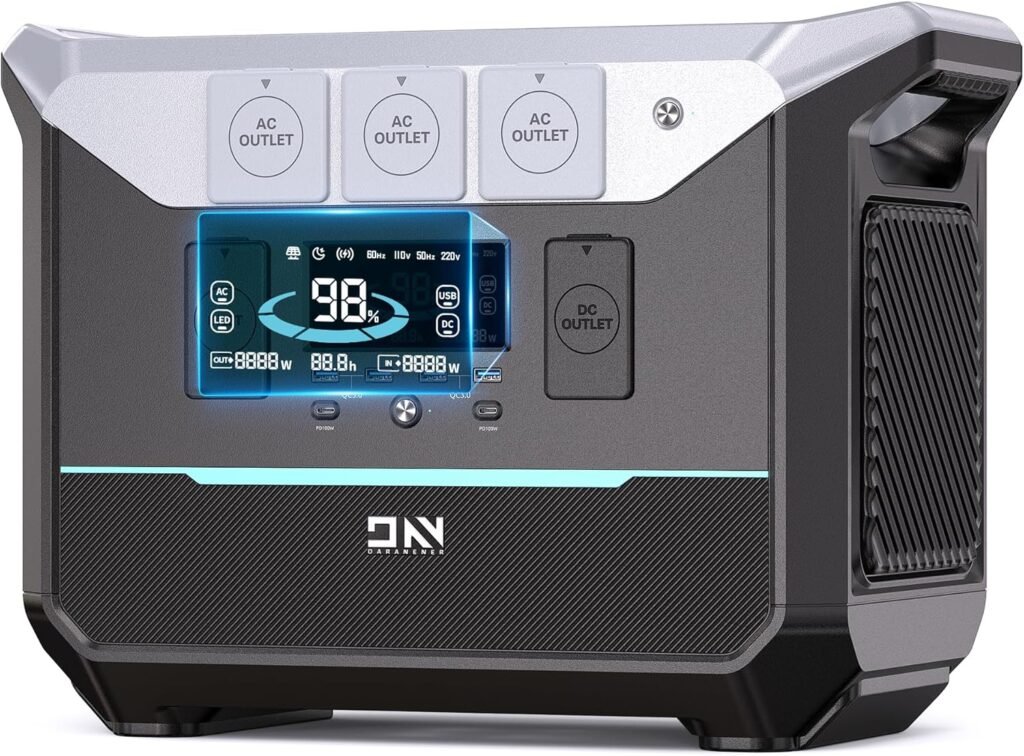
We appreciate when controls, ports, and screens are laid out logically. On this unit, we have:
- A clear display to show remaining capacity, current input and output, and other essential stats
- Grouped port sections (AC, DC, USB) to keep things organized
- Easy-to-understand buttons and status indicators
The interface feels straightforward enough that we don’t need a tech background to understand what’s going on.
Battery Technology: Why LiFePO4 Matters
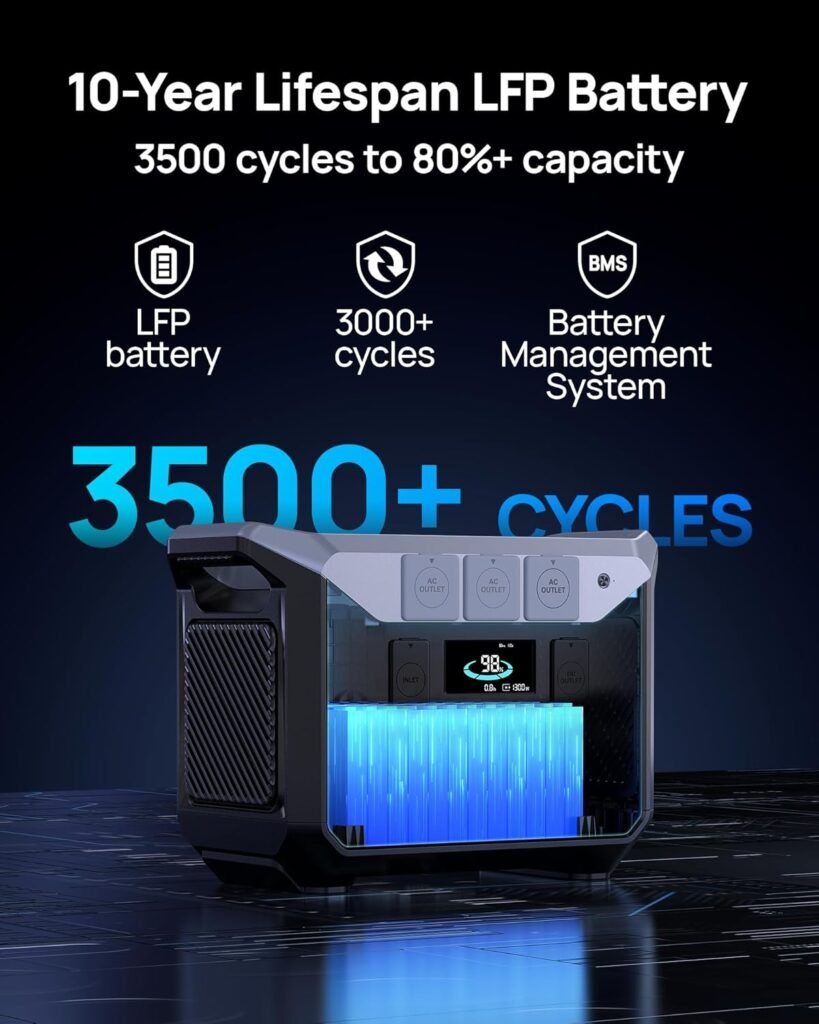
Battery chemistry is a big deal when we’re thinking long-term. The DaranEner uses LiFePO4 (Lithium Iron Phosphate) cells, which deliver several advantages over common lithium-ion or lithium-polymer batteries.
Longer Lifespan and More Value
We get 3500+ cycles listed for this unit. A “cycle” means charging from 0% to 100% and back down. If we used a full cycle every single day, that would be over nine years of use before we even see notable degradation. In more typical use—occasional emergency backup, weekend camping, periodic RV trips—we’re looking at a power station that can realistically last around a decade.
That turns this into an investment rather than a disposable gadget.
Safer and More Stable Chemistry
LiFePO4 is known for:
- Better thermal stability
- Lower risk of overheating
- Reduced risk of thermal runaway (which can lead to fires in lesser designs)
This makes us more comfortable using the unit indoors, near our families, and around sensitive surroundings like RVs and tents.

Capacity and Runtime: What 1382.4Wh Actually Powers
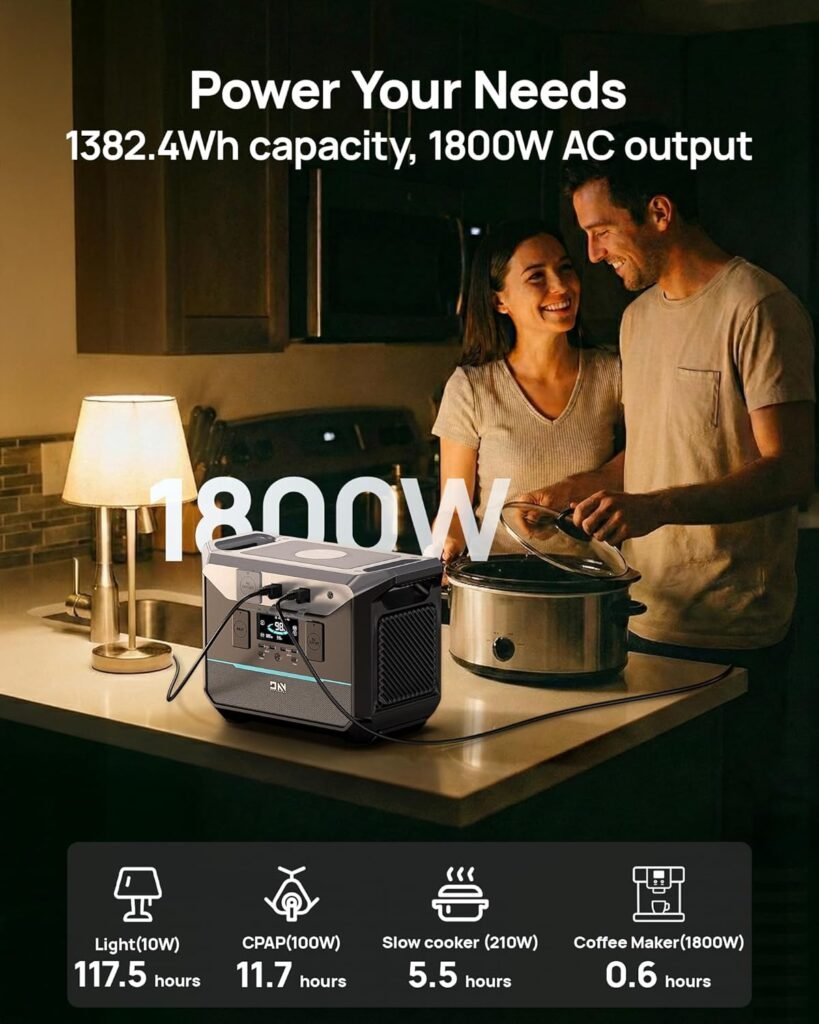
The number 1382.4Wh sounds impressive, but we care about what it powers and for how long in real life.
Realistic Usage Examples
Here’s how we can think about the capacity in common scenarios (all runtimes are approximate and assume efficient usage):
-
Smartphone (10–15Wh per full charge)
We can charge phones 80–120 times depending on model and efficiency. -
Laptop (50–70Wh per charge)
We can get around 15–20 laptop charges. -
Wi-Fi router (10–15W)
Keeps us online for 60–100 hours. -
CPAP machine (40–60W, no heated humidifier)
Can run for roughly 20–30 hours, enough for several nights of sleep. -
Mini-fridge (60–100W average)
Operates for 12–20 hours, sometimes more if the compressor cycles efficiently. -
Full-size fridge (120–150W average with cycling)
Potentially 8–12 hours or more, depending on how often it kicks on. -
LED lights (5–10W each)
Can run several lights for multiple nights.
These are ballpark numbers, but they show us that this is not just a small backup battery; it’s a meaningful storage system for real appliances and needs.
Output Power: 1800W Continuous, 3000W Surge
Output power determines what we can actually run at the same time. The DaranEner’s 1800W continuous output with 3000W surge means it can handle both everyday loads and short startup spikes from demanding devices.
Running High-Power Appliances
With an 1800W ceiling, we can use:
- Coffee makers (800–1500W)
- Microwaves (typically 900–1500W)
- Electric kettles (often around 1200–1500W)
- Toasters and small ovens
- Power tools (drills, saws, etc.) as long as we stay under the continuous rating
The 3000W surge rating matters for devices that temporarily need more power when they start up—like fridges, freezers, and some power tools. This helps prevent the system from shutting down when a motor kicks on.
Real-World Multi-Device Use
In a realistic home power outage situation, we might be running:
- A fridge (average 120W with cycles)
- A Wi-Fi router (10W)
- A couple of LED lights (20W total)
- Charging phones and a laptop (maybe 50–70W total)
That’s well under 300W in many cases, letting us stretch the runtime significantly. We just need to be mindful if we turn on big items like a microwave or kettle, as they use a chunk of the 1800W capacity while they run.
Fast Charging: 0–100% in About 1.3 Hours
One of the standout features is the 6.5x super-fast charging. Being able to charge from 0% to 80% in about 1 hour and fully charged in around 1.3 hours via AC input sets this apart from many competing units that can take several hours or even most of a day.
Why Fast Charging Matters
Fast charging changes the way we use a power station:
- Before a storm: We can fully recharge in just over an hour when we see bad weather coming.
- On the road: Stop at a café or friend’s house and top up quickly.
- During daily life: Easier to integrate into routines without planning hours ahead.
This is enabled by advanced bidirectional inverter technology, which lets the unit handle higher charge rates safely without excessive stress on the battery.
Balancing Speed and Care
The key question with fast charging is always long-term battery health. Here, the combination of LiFePO4 chemistry and a design rated for 3500+ cycles reassures us that this fast charging is not coming at the expense of immediate severe degradation.
UPS Function: 15–20ms Seamless Backup
For those of us who rely on continuous power for home offices, media setups, or medical devices, the UPS (Uninterruptible Power Supply) function is one of the greatest strengths.
How the UPS Mode Works
We plug the DaranEner into the wall and our devices into the DaranEner. When the grid power is present, everything runs normally while the battery stays topped up. When the power cuts out:
- The unit automatically switches to battery mode
- The switchover happens within about 15–20 milliseconds
This switch time is usually quick enough that devices like:
- Desktop computers
- Home servers
- Wi-Fi routers
- Monitors
- CPAP machines
continue to run without rebooting or dropping connection.
Everyday Reliability and Peace of Mind
This means we can:
- Keep a home office online through outages
- Avoid corrupting files or damaging systems through sudden power loss
- Sleep more confidently if we need a CPAP or similar medical device
- Provide stability for a smart home system that depends on continuous power
We essentially get a UPS and a portable power station in one device, which is rare at this capacity and price point.
Ports and Connectivity: Powering All Our Gear
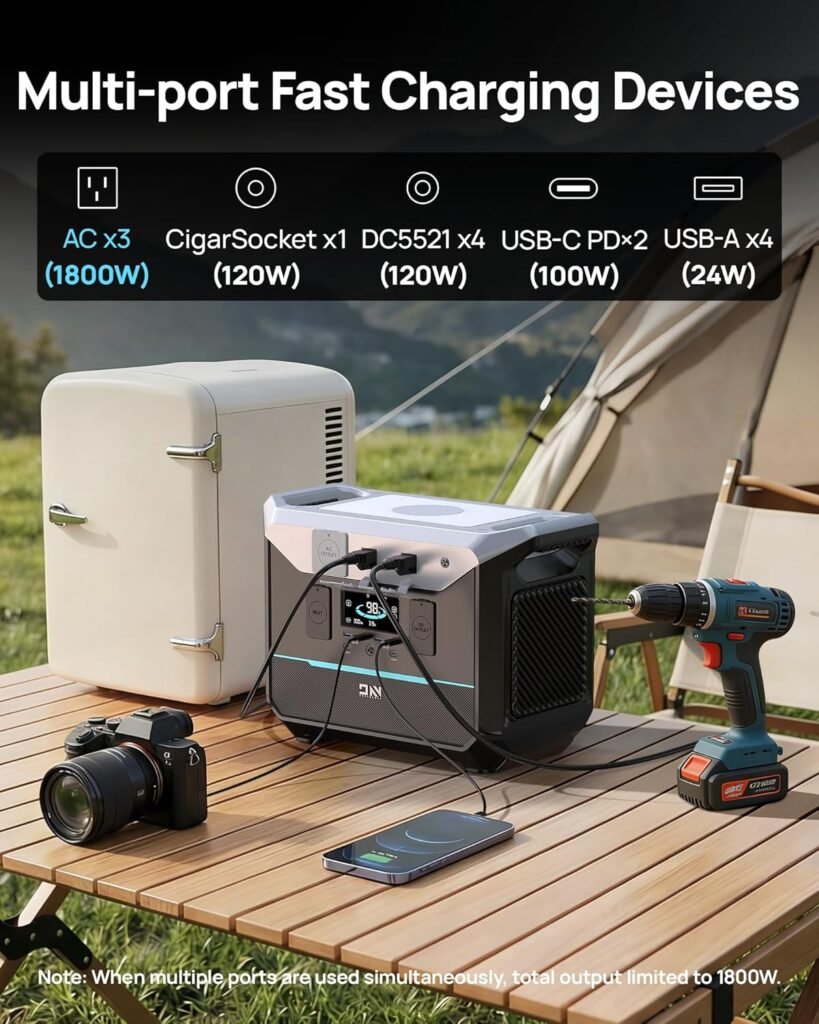
A versatile power station needs enough ports to support everything from phones to tools. The DaranEner unit includes a mix of AC, USB-C, USB-A, and DC outputs.
AC, USB, and DC Outputs
We can expect something along the lines of:
- Multiple AC outlets (standard household-style) for appliances, laptop chargers, etc.
- USB-C ports for fast-charging modern phones, tablets, and laptops that support USB-C power delivery
- USB-A ports for legacy devices like older phones, cameras, and small gadgets
- DC outputs (like car-style sockets) for 12V devices such as mini-fridges and some lights
This mix lets us power a wide range of equipment at the same time without a jungle of adapters.
Everyday Use Cases
In a typical situation, we might have plugged in:
- A laptop via USB-C
- Phones on USB-A/USB-C
- A router on AC
- A fan or small appliance on AC
- A camping fridge on the DC port
Because the total continuous power limit is 1800W, we only need to worry about load if we start stacking large appliances.
Noise, Emissions, and Indoor Safety
For those of us used to gasoline generators, an electric, battery-based power station feels like a different world.
Virtually Silent Operation
Unlike gas generators that roar in the background, this unit runs quietly. We may hear a fan kick in under heavy load or during charging, but it’s not disruptive in a bedroom, RV, or living room setting.
That quiet operation lets us:
- Run it overnight without disturbing sleep
- Use it in small apartments
- Keep it next to a workstation or gaming setup without irritation
Zero Emissions, Indoor-Friendly
Because it uses a LiFePO4 battery, there are:
- No fumes
- No exhaust
- No fuel to store
We can safely use it indoors, including closed spaces like:
- Bedrooms
- RV interiors
- Offices
- Tents (as long as there’s reasonable airflow and we follow standard electronic safety practices)
That’s a huge advantage over traditional gas generators, which must be kept far from enclosed spaces due to carbon monoxide risks.
Solar Compatibility: Turning It into a Mini Power System
The DaranEner unit is solar-ready, meaning we can pair it with compatible solar panels (sold separately) to create a renewable, off-grid capable system.
Benefits of Solar Charging
With solar panels connected, we can:
- Keep batteries topped up during extended outages
- Run off-grid setups for RVs, vans, or cabins
- Reduce dependence on wall power during camping or road trips
The solar input effectively turns the power station into a small-scale solar generator, letting us harvest free energy from the sun whenever conditions allow.
Practical Solar Use Cases
Some realistic setups might include:
- A pair of 100W or 200W solar panels set up at a campsite
- A roof-mounted array on an RV or van feeding into the unit
- A balcony or backyard solar array that plugs into the DaranEner during the day
We should remember that solar charging speed depends heavily on panel wattage, sun angle, cloud cover, and other environmental conditions. But the ability to continuously gather energy can significantly extend our runtime in off-grid situations.
Use Cases: Where This Power Station Truly Shines
We see this unit as a very flexible solution that works across several lifestyles and needs.
Home Backup and Emergencies
For home use, we can see this unit as a compact, quiet emergency backup system. It’s particularly good for:
- Powering fridges and freezers in short to moderate outages
- Keeping phones, laptops, and internet running
- Running medical devices like CPAP machines
- Providing light, fans, and communication tools during storms or grid failures
When paired with solar, it can support longer-term needs at a basic, essential level.
Camping and Outdoor Adventures
For camping and outdoor activities, this unit lets us:
- Power electric coolers or mini-fridges
- Brew coffee, boil water, or cook with electric appliances
- Charge cameras, drones, GPS devices, and phones
- Run lights and fans in tents or RVs
Because it’s whisper-quiet and fume-free, we can use it at night without disturbing others or breaking campground rules against noisy generators.
RV, Van Life, and Tailgating
In RVs and vans, this power station works as either a primary or backup energy source:
- Runs small air conditioners or heaters (within the 1800W limit)
- Charges devices for extended travel days
- Powers entertainment systems for tailgating or road trips
- Supplements or replaces noisy gas generators
The fast-charging ability also makes it great for brief plug-ins at RV parks or friends’ homes.
Professional and Job Site Use
For professional users, we can bring clean power to:
- Construction or renovation sites
- Outdoor events
- Filming locations
- Remote work setups
It can run tools (within the wattage limit), charge batteries, and keep laptops and devices going without fumes or extended noise, which can be especially important in residential neighborhoods.
Ease of Use and Everyday Experience
Complex gear can be intimidating, but this power station aims to be simple enough that we only need a few minutes to feel comfortable.
Setup and Operation
Typical usage looks like this:
- Plug the unit into an AC outlet to charge (or connect solar, if we’re off-grid).
- Confirm the state of charge on the screen.
- Plug in our devices to the appropriate ports.
- Turn on the specific output sections (like AC or DC) via buttons if needed.
- Monitor usage and remaining time as shown on the display.
The display readouts help us understand how much power we’re drawing and how long the battery is expected to last at current usage.
Learning Curve and Maintenance
We don’t have to be experts to use it, but we do need to:
- Be aware of total wattage used, especially with high-power appliances
- Charge the unit periodically if we store it for emergencies
- Keep it in a temperature-safe environment (not baking in direct sun or left in freezing conditions for prolonged periods)
The LiFePO4 chemistry is fairly forgiving compared to some other battery types, but general care still extends its life.
Advantages Compared to Traditional Generators
If we’ve ever struggled with gas generators, this unit can feel like a relief.
No Fuel, No Fumes, No Pull-Starting
With a traditional gas generator, we’re used to:
- Buying and storing gasoline
- Oil changes and regular maintenance
- Pull cords that sometimes take several attempts
- Carbon monoxide concerns and strict outdoor-only usage
With this power station:
- We plug it in to charge or connect solar
- We don’t store fuel
- We don’t deal with exhaust or CO risk
- We can place it indoors and use it anywhere we need power
That’s a significant improvement in both safety and convenience for many households.
Quieter and More Community-Friendly
Neighborhoods, campgrounds, and even some job sites are increasingly strict about noise. A nearly silent battery-based station lets us:
- Stay within regulations
- Maintain good relationships with neighbors or fellow campers
- Use power at night without disturbance
For many of us, that alone is reason enough to favor a battery-based system.
Potential Limitations and Things to Keep in Mind
No product is perfect for everyone, and it’s helpful to be realistic about what this power station does and doesn’t do.
Weight and Portability
This is a high-capacity unit. That generally means it’s going to be relatively heavy compared to small battery packs. It’s portable in the sense that we can pick it up and move it, but we’re not going to treat it like a pocket device.
So, for:
- Ultralight backpacking or hiking trips, this is probably too large
- Car camping, RVs, and home use, it’s perfectly reasonable
We just need to be prepared for the weight if we’re carrying it over any distance.
Not a Whole-Home Replacement
An 1800W, 1382.4Wh system is substantial, but it’s not a full-house replacement generator. We shouldn’t expect it to:
- Run central air conditioning
- Power electric ovens and multiple large appliances at once
- Cover every outlet in a large home for days on end
It’s best thought of as:
- A powerful essentials backup
- A versatile portable generator alternative
- A practical off-grid or partial backup solution
Solar Panels Sold Separately
If we want full off-grid capability, we’ll need to buy compatible solar panels. That adds to the total investment cost. However, even without solar, the fast AC charging still gives this unit a lot of standalone value.
Safety Features and Protections
When we’re dealing with high-capacity batteries and multiple electronics, built-in protection is crucial.
Typical Protection Systems
Units of this class usually include:
- Overcharge protection
- Over-discharge protection
- Short-circuit protection
- Overcurrent protection
- Overtemperature and low-temperature protection
Combined with LiFePO4 chemistry, these safeguards help ensure the system operates safely across a wide range of conditions.
Practical Safety Tips
We still want to:
- Keep the unit dry and away from direct moisture
- Avoid placing it right next to heat sources
- Use appropriate cables and avoid damaged cords
- Not exceed the rated power draw
Used responsibly, it’s designed to be a safe and long-lasting part of our power setup.
Who This Power Station Is Best For
We find this unit especially appealing for certain types of users.
Ideal Users
- Homeowners and renters who want a quiet, fume-free backup for outages
- RV and van lifers who need reliable off-grid power for appliances, devices, and climate control (within limits)
- Campers and outdoor enthusiasts who enjoy comfort (fridge, coffee, lights) without gas noise
- Remote workers who need continuous power for computers, routers, and monitors
- People relying on medical devices (like CPAP) who need a UPS-ready solution
- Small business owners and professionals needing portable, clean power at job sites or events
Its combination of capacity, output, UPS function, and fast charging fits these use cases extremely well.
Maybe Not the Best Fit For
- Backpackers and ultra-minimalist travelers who need very lightweight gear
- Households requiring full-home backup with big HVAC loads (this is more of an essentials backup, not a whole-house generator)
If we fall into those categories, we might prefer either smaller, more portable units or full-scale home battery systems with larger inverters and capacities.
Overall Value and Long-Term Outlook
When we look at the full feature set, the DaranEner Portable Power Station 1382.4Wh stands out due to its balance of capacity, power, durability, and convenience.
Long-Term Investment Perspective
We’re getting:
- LiFePO4 longevity: 3500+ cycles, up to around 10 years of use
- Serious capacity: 1382.4Wh for meaningful runtimes
- High output: 1800W continuous and 3000W surge
- Fast charging: 0–100% in about 1.3 hours via AC
- UPS functionality: ~15–20ms switchover time
- Solar readiness: Ability to use solar panels for ongoing power
Over time, this can pay off in:
- Reduced dependence on gas and traditional generators
- Fewer disruptions during blackouts
- More comfortable camping and road trips
- Better protection for our electronics and medical devices
Peace of Mind and Everyday Utility
What we value most about this kind of product is not just the specs, but the peace of mind. Knowing we can keep critical devices running, stay connected, and maintain a basic level of comfort during grid failures or remote trips has real emotional and practical value.
We’re not just buying watts and watt-hours; we’re buying preparedness, convenience, and flexibility.
Final Thoughts: A Versatile, Future-Ready Power Solution
Putting everything together, the DaranEner Portable Power Station 1382.4Wh LiFePO4 Battery, 1800W (3000W Surge) Solar Generator with 1.3Hr Fast Charge, 15ms UPS Portable Generator for Home, Camping, RV, Emergency brings a compelling combination of:
- High-capacity LiFePO4 battery for longevity and safety
- Strong 1800W continuous output with 3000W surge for real appliances
- Very fast AC charging to keep downtime short
- UPS functionality that protects sensitive devices from outages
- Silent, zero-emission operation suitable for indoor use
- Solar readiness for off-grid and extended emergency scenarios
For us, it stands out as a smart choice if we want one unit that can handle home backup needs, support our outdoor adventures, and give us dependable power wherever we go. It may be more than we need for simple phone charging on a weekend campout, but for serious preparedness and versatile day-to-day use, it offers a robust and future-proof solution.
Disclosure: As an Amazon Associate, I earn from qualifying purchases.