
Have we ever wished we could bring reliable wall-outlet power with us wherever we go—on the road, outdoors, or through a blackout at home?


What Is the Jackery Explorer 1000 v2 Portable Power Station?
The Jackery Explorer 1000 v2 Portable Power Station, 1070Wh LiFePO4 Battery, 1500W AC/100W USB-C Output is a compact yet powerful battery generator for camping, emergency backup, RV use, and off‑grid living. We can think of it as a portable, silent power hub that replaces (or supplements) a gas generator in many situations.
This model is part of Jackery’s LiFePO4 lineup, which gives us longer battery life, faster charging, and more reliable performance over time. It is designed for anyone who needs serious power in a package that is still easy to carry and use.
Key Specifications at a Glance
Sometimes it helps to see the essentials laid out clearly. We put together this table so we can quickly understand what the Explorer 1000 v2 actually offers.
| Feature | Specification |
|---|---|
| Battery Capacity | 1,070Wh (watt-hours) |
| Battery Type | LiFePO4 (LFP) |
| AC Output | 1,500W continuous, 3,000W surge, pure sine wave |
| USB-C Ports | 2 × USB-C (up to 100W PD fast charging) |
| USB-A Ports | 1 × USB-A |
| DC Car Port | 1 × 12V DC car outlet |
| AC Outlets | 3 × AC ports (pure sine wave) |
| Weight | 23.8 lbs (approx. 10.8 kg) |
| Charging Time (Fast) | About 1 hour from 0–100% with emergency charging mode (via Jackery App) |
| Standard Charging Time | About 1.7 hours (default, for battery health protection) |
| Lifespan | 4,000 cycles to 70% capacity (over 10 years of typical use) |
| App Control | Yes – multiple charging modes via Jackery App |
| Noise Level (Quiet Mode) | Around 30 dB overnight charging mode |
| Solar Compatibility | Compatible only with Jackery solar panels (sold separately) |
| Carry Handle | Foldable handle design for easier transport |
| Included in Box | Explorer 1000 v2, AC charging cable, user manual |
This overview gives us a snapshot of what we get with the unit: plenty of capacity, strong output, and notably fast charging.

Design, Build, and Portability
The look and feel of a power station matter more than we might think, especially when we’re carrying it around, loading it into a car, or using it in a small RV. The Explorer 1000 v2 aims for a balance between ruggedness and portability.
Compact but Substantial Form Factor
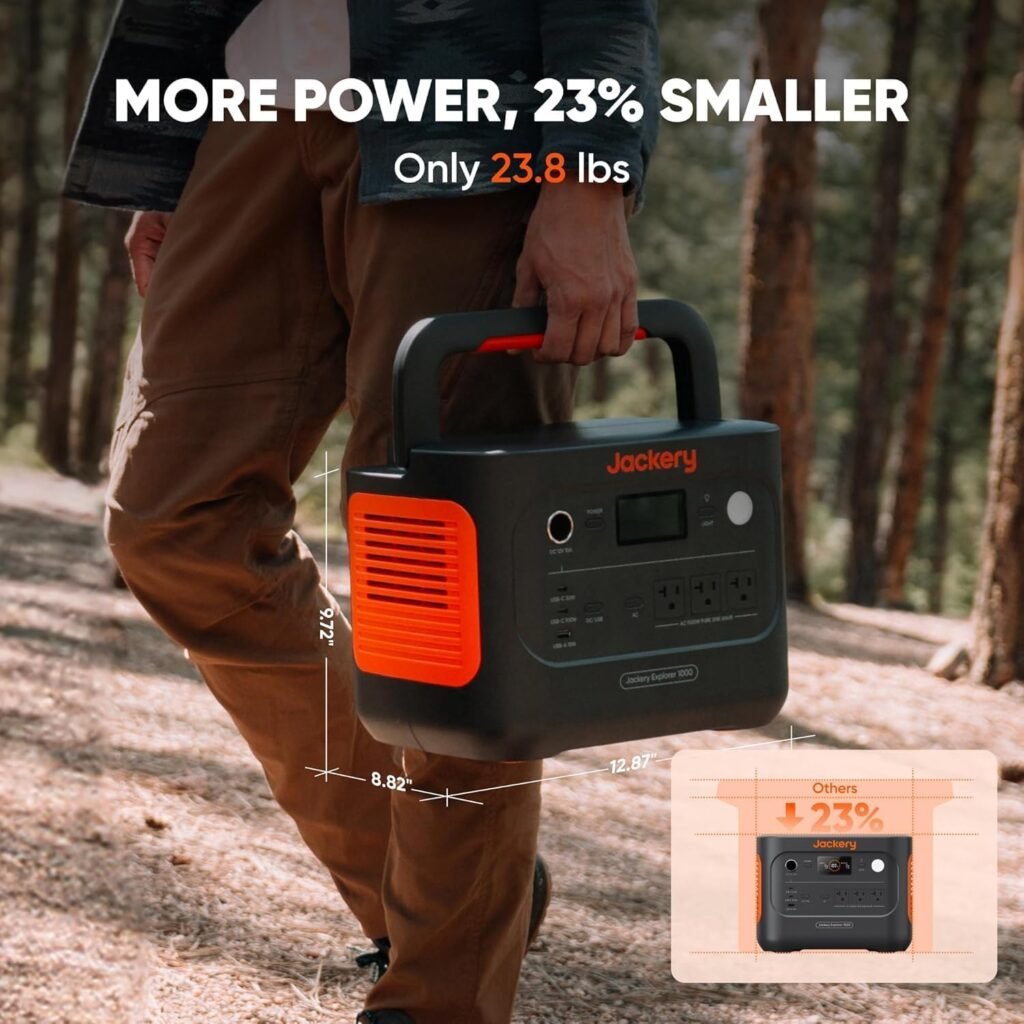
At 23.8 lbs, the Explorer 1000 v2 is not feather-light, but it is very reasonable for a 1,070Wh LiFePO4 unit with 1,500W AC output. We can comfortably carry it with one hand using the foldable handle, which tucks away to make the top surface flatter and easier to stow.
The overall footprint fits neatly in a car trunk, RV cabinet, or under a desk at home. It feels intentional—big enough to store serious energy, yet compact enough that we will actually bring it with us rather than leaving it behind.
Build Quality and Durability
The casing feels sturdy and well-mounted, with clean seams and a robust exterior housing. Jackery has a reputation for solid build quality, and the Explorer 1000 v2 continues that lineage.
While it is not advertised as waterproof or extremely ruggedized, it feels secure in everyday conditions: car camping, road trips, indoor emergency use, and typical outdoor setups under a canopy or tent. We just need to keep it away from heavy rain and standing water, as we would with any powered device.
Battery Technology and Lifespan
The heart of this power station is the LiFePO4 battery, which is a major upgrade in longevity and safety compared with older lithium-ion chemistries.
Why LiFePO4 Matters
LiFePO4, also known as LFP, is favored for:
- Long cycle life: The Explorer 1000 v2 is rated for 4,000 charge cycles before dropping to around 70% of original capacity. For most of us, even with frequent use, that easily translates to over 10 years of service.
- Improved thermal stability: LFP batteries are generally more stable at high temperatures and less prone to thermal runaway issues.
- Consistent performance: They tend to hold voltage more steadily as they discharge, which helps keep devices running more reliably.
For emergency backup or off-grid use, that long lifespan means our investment makes sense over the long term. We won’t feel like the unit becomes obsolete or weak after just a couple of years.
Capacity and Real-World Runtime
With 1,070Wh, we’re dealing with a significant amount of stored energy. In simple terms, this helps power:
- A 50W laptop for 15–18 hours (accounting for some conversion loss).
- A 10W phone charger for dozens of full charges.
- A 500W mini electric cooker for around 1.5–2 hours.
- A small portable fridge (60–70W average) for well over a day in many scenarios.
Of course, actual runtimes depend on efficiency, power draw variations, and environmental conditions, but we have more than enough capacity for weekend trips and short-term outages.
Output Power: What We Can Actually Run
Power output determines what kinds of devices we can use. Here, the Explorer 1000 v2 is quite impressive for its size.
1,500W AC Output and 3,000W Surge
The unit offers:
- 1,500W continuous AC power
- 3,000W surge capacity
In practical terms, this means we can run:
- A typical mini-fridge or small fridge
- A CPAP machine
- Laptops, tablets, and phones simultaneously
- Many small kitchen appliances like blenders, coffee makers (depending on wattage), and electric pots within the 1,500W limit
- Some portable AC units or fans
The 3,000W surge rating helps cover startup loads from devices like compressors in fridges or some AC units, which briefly pull extra power when they turn on.
Pure Sine Wave AC for Sensitive Devices
The three AC outlets are pure sine wave outputs. That matters when powering electronics that do not react well to the choppy output from modified sine wave inverters.
With pure sine wave, we can safely run:
- Laptops and PCs
- Monitors
- Audio equipment
- Sensitive medical equipment (within rated power)
This level of power quality makes the Explorer 1000 v2 feel like a clean, portable wall outlet.
Ports and Connectivity
We do not want to be forced to choose between charging our phone or running a lamp. Port variety is crucial, and this unit includes a thoughtful mix.
AC, DC, USB-C, and USB-A Options
The Explorer 1000 v2 gives us:
- 3 × AC outlets (pure sine wave)
- 2 × USB-C ports (up to 100W PD fast charging)
- 1 × USB-A port
- 1 × 12V DC car port
- Built-in LED lights
This spread allows us to plug in a mix of:
- Laptops via USB-C or AC
- Phones and tablets via USB-A or USB-C
- DC appliances like portable coolers via the car port
- Household devices via the three AC outlets
We can run several things at once—like a laptop, phone, light, and mini-fridge—without overcomplicating our setup.
PD 100W Fast USB-C Charging
The 100W USB-C PD capability is especially helpful, because many modern laptops, tablets, and phones support USB-C Power Delivery.
This means:
- We can charge USB-C laptops directly, with no bulky power brick.
- High-power tablets and phones charge much faster.
- We preserve the AC outlets for devices that truly need them.
For anyone who works remote from a camper, van, or off-grid cabin, these high-powered USB-C ports are exactly what we want.
Charging the Explorer 1000 v2
Recharging speed is where this power station stands out. Long charging times are a common complaint about portable generators, but Jackery addresses that head-on.
1-Hour Fast Charging with Emergency Mode
The headline feature is the 1-hour fast charge, which takes the Explorer 1000 v2 from 0% to 100% when emergency charging is activated via the Jackery App.
Key points:
- We must enable emergency charging in the app each time we want the 1-hour charge.
- This mode is ideal when we need power quickly—such as ahead of a storm or when we only have limited access to AC power.
The underlying support comes from ChargeShield 2.0, an advanced charging technology engineered for safer, faster, and smarter charging.
Default 1.7-Hour Charging for Battery Health
By default, the system charges from 0–100% in about 1.7 hours. This mode is designed to optimize battery health and longevity.
We can think of it as the “everyday” charging option. It’s already fast compared to many competitors, and we do not need to manually adjust anything for this mode—it is the default.
Solar and Other Input Options
While the details for every charge input are not fully listed in the description, we do have one crucial note:
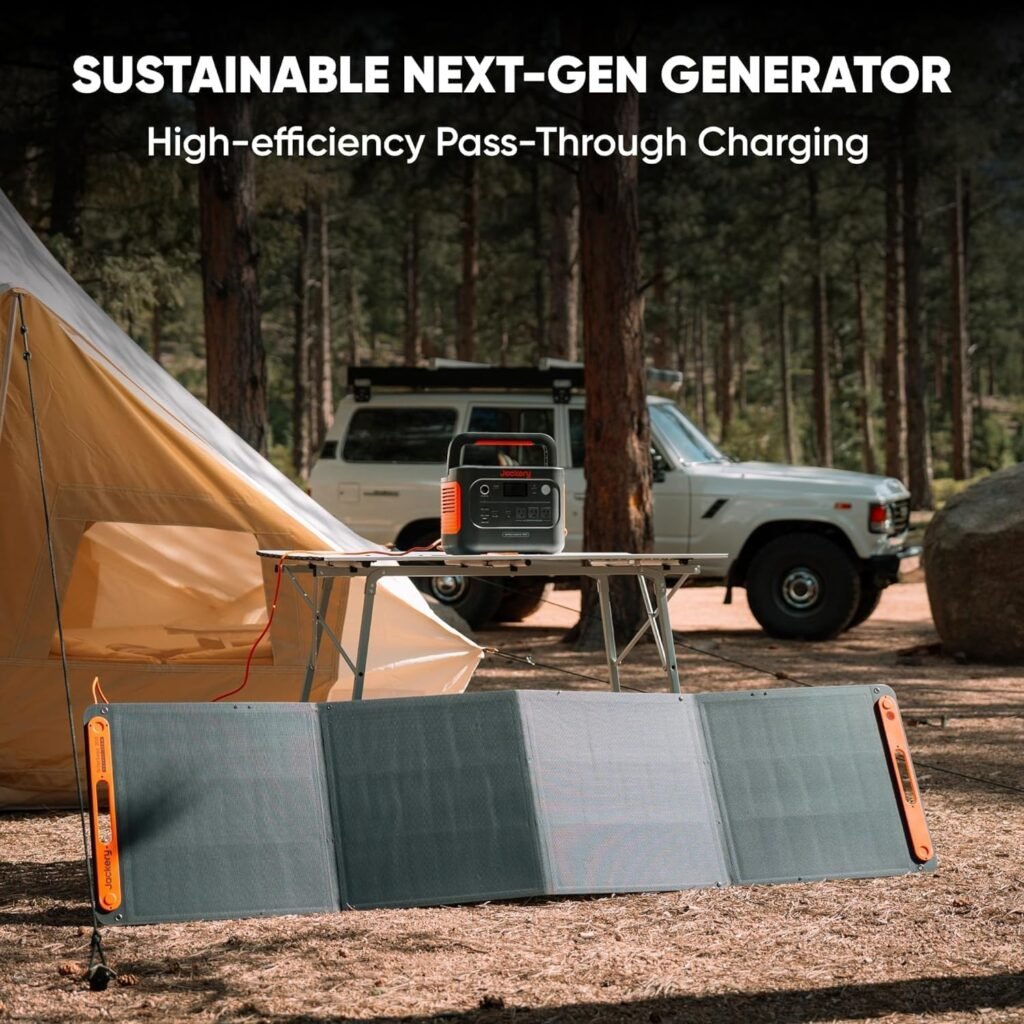
- The Explorer 1000 v2 is compatible only with Jackery solar panels for solar charging.
- Solar panels are optional and not included with the base product.
So, if we already own Jackery panels or plan to buy them, the Explorer 1000 v2 becomes a true solar generator, allowing off-grid recharging. This makes it excellent for long stays in remote areas or sustainable off-grid setups.
Smart App Control and Charging Modes
The integrated app support turns the Explorer 1000 v2 into more than a simple plug-and-play battery; it becomes a smart energy device that we can tune to our needs.
What the Jackery App Allows Us to Do
With the Jackery app, we can:
- Switch between charging modes, including:
- 1-hour emergency charging
- Standard 1.7-hour charging
- 30 dB quiet overnight charging mode
- Energy efficiency mode
- Monitor battery percentage, input, and output power
- Adjust settings remotely, as long as we are within range and connected
Instead of manually guessing or fiddling with buttons on the station, we simply use our phone to change how the unit behaves, depending on the time of day and urgency.
Quiet Overnight Charging (Around 30 dB)
The 30 dB quiet overnight charging mode keeps the unit operating at a very low sound level. While power stations are generally quieter than gas generators, some charging fans can still make noise.
With this mode:
- We can sleep in the same room or tent without being disturbed by fans ramping up.
- We maintain a more peaceful environment while still recharging the unit.
This is particularly nice for RV owners, van lifers, and anyone using the Explorer 1000 v2 in a bedroom during power outages.
Real-World Use Cases
Specifications are one thing, but we often want to know how a product actually fits into our lives. The Explorer 1000 v2 is designed for a wide range of scenarios.
Camping and Outdoor Adventures
For camping, we can use the power station to:
- Run lights, fans, and small heaters (within power limits).
- Charge phones, cameras, drones, tablets, and Bluetooth speakers.
- Power portable fridges or coolers, keeping food fresh without melting ice.
- Support laptops for remote work in nature.
If we pair it with Jackery solar panels, we effectively create a small off-grid power ecosystem. We can spend multiple days or weeks off-grid and still have electricity for essentials.
RVs, Vans, and Road Trips
In RVs and vans, the Explorer 1000 v2 works as:
- A central power hub for laptops, lights, and kitchen gadgets.
- A supplement to onboard batteries, giving us separate backup capacity.
- A quick-charge solution at campgrounds where we might only have limited hookup time.
The moderate weight and compact profile make it easy to transfer between a vehicle and a cabin, or from one side of the RV to another.
Emergency Backup at Home
For home emergencies, we can rely on the power station to:
- Run lights, routers, modems, and small electronics during blackouts.
- Keep a CPAP machine running if we lose grid power.
- Charge phones and laptops, helping us stay connected and informed.
- Power a small fridge to protect sensitive food and medicine—within the device’s power and capacity limits.
The 1-hour fast charge mode is especially powerful in this context; if we see a storm warning or know there are planned outages, we can quickly top up the power station and be prepared.
Off-Grid Living and Cabins
For tiny homes and cabins, the Explorer 1000 v2 serves as:
- A modular component of a larger off-grid system, especially with Jackery solar panels.
- A portable power supply we can reposition to different outbuildings or work areas.
- A backup for more permanent solar and battery setups.
Its long lifespan and LiFePO4 chemistry support long-term off-grid reliability rather than being just a short-term gadget.
Ease of Use and Everyday Experience
Even powerful devices can be frustrating if they are complicated to operate. Jackery usually emphasizes user-friendliness, and the 1000 v2 follows that approach.
Simple Controls and Clear Interface
The front panel typically includes:
- Power buttons for AC and DC outputs.
- An easy-to-read screen showing:
- Remaining battery percentage
- Input wattage
- Output wattage
- Possibly estimated runtime in some use situations
We can quickly glance at the display to understand what is happening: how quickly we are draining the battery and how fast it charges.
LED Lights for Convenience
The built-in LED lights are a thoughtful touch. They provide:
- Illumination when we are setting up camp in the dark.
- A small emergency light during power cuts, without needing a separate lamp.
- Guidance when plugging in cables in low-light situations.
These lights won’t replace powerful lanterns for large spaces, but they are more than enough to help us operate the unit comfortably at night.
Safety Features and Reliability
We want our power station to be safe not only for our devices but also for us and our surroundings. While the product details highlight ChargeShield 2.0 and LiFePO4 safety, we can infer typical protections from a device of this caliber.
ChargeShield 2.0 and Battery Protection
With ChargeShield 2.0, the Explorer 1000 v2 is tuned for:
- Safe, controlled high-speed charging
- Monitoring of temperature and current
- Protection against overcharge and over-discharge
That means the system manages fast charging intelligently, instead of simply pushing maximum current at all times, which can degrade battery health or risk overheating.
Built-In Electrical Safeguards
Even though not every single protection is spelled out in the description, we can reasonably expect:
- Over-current protection
- Over-voltage protection
- Short-circuit protection
- Temperature monitoring
Combined with LiFePO4’s stability, this makes the unit a solid choice for use around children, pets, and sensitive electronics when used as instructed.
What Comes in the Box (and What Does Not)
Knowing exactly what we receive avoids surprises after purchase.
Included Items
When we order the Jackery Explorer 1000 v2, we get:
- 1 × Explorer 1000 v2 Portable Power Station
- 1 × AC charging cable
- 1 × User manual
This is everything needed to start using AC charging immediately. We can plug it into a standard wall outlet and begin charging the unit.
Not Included: Solar Panels and Extras
A few important notes:
- Solar panels are not included. If we want solar charging, we need to purchase Jackery solar panels separately.
- The unit is compatible only with Jackery solar panels for solar input.
- We must provide a physical delivery address for orders; PO Box addresses are not acceptable for this product shipment.
If we plan to rely heavily on solar, we might want to bundle a panel purchase or plan it for a future upgrade.
Strengths of the Jackery Explorer 1000 v2
It often helps to step back and summarize where a product really shines. The Explorer 1000 v2 has several standout strengths.
1. Powerful Output in a Portable Package
- 1,500W continuous / 3,000W surge gives us enough power to run multiple appliances and some high-demand devices.
- The mix of AC, USB-C, USB-A, and DC outputs offers great flexibility.
- The 23.8 lb weight and foldable handle keep it manageable for frequent use.
This combination makes the unit feel like a sweet spot between small “power banks” and large, heavy stationary power systems.
2. Fast Charging with Smart Control
- 1-hour full charge with emergency mode via the app is remarkable.
- The default 1.7-hour charge is still very fast and optimized for battery health.
- App-based modes allow us to tailor noise level, speed, and efficiency to our situation.
This means we are not stuck waiting many hours for the unit to recharge between uses, which can be a real limitation with many smaller power stations.
3. Long Life LiFePO4 Battery
- 4,000 cycles to 70% is excellent for long-term investment.
- LiFePO4 chemistry offers improved safety and stability.
- Over more than 10 years of use, we still retain substantial capacity.
We can confidently plan around this unit not becoming weak or obsolete quickly.
4. Versatile Use Cases
The Explorer 1000 v2 adapts well to:
- Camping and road trips
- RV and van living
- Home emergency backup
- Off-grid cabins and remote work
We are not buying a gadget for just one strict use case; we are gaining a flexible power solution that supports many lifestyles and situations.
Limitations and Considerations
No product is perfect, and it’s fair to acknowledge a few limitations or trade-offs so we can decide whether this model fits our needs.
Solar Compatibility Limited to Jackery Panels
- The unit is only compatible with Jackery solar panels.
- If we already own third-party panels with different connectors or voltages, they won’t work directly.
This keeps the ecosystem simple and controlled but reduces cross-brand flexibility. If we plan to build a larger DIY solar setup with mixed hardware, we need to factor this limitation into our planning.
Weight vs. Ultra-Portable Options
- At 23.8 lbs, the unit is manageable but not ultra-light.
- For backpacking or long hikes, we would want something smaller.
The Explorer 1000 v2 is ideal for car-based travel, RV life, and home backup, but it is not the device we carry miles on a trail in a backpack.
Energy Limits for High-Draw Appliances
- While 1,500W is substantial, some big appliances (like full-size electric ovens or large AC units) will exceed that.
- We also need to manage total runtime; heavy loads like electric kettles, high-wattage heaters, or large power tools will drain the battery quickly.
As long as we understand these boundaries, the unit performs impressively. It is a portable power station, not a full household grid replacement.
Who Is the Jackery Explorer 1000 v2 Best For?
Different users have different needs, so we find it helpful to imagine who benefits the most from a device like this.
Ideal Users
We think this model is perfect for:
- Campers and overlanders who want quiet, reliable power for weekend or multi-day trips.
- RV and van owners who need an additional, flexible power bank for devices, cooking, and work.
- Homeowners who want a clean, indoor-safe backup power solution for outages, without dealing with gasoline or fumes.
- Off-grid enthusiasts who plan to expand into a solar-based power system over time using Jackery panels.
- Remote workers setting up mobile offices around the home, property, or on the road.
In all these cases, the balance of power, size, and fast charging is very appealing.
Less Ideal Users
We might want to consider other options if:
- We want to build a mix-and-match solar system with panels and batteries from many brands.
- We need to power very large or power-hungry appliances on a regular basis.
- We require an ultra-light backpack solution for extended on-foot expeditions.
In those specific cases, different product categories or models may fit better.
Practical Tips for Getting the Most from the Explorer 1000 v2
We can stretch both the battery life and daily usefulness of this power station by following a few practical habits.
Managing Loads Wisely
- Use energy-efficient devices where possible (LED lights, efficient fridges, low-wattage gadgets).
- Avoid running several high-wattage devices at once; staggering usage helps retain runtime.
- Take advantage of USB-C PD instead of AC bricks when possible, to reduce conversion losses.
Choosing Charging Modes Intelligently
- Use 1-hour emergency charging when time is critical, and we must recharge quickly.
- Stick with the default 1.7-hour mode for general use to support long-term battery health.
- Activate the quiet nighttime mode when charging near sleeping areas.
Balancing speed and longevity like this ensures we get the most from the LiFePO4 cells over many years.
Maintaining the Battery Over Time
- Store the unit in a cool, dry environment when not in use.
- Avoid leaving it at 0% for long periods; recharge after heavy use.
- Periodically check the battery and give it a top-up charge, even during off-seasons.
LiFePO4 is forgiving, but consistent moderate care helps preserve that high cycle life.
Our Overall Thoughts on the Jackery Explorer 1000 v2
When we look at the full picture, the Jackery Explorer 1000 v2 Portable Power Station offers a compelling mix of power, portability, and longevity.
We get:
- 1,070Wh of LiFePO4 capacity with a long lifespan.
- 1,500W AC output and 3,000W surge, enough for many household and outdoor devices.
- Fast charging capability, including a 1-hour full charge option.
- A lightweight 23.8 lb design with a foldable handle for easier carrying.
- A versatile mix of AC, DC, USB-C, and USB-A outputs.
- App-based control over charging modes, noise level, and efficiency.
- A product suited for camping, emergencies, RV life, and off-grid scenarios.
We do need to accept that:
- Solar compatibility is limited to Jackery panels only.
- The unit, while portable, is not a backpacking item.
- Very large or high-draw appliances will exceed its capabilities.
Still, within its intended range, it is a powerful, well-designed tool that can dramatically simplify how we access electricity away from the grid—or when the grid fails us.
For those of us who want a friendly, reliable, and long-lasting power partner for our adventures, home preparedness, or mobile workspace, the Jackery Explorer 1000 v2 makes a strong case as a central piece of our energy setup.
Disclosure: As an Amazon Associate, I earn from qualifying purchases.