
Have we ever wished we could bring reliable, wall-outlet power with us anywhere—without worrying about rain, dust, or dead batteries at the worst possible time?

Overall Impressions of the Jackery Explorer 1500 Ultra Portable Power Station
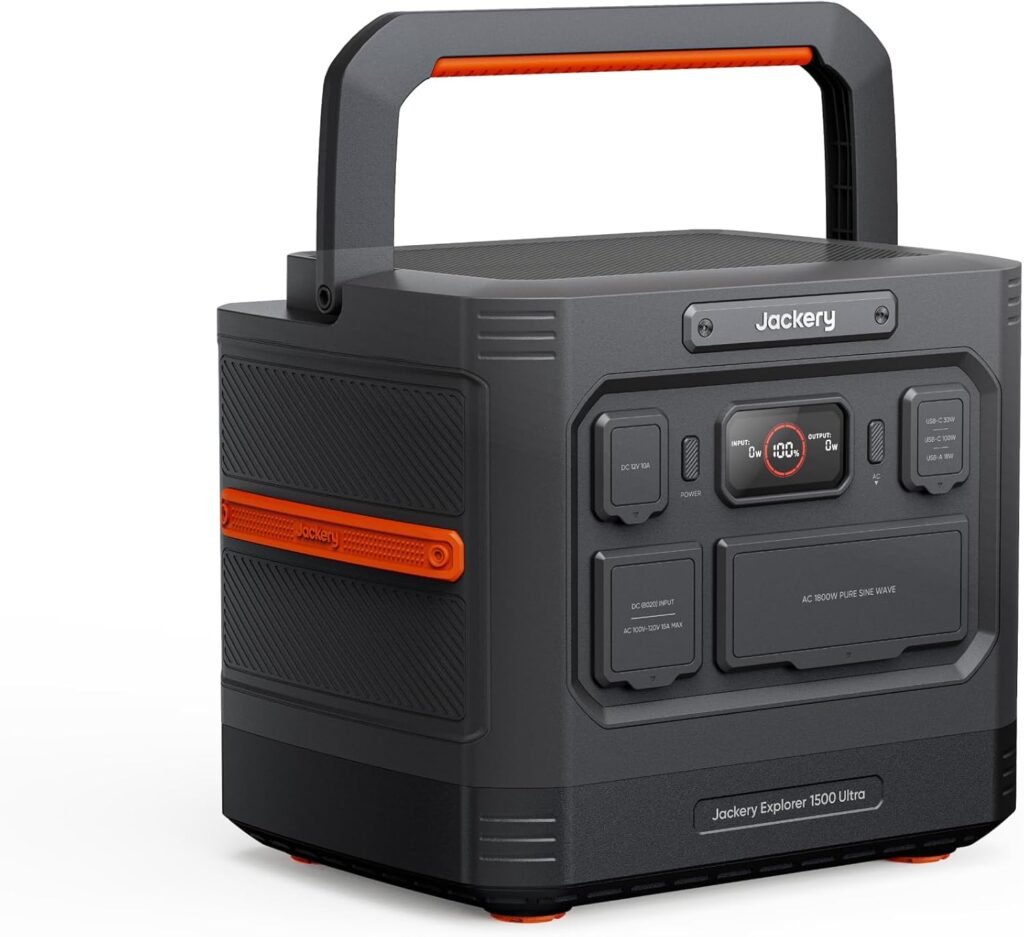
We see the Jackery Explorer 1500 Ultra as a heavy-hitting portable power solution built for people who need more than just a casual backup. This isn’t a small power bank; it’s closer to a compact, highly rugged, mini power grid that we can carry in one hand.
From the first look at its specs—1536Wh LiFePO4 battery, 1800W continuous AC output, 3600W peak, IP65 waterproof rating, ultra-fast 1.5-hour AC charging—it’s clear this model is designed for off-grid users, DIYers, road trippers, and home backup needs.
Its combination of power, durability, and battery lifespan sets it apart from many standard portable power stations that feel a bit more “consumer gadget” and a bit less “field-ready tool.” With this unit, we feel like we’re getting something that belongs equally at a campsite, in a construction zone, or in our emergency kit at home.
Design, Build Quality, and Portability
We always notice design first, and the Explorer 1500 Ultra has a very deliberate industrial feel. It doesn’t try to hide that it’s a serious piece of gear—and that’s a good thing for anyone counting on it during real-world emergencies or off-grid work.
Materials and Construction
The housing uses a combination of robust plastics and metal, with an emphasis on impact protection and environmental sealing. The multi-faceted beveled corners are not just for looks; they help absorb shocks from bumps and drops. The PMMA+PC protective screen over the display gives us more confidence that the front panel will withstand knocks and scratches.
We really appreciate the silicone impact buffers built into the design. Those act like bumpers, so when the unit gets moved around, set down hard, or transported in a vehicle, it’s less likely to suffer structural damage. It feels more like a piece of pro equipment than a fragile gadget.
IP65 Water and Dust Protection
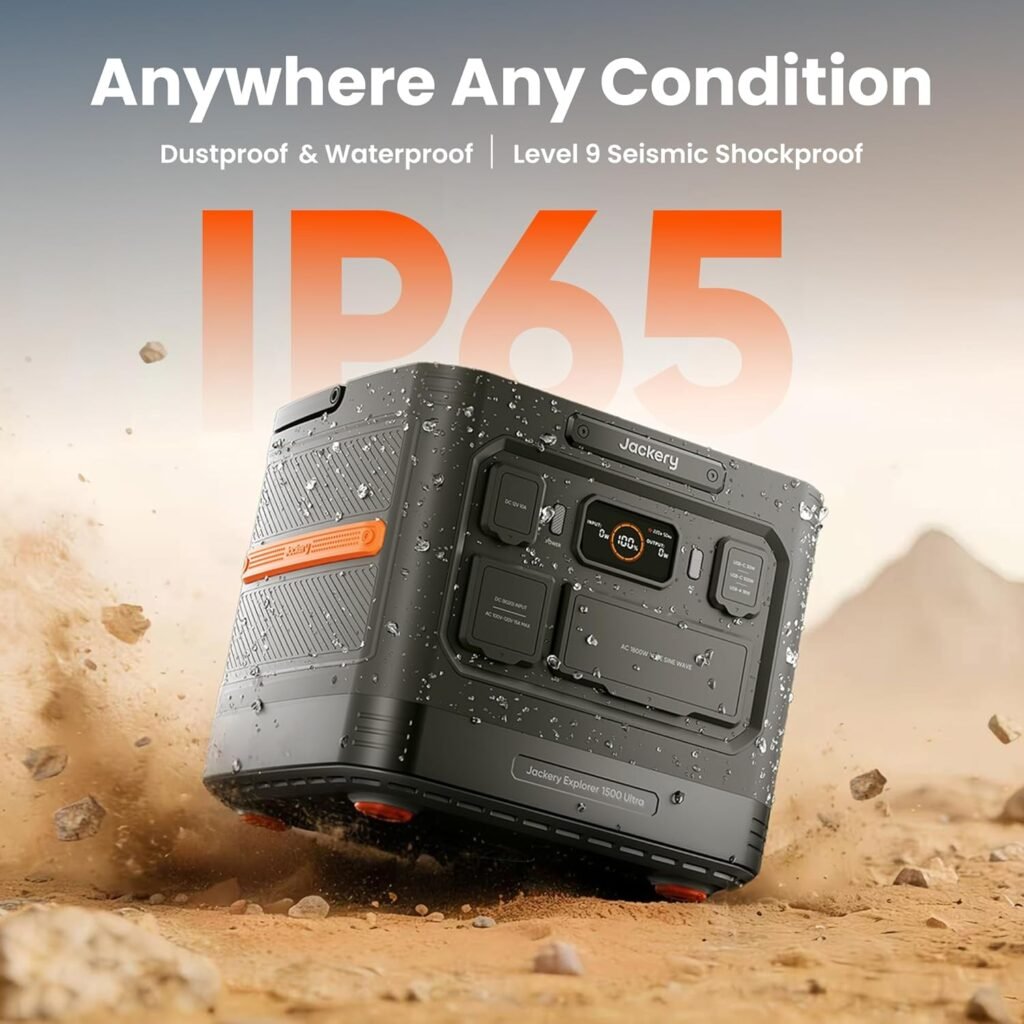
One of the standout features for us is the IP65 rating. That means it’s dust tight and protected against low-pressure water jets from any direction. Practically speaking, we don’t need to panic if we get stuck in a downpour, deal with blowing sand, or operate this near splashy conditions like a campsite kitchen or wet ground.
We wouldn’t submerge it or leave it sitting in standing water, but being able to use a power station confidently in the rain is a huge upgrade over many competing models that require babying under a tarp. For off-grid work or emergency conditions, that kind of resilience matters.
Size, Weight, and Carrying
Jackery notes that the Explorer 1500 Ultra is 50% smaller and 53% lighter than typical industry standards for its class. That doesn’t mean it’s feather-light, but for a 1536Wh, 1800W-capable power station, it’s impressively compact.
We can carry it with one hand, and loading it into a vehicle or moving it around a campsite is very manageable. The anti-slip laser-etched top is a small but smart detail—it helps prevent devices from sliding off when we set them on top, such as radios, smaller tools, or even a phone while it’s charging.
Durability in Real-World Conditions
The Explorer 1500 Ultra has been one-meter drop-tested and Level 9 seismic-tested, which tells us it’s engineered for environments harsher than a quiet living room. Add in the titanium-alloy cooling structure and the patented bottom-drainage design, and we’re looking at a unit clearly built with outdoor use in mind, not just the occasional backyard BBQ.
We especially like the removable metal base. That not only adds structural strength but also makes it easier to clean or maintain if dirt, mud, or debris build up from extended outdoor use.

Battery Technology: LiFePO4 for Longevity and Safety
If we care about long-term value and reliability, the battery chemistry inside any power station is a big deal. The Explorer 1500 Ultra uses LiFePO4 (Lithium Iron Phosphate) cells, which are a step up from older NMC lithium-ion cells in terms of lifespan and heat stability.
1536Wh Capacity in Practice
A 1536Wh (watt-hour) capacity gives us a generous power reservoir, especially when paired with a robust 1800W inverter. In everyday terms, that kind of capacity can run typical household devices and tools for hours. For short to medium outages, this can be enough to comfortably bridge the gap.
We can think of it this way:
- A 60W laptop could theoretically run for 20–25 hours
- A 100W TV could run for ~12–14 hours
- A 800W refrigerator (with cycling) might be supported for many hours, depending on its duty cycle
- A 1500W space heater might run for around 1 hour at full blast
Actual run time always depends on device efficiency and duty cycles, but 1536Wh gives us real flexibility for a wide range of use cases.
Over 4,000 Charge Cycles
The claim of 4,000+ charge cycles to 70% capacity means that if we were to charge and discharge this unit daily, we’d still have useful capacity more than 10 years later. That’s a huge advantage if we’re buying this as an emergency power backbone or an everyday off-grid companion.
Many NMC-based power stations lose capacity far faster, often in the 800–1,000 cycle range. With LiFePO4, we get slower capacity degradation and better thermal safety. For us, that translates to a better long-term investment rather than a disposable gadget.
Safety and Thermal Stability
LiFePO4 cells are known for their improved thermal stability and lower risk of thermal runaway compared to some other lithium chemistries. Coupled with Jackery’s titanium-alloy cooling structure, this setup is clearly designed to control heat, maintain performance, and reduce risk even under heavy loads or high ambient temperatures.
When we’re powering critical devices—such as medical equipment, refrigerators, or essential tools—having that enhanced safety margin offers real peace of mind.
Power Output and Performance
Raw power specs are where the Explorer 1500 Ultra really shines, especially if we need to run devices that draw high wattage or have tough startup surges.
1800W AC Output (3600W Peak)
The inverter can handle 1800W of continuous AC output, which is a serious amount of power. That’s enough to run:
- Power tools like miter saws, drills, smaller air compressors (within ratings)
- Kitchen appliances like microwaves, coffee makers, blenders
- Home essentials like refrigerators, lights, routers, and TVs
- Some smaller electric heaters and portable AC units (depending on draw)
The 3600W peak output for up to 5 seconds is particularly important for devices with high startup surges—things like fridges, well pumps, or certain tools that momentarily pull a lot more power than their running wattage. Jackery states that 5-second peak is 10 times longer than the typical industry standard, making this unit better able to handle tricky loads that cause other stations to fault or shut down.
2000W Peak for 15 Minutes
The ability to handle 2000W peak for up to 15 minutes gives us a buffer for short periods of higher demand. Maybe we’re running a heavy-duty appliance for a short burst or using a pair of tools together briefly. Instead of having to constantly worry about crossing the continuous rating, we get a more forgiving envelope for real-world usage.
This flexibility matters when we’re working on DIY projects, managing a job site, or juggling multiple household devices during an outage.
Suitable for 98% of Household Appliances
Jackery states that this power station can run 98% of household appliances, and in practical terms, that’s believable given the 1800W continuous and 3600W surge capacity. High-draw central systems like large electric ovens, central HVAC compressors, or large well pumps may be off-limits, but most common plug-in devices are fair game.
Being able to confidently support refrigerators, freezers, Wi-Fi routers, lights, laptops, and small cooking devices during a blackout is a big step toward keeping our home livable when the grid goes down.
Charging Options and Speeds
One of the most appealing aspects of the Explorer 1500 Ultra is how quickly it can be recharged. When we’re in the field or living with unreliable power, fast turnaround times can be just as important as raw capacity.
Ultra-Fast AC Charging (1.5 Hours)
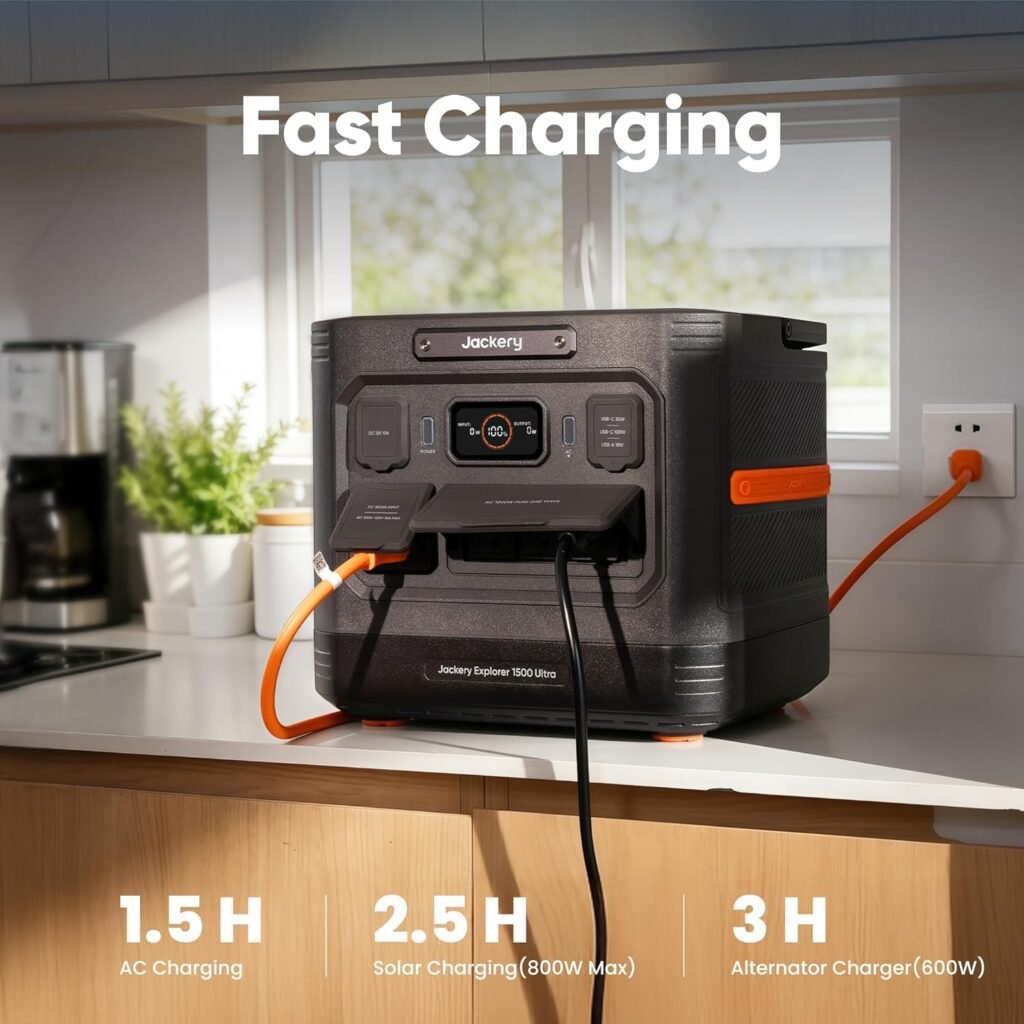
Using standard AC power, we can charge the station from empty to full in about 1.5 hours thanks to Jackery’s ChargeShield 2.0 technology. That’s impressively fast for a 1536Wh battery.
In practice, that means:
- We can plug it in before a storm hits and top it off quickly
- We can recharge between use cycles during the day
- We can keep it ready more easily without tying up a wall outlet for half a day
This fast charging also makes it more practical for those of us using it regularly at work or on the road. Shorter downtime means more workable uptime.
Solar Charging (Up to 800W, ~2.5 Hours)
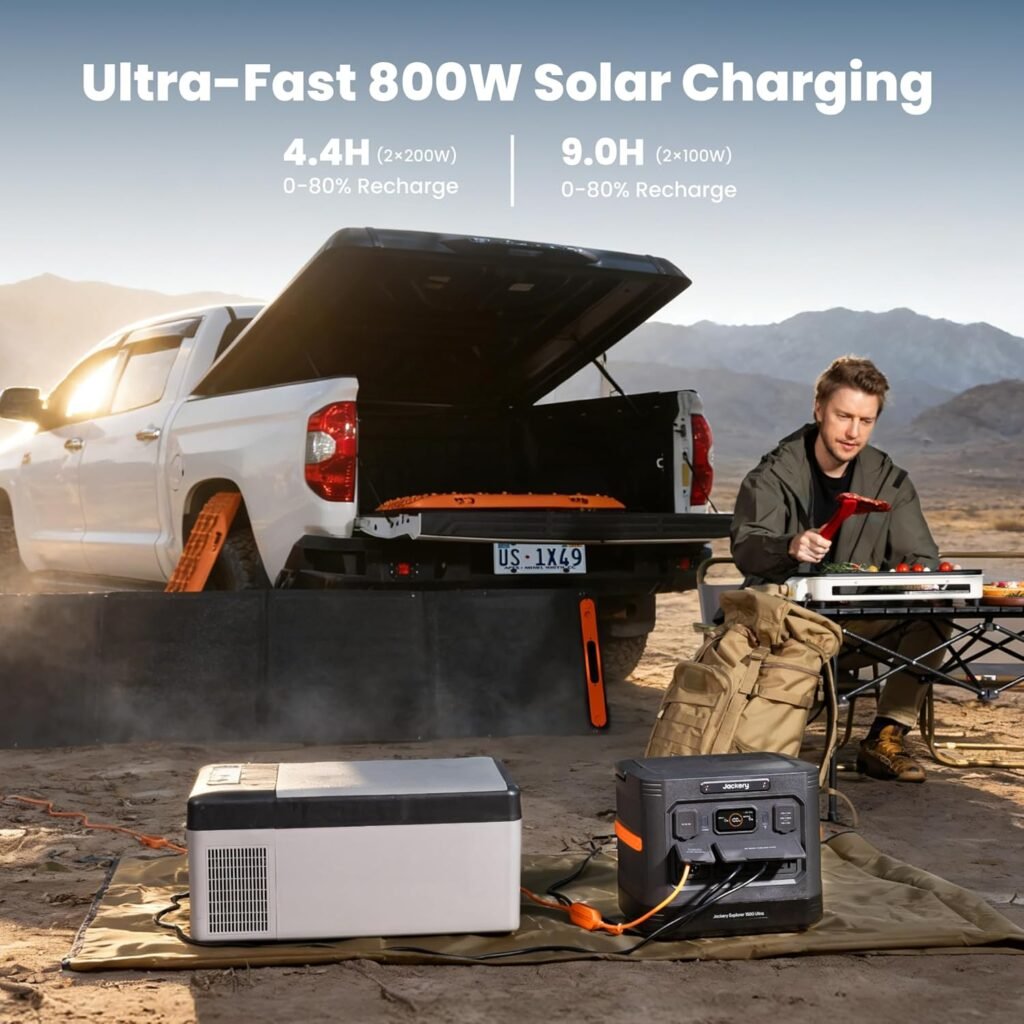
When paired with compatible Jackery solar panels (sold separately), the Explorer 1500 Ultra supports up to 800W of solar input. Under ideal conditions, that can recharge the unit in as little as 2.5 hours.
Of course, real-world solar depends on sun angle, weather, and panel placement. But 800W potential solar input is substantial. It turns this power station into a real off-grid energy hub, particularly for RVers, van dwellers, and remote work setups.
Even at lower effective wattage—say 400–600W in mixed conditions—we could still reasonably recharge most or all of the battery during a single day, provided we pay attention to panel orientation.
Vehicle Charging (~3 Hours)
Being able to recharge from a vehicle alternator in about 3 hours is another useful backup method. This is especially handy for road trips and remote work sites. If we’re driving between locations, we can use travel time to keep the power station topped up instead of relying solely on grid or solar.
This multi-way charging flexibility—AC, solar, and vehicle—reduces our dependence on any single power source. That’s exactly what we want in a robust emergency and off-grid solution.
Performance in Extreme Temperatures
If we plan to use a power station outdoors year-round, temperature range becomes critical. Many batteries suffer in the cold and can struggle in high heat.
Operating Range: 5°F to 113°F
Jackery rates the Explorer 1500 Ultra for stable performance from as low as 5°F (-15°C) up to 113°F (45°C). That’s a highly practical range for most climates, especially for camping, road trips, and outdoor work.
In colder conditions, LiFePO4 cells naturally have some performance limitations, but with this design, we can still count on the station functioning instead of just shutting down as soon as the thermometer drops. In hot environments, the optimized cooling structure helps maintain reasonable temperatures even under load.
Real-World Use Cases
- Winter camping in near-freezing temperatures
- Backup power in unheated garages or sheds
- Desert or summer camping where daytime temps soar
- Emergency use in locations without reliable climate control
We don’t need to treat this unit as a delicate indoor-only device. Instead, we can integrate it into real-world outdoor adventures and emergency preparedness plans with more confidence.
Ports, Outputs, and User-Friendly Features
While the product details provided focus heavily on power and durability, we can reasonably infer the Explorer 1500 Ultra includes a typical assortment of outputs commonly found on Jackery stations: AC outlets, USB ports, and DC outputs. Even if exact counts may vary by model revision, the key is how these are meant to be used.
Typical Output Variety
We can expect:
- Multiple AC outlets for standard plug-in appliances
- USB-A and USB-C ports for phones, tablets, and laptops
- A DC car-style outlet (12V) for vehicle accessories, coolers, and some pumps
Having all these in one place allows us to power several devices simultaneously, often with no need for extra adapters. That flexibility helps when we’re running a mix of small and large devices.
Display and Controls
Jackery usually includes a clear front display showing:
- Remaining battery percentage
- Input wattage (what’s coming in from chargers or solar)
- Output wattage (total power going to devices)
- Estimated time to empty or full
That sort of at-a-glance information lets us manage our power instead of guessing. We can decide which devices to prioritize, when to shut things down, and how to time our recharges for maximum efficiency.
The control layout is generally intuitive, with clearly labeled buttons for AC/DC toggles, display, and other essential functions. That matters when we’re operating in stressful conditions such as storms or nighttime emergencies.
Rugged Features for Harsh Environments
The Explorer 1500 Ultra is clearly marketed not just for casual users but for those of us who need something tougher than average.
Titanium-Alloy Cooling Structure
This isn’t a cosmetic buzzword. A titanium-alloy cooling system suggests high strength combined with efficient heat dissipation. Better cooling means the internal components can operate safely under heavy loads for extended periods, which in turn helps prolong overall lifespan and maintain consistent performance.
Patented Bottom-Drainage Design
We especially like the idea of a bottom-drainage design. In wet environments, puddles, condensation, or splashes can find their way into crevices. By giving that moisture somewhere to go and structuring the enclosure accordingly, Jackery helps prevent water from pooling inside critical areas.
Combined with the IP65 rating, this underscores the unit’s ability to tolerate real-world messiness: muddy job sites, damp campgrounds, or rainy roadside scenarios.
Seismic and Drop Testing
Level 9 seismic testing and one-meter drop resistance mean we’re not dealing with a fragile device. While we still shouldn’t intentionally abuse it, we can be less worried about accidental knocks or unplanned jostling in a moving vehicle.
For RVers, van lifers, and contractors hauling gear in trailers or trucks, that robustness is particularly valuable.
Long-Term Value and Warranty
A portable power station is a significant investment, so we always look at long-term protection and expected life.
10-Year Expected Lifespan
Because of its LiFePO4 chemistry and robust thermal management, the Explorer 1500 Ultra is designed to last over a decade under normal usage. We’re looking at more than 4,000 cycles before the battery drops to about 70% of its original capacity, which is still usable for many tasks.
For us, that means we can treat this as a long-term part of our preparedness or off-grid system—something we can depend on for years rather than replace after a short service life.
5-Year Warranty Coverage
Jackery backs the Explorer 1500 Ultra with a 5-year warranty (3-year standard plus a 2-year extension). That’s a strong signal of confidence in the build quality and performance.
Knowing we have long warranty coverage matters when we’re using this in critical applications—not just for weekend recreation but also for emergency readiness or as essential work equipment.
What Comes in the Box
Inside the package we should find:
- 1 × Jackery Explorer 1500 Ultra Portable Power Station
- 1 × AC Charging Cable
- 1 × User Manual
Solar panels are not included and must be purchased separately if we want to use solar charging. That’s an important detail for anyone budgeting an off-grid system—panels can be a significant additional cost, but they also eventually pay for themselves in energy savings and independence.
We also need to provide an actual street address for delivery. Shipments cannot be delivered solely to a PO Box, so we should plan accordingly when placing an order.
Use Cases: Where the Explorer 1500 Ultra Shines
To better understand whether this unit fits our needs, it helps to picture specific scenarios where it excels.
Off-Grid Camping and Overlanding
For camping, van life, and overlanding, the Explorer 1500 Ultra gives us a dependable central power hub. We can run:
- Portable fridges or coolers
- LED lighting strips or lanterns
- Laptops, cameras, and drones
- Induction cooktops or electric kettles (within limits)
Combined with solar panels, we can set up a self-sustaining system capable of powering a basecamp day after day. The IP65 rating and rugged design make it particularly suited to muddy roads, dusty trails, and sudden showers.
RVs and Road Trips
In RVs and road-trip setups, we can use this power station to:
- Supplement or replace noisy gas generators
- Run small appliances without firing up the whole RV electrical system
- Charge devices while driving (via vehicle charging)
- Provide backup when shore power is absent or unstable
Because it’s quieter and cleaner than gasoline generators, it’s better suited for nighttime and campground rules, as well as for our own comfort.
DIY Projects and Job Sites
For DIYers and small job sites, having 1800W AC output with high surge capacity means we can:
- Run many corded power tools
- Operate shop vacuums or air movers
- Power lighting and chargers simultaneously
We can use it on new builds without grid connections, or as backup when we don’t want to rely entirely on on-site power. The dust and water resistance become very valuable in this setting.
Home Backup and Emergencies
For home emergencies, we can keep:
- Refrigerators and freezers running
- Phones, tablets, and laptops charged
- Lights and fans operational
- Routers powered for internet access
By planning our loads well, 1536Wh can carry us through shorter grid outages with relative comfort. Solar or vehicle charging can extend this capability. The ability to recharge quickly via AC is also a major advantage if we get windows of grid power in unstable conditions.
Pros and Cons at a Glance
To make things easier to digest, we can break down key strengths and potential drawbacks of the Jackery Explorer 1500 Ultra.
| Aspect | Pros | Cons |
|---|---|---|
| Battery & Lifespan | 1536Wh LiFePO4 battery; 4,000+ cycles to 70%; stable and safe chemistry | Capacity may be overkill for very light users; LiFePO4 units often cost more upfront |
| Power Output | 1800W continuous, 3600W peak (5s), 2000W peak (15 min); supports ~98% of household appliances | Not suitable for very high-demand central systems (large HVAC, big well pumps) |
| Ruggedness | IP65 water/dust-proof; Level 9 seismic tested; 1m drop-resistant; titanium-alloy cooling | Not designed for full submersion; still needs reasonable care despite tough build |
| Charging | 1.5h full recharge via AC; up to 800W solar (~2.5h); vehicle charging (~3h) | Solar panels sold separately; full-speed charging may require robust circuits and accessories |
| Portability | 50% smaller and 53% lighter than industry average for its class; easy to transport | Still sizeable and not “ultra-light”; may be heavy for some users over long distances |
| Temperature Range | Reliable from 5°F to 113°F; good for wide climate use | Performance at extreme edges of range will still be somewhat reduced (as with any battery) |
| User Experience | Clear display, multiple outputs, quiet operation vs. gas generators | Requires planning for load management; not a full-house generator replacement |
| Warranty & Value | 5-year warranty (3 + 2); strong long-term value with LiFePO4 durability | Higher upfront cost than smaller, lower-spec power stations |
Who This Power Station Is Best For
We see the Jackery Explorer 1500 Ultra as an excellent match for certain types of users and use cases.
Ideal Users
-
Outdoor Enthusiasts and Overlanders
Who want robust, weather-resistant power that can keep fridges, lights, and devices running far from the grid. -
RV Owners and Van Lifers
Who need a compact but serious power hub, with fast recharge and solar compatibility, to support daily life on the road. -
DIYers and Small Contractors
Who appreciate portable, quiet power for tools, lights, and chargers on job sites without reliable grid connections. -
Preparedness-Focused Households
Who want a long-lifespan, low-maintenance backup power station for outages, storms, and emergency situations.
Users Who Might Want Something Else
-
Those Who Only Need to Charge Phones Occasionally
If all we need is a little backup for phones and small devices, this is probably more power and budget than necessary. -
Homes Seeking Whole-House Backup
For running large central HVAC systems or multiple major appliances at once, we’d need a larger-scale backup or a dedicated generator system. -
Extreme Ultralight Backpackers
For human-powered travel, this is more of a basecamp station than something we’d carry long distances on foot.
Practical Tips for Getting the Most Out of the Explorer 1500 Ultra
To maximize the value of this power station, we can follow a few practical strategies.
Plan Our Load
We should list the essential devices we want powered during outages or trips, and note their wattage. That way, we can:
- Prioritize what really matters (fridge, lights, communication devices)
- Avoid overloading the inverter
- Estimate how long our battery will last per charge
By managing loads intelligently, the same 1536Wh capacity can carry us much further.
Combine with Solar Panels
If we want true off-grid independence, pairing the Explorer 1500 Ultra with solar panels is a smart move. With up to 800W input capacity, we can recharge quickly on sunny days.
We’ll want to:
- Set panels at a proper angle to the sun
- Keep them clean from dust, snow, or dirt
- Use quality cables and connectors compatible with Jackery guidelines
Keep It Topped Off for Emergencies
For emergency readiness, it’s best to keep the unit reasonably charged and stored in a safe, dry, but accessible location. We can:
- Check its charge level every few weeks
- Plug it in to top off if it dips significantly
- Run a few test cycles with our essential devices so we know exactly what it can handle
Respect Its Limits
Even though the Explorer 1500 Ultra is tough and powerful, we should still:
- Avoid exposing it to total submersion or standing water
- Keep it ventilated and avoid blocking cooling vents
- Store it within recommended temperature ranges when not in use
Treating it as a professional-grade tool rather than a toy will help it last for many years.
Final Thoughts
We view the Jackery Explorer 1500 Ultra Portable Power Station as a thoughtfully engineered solution for serious users who want reliable, rugged, and fast-charging portable power. With its 1536Wh LiFePO4 battery, 1800W continuous and 3600W peak output, IP65 rating, and multi-way ultra-fast charging, it stands out as more than just a convenient gadget.
It’s a versatile backbone for off-grid adventures, emergency preparations, RV life, and field work, backed by a long-life battery chemistry and a 5-year warranty. While it’s not meant to power an entire large home or replace industrial-scale generators, it hits a powerful sweet spot: big enough to run most of our key devices and tough enough to handle real-world conditions.
If we’re looking for a portable power station that feels like a serious tool rather than a fragile accessory, the Jackery Explorer 1500 Ultra is a compelling option that can serve us well for years to come.
Disclosure: As an Amazon Associate, I earn from qualifying purchases.