
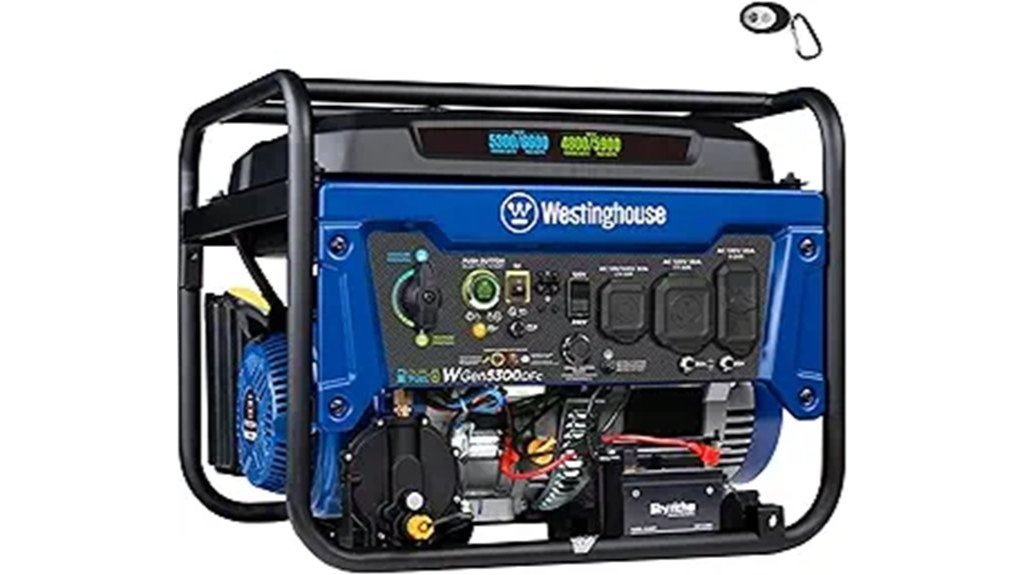
Westinghouse’s 6600 Watt Dual Fuel generator positions itself as a practical mid-tier backup. It delivers 6,600/5,300W on gasoline and 5,900/4,800W on propane, with 120/240V output via L14‑30R, TT‑30R, and 5–20R. A 274cc OHV engine, remote electric start, CO shutdown, and up to 14.5 hours runtime enhance utility. Compared to inverter rivals, it’s heavier and louder but RV- and transfer-switch ready. The trade-offs become clearer when examining real-world load behavior and costs.
Key Takeaways
- Delivers 6,600 peak/5,300 running watts on gasoline and 5,900/4,800 on propane, with a 274cc OHV engine and remote electric start.
- Offers true 120/240V output, L14-30R transfer-switch port, RV-ready TT-30R, and protected 5–20R duplex outlets.
- Runs up to 14.5 hours on a 4.7-gallon tank; includes CO shutdown and low-oil protection for safety.
- EPA-compliant with 3-year coverage, nationwide service, and includes oil, funnel, propane hose, toolkit, and manual.
- Strong home backup/RV versatility and surge headroom, but heavier and louder; lacks a 50A receptacle.
Overview(optimize_title)(yt)
How does a 6.6 kW-class portable generator stand out in real-world backup and RV use? This Westinghouse unit delivers 6,600 peak/5,300 running watts on gasoline, 5,900/4,800 on propane, giving users fuel freedom with predictable derating. A 120/240V selector and L14-30R ease transfer-switch tie-in, while TT-30R simplifies RV hookup.
Compared with peers, runtime up to 14.5 hours from a 4.7-gallon tank is competitive, aided by a 274cc OHV engine and cast-iron sleeve for durability. Electric and remote start reduce dependence on pull cords. CO shutdown and low-oil protection enhance safety. Rubber-covered outlets and included setup kit accelerate deployment.
Detailed features(CTA)
Why this model’s feature set matters becomes clear in the interface and power delivery: a 120/240V selector feeds a Transfer Switch Ready L14-30R, allowing balanced 240V loads at home, while an RV-ready TT-30R provides direct 120V 30A service without adapters.
A 5–20R duplex covers everyday circuits, all under rubber covers.
Dual fuel extends choice—6600/5300W on gasoline, 5900/4800W on propane—backed by a 274cc OHV with cast-iron sleeve and remote electric start.
1) Runtime: up to 14.5 hours from a 4.7-gallon tank.
2) Safety: CO shutdown, low-oil protection.
3) Compliance: EPA, nationwide service, 3-year coverage.
4) Included: oil, funnel, propane hose, toolkit, manual.
Pros and Cons
When stacked against similarly sized dual-fuel portables, this 6600-watt Westinghouse stands out for practical versatility: true 120/240V output with an L14-30R for transfer switches, an RV-ready TT-30R, and a 5–20R duplex under covered outlets, plus remote electric start and CO shutdown. Gasoline delivers 5300 running watts; propane trims to 4800, still adequate for essentials. A 4.7-gallon tank yields up to 14.5 hours—solid at 25% load. The 274cc OHV with cast-iron sleeve favors longevity. Trade-offs: weight, noise versus inverter peers, and no 50A port.
| Pros | Cons |
|---|---|
| Dual-fuel flexibility | Lower propane output |
| Transfer switch ready | No 50A receptacle |
| Remote electric start | Heavier chassis |
| CO/low-oil protection | Not inverter-quiet |
Concluding thoughts(cta)
Ultimately, the Westinghouse 6600 Watt Dual Fuel presents a well-rounded home-backup and RV option for buyers prioritizing 120/240V flexibility, remote electric start, and transfer-switch readiness over ultra-quiet operation or a 50A outlet. Its 5300/4800 running watts (gas/propane), 14.5-hour max runtime, and CO shutdown create dependable autonomy with practical safeguards. Compared to inverter rivals, it trades lower noise and cleaner power for higher surge headroom and simpler maintenance.
- Validate load: well pumps, fridges, RV A/C, tools.
- Choose fuel: gasoline for peak power; propane for shelf-life.
- Plan connections: L14-30R or TT-30R.
- Act: secure before storms.
Frequently Asked Questions
Can This Generator Be Used at High Altitudes Without Adjustments?
No. Altitude derates power roughly 3.5% per 1,000 ft. Compared to sea level, operation above 5,000 ft benefits from carburetor jetting and mixture adjustments; propane fares slightly better. Users seeking autonomy should expect harder starts and reduced runtime.
What Is the Recommended Maintenance Schedule and Service Intervals?
Recommended schedule: change oil after 5 hours, then every 50–100 hours; replace air filter 100–200 hours; inspect spark plug 100 hours, replace 300; check CO sensor monthly; valves 300 hours. More frequent service under heavy, dusty, or propane use.
How Loud Is the Generator at 25% and 50% Load?
At 25% load, it typically measures around 67–70 dBA; at 50% load, about 72–74 dBA. Quieter on propane than gasoline, it remains conversation-level, enabling off-grid autonomy while balancing portability, runtime, and transfer-switch-ready practicality.
Does It Support Parallel Operation With Another Generator?
No, parallel operation is not supported. Unlike inverter models with parallel ports, this conventional dual-fuel unit emphasizes 120/240V L14-30 transfer-switch readiness and TT-30 RV use. Users seeking scalable wattage should consider compatible Westinghouse inverter generators instead.
Are Wheel and Handle Kits Included or Sold Separately?
They are included. The 6600-watt dual-fuel ships with wheel and handle kits for quick mobility, unlike some rivals requiring add-ons. Users gain faster deployment, fewer hidden costs, and easier single-person transport across job sites, campsites, or outage scenarios.